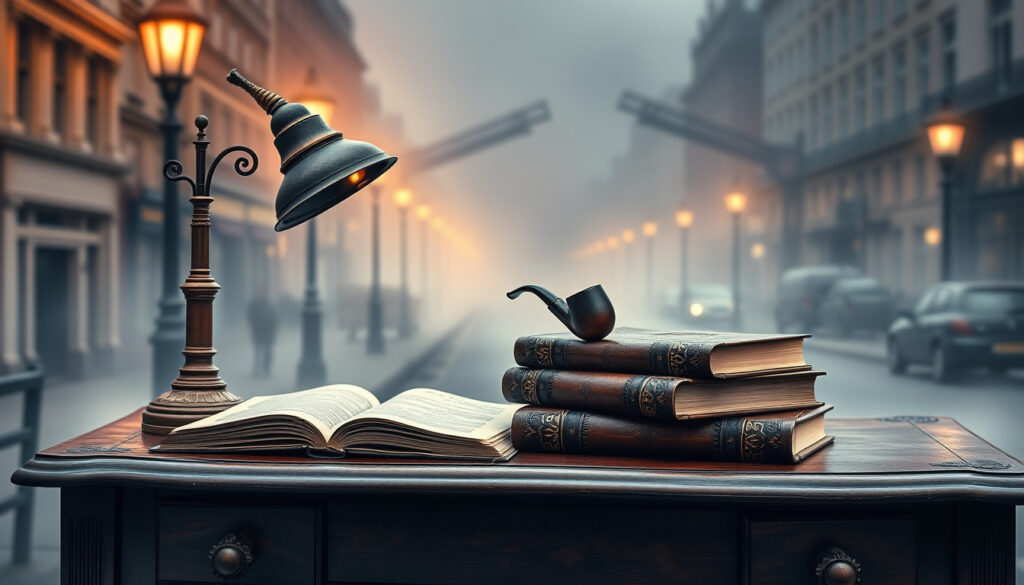
Arthur Conan Doyle: Life, Works, and Legacy
The image of a deerstalker cap and a curved pipe exists because of one man: Arthur Conan Doyle, a Scottish physician who gave us Sherlock Holmes. Yet Conan Doyle was a man of deep contradictions—a rational doctor who became a passionate believer in spiritualism, and a writer who grew so tired of his own creation that he tried to kill him off.
Born: 22 May 1859, Edinburgh, Scotland ·
Died: 7 July 1930, Crowborough, England ·
Known for: Creator of Sherlock Holmes (4 novels, 56 short stories) ·
Profession: Physician and writer ·
Spiritualism: Prominent advocate in later life ·
Number of works: Over 60 books and numerous short stories
Quick snapshot
- Created Sherlock Holmes and wrote 4 novels and 56 short stories (Britannica (encyclopedia))
- Qualified as a physician from the University of Edinburgh (Britannica (summary))
- Knighted in 1902 (Britannica (summary))
- Died on 7 July 1930 in Crowborough, England (Britannica (encyclopedia))
- The exact wording of his last words is disputed
- The reason for his upright burial is not fully documented
- Moriarty’s nationality is not specified in the original stories
- The exact number of living descendants is not publicly known
- 1859: Born in Edinburgh, Scotland (Britannica (summary))
- 1893: Killed off Holmes in The Final Problem (Britannica (summary))
- 1902: Published The Hound of the Baskervilles after public pressure (Britannica (summary))
- 1930: Died at age 71 (Britannica (summary))
- The Conan Doyle Estate continues to protect his legacy
- New adaptations of Sherlock Holmes appear regularly on screen
- Scholarship on Doyle’s spiritualist writings is growing
- Descendants remain active in managing his literary estate
Here is a structured overview of the key facts about Arthur Conan Doyle’s life and career.
| Label | Value |
|---|---|
| Full name | Arthur Ignatius Conan Doyle |
| Birthplace | Edinburgh, Scotland |
| Nationality | British (Scottish) |
| Occupation | Writer, physician |
| Years active | 1879–1930 |
| Spouse(s) | Louisa Hawkins (1885–1906), Jean Leckie (1907–1930) |
| Children | 5 children |
| Notable honors | Knighted (1902) |
The pattern here is clear: a man of many roles, from physician to spiritualist.
What was Arthur Conan Doyle famous for?
His role as a physician
Before he became the world’s most famous crime writer, Conan Doyle trained as a medical doctor at the University of Edinburgh between 1876 and 1881 (Britannica (summary)). He studied under Dr. Joseph Bell, a surgeon whose deductive methods became the blueprint for Sherlock Holmes’s own powers of observation. Doyle practiced medicine until 1891, when he decided to focus full-time on writing.
Major works beyond Sherlock Holmes
While Holmes made him a household name, Conan Doyle also wrote historical novels like The White Company (1890), science fiction including The Lost World (1912), and a series of spiritualist non-fiction books. According to the Sherlock Holmes Society of London (literary society), The Lost World remains one of his best-known non-Holmes works. He also wrote short stories, poetry, and war pamphlets.
Influence on crime fiction
Holmes set the template for the modern detective: the brilliant, eccentric sleuth with a loyal companion. The Poetry Foundation (literary nonprofit) notes that Holmes and Dr. Watson are among the most widely recognized fictional characters in literature. The Sherlock Holmes canon—4 novels and 56 short stories—has been adapted into countless films, TV series, and stage plays, inspiring every detective from Hercule Poirot to Columbo.
Conan Doyle’s medical training gave Holmes a scientific rigor that was revolutionary for crime fiction in the 1880s. The pattern—a detective who uses evidence and logic—became the gold standard for the genre.
The implication: his medical background was not incidental but foundational to his most famous creation.
Why did Conan Doyle stop writing about Sherlock Holmes?
The attempted killing of Holmes in 1893
Conan Doyle grew tired of his creation. He felt that writing Sherlock Holmes stories kept him from more serious literary work. In December 1893, he published “The Final Problem” in The Strand Magazine, in which Holmes and his arch-nemesis Professor Moriarty plunge to their deaths over the Reichenbach Falls (Britannica (summary)). Doyle’s diary entry at the time reveals a sense of relief: “I have been guilty of a great sin in writing about Sherlock Holmes.”
Public pressure and eventual revival
The outcry was enormous. Over 20,000 readers cancelled their subscriptions to The Strand. The public demanded Holmes’s return. Eight years later, in 1901, Conan Doyle published The Hound of the Baskervilles, set before Holmes’s death. Then, in 1903, he brought Holmes back for good in “The Adventure of the Empty House”, explaining that Holmes had faked his death. The BBC History (public broadcaster) notes that public demand literally forced Doyle to restore Holmes to life.
The author’s desire to focus on historical and spiritualist writing
Doyle’s literary ambitions extended far beyond detective fiction. He wanted to be remembered for his historical novels and his work on spiritualism. In the final years of his life, he wrote The History of Spiritualism (1926) and gave lectures on the subject. The last Holmes story, “The Adventure of Shoscombe Old Place”, was published in 1927, three years before his death. By then, Doyle had largely moved on.
What this means: the creator of the world’s greatest detective spent much of his career trying to escape that shadow.
Why is Moriarty portrayed as Irish?
Literary origins of Professor Moriarty
Professor James Moriarty appears in only two stories: “The Final Problem” (1893) and “The Adventure of the Empty House” (1903). In the original texts, his nationality is never explicitly stated. He is described as a mathematician from a “good family” who turned to crime. The name “Moriarty” is of Irish origin, but that alone does not confirm his nationality.
Conan Doyle’s Irish heritage
Conan Doyle himself was born to an Irish Catholic family. The Poetry Foundation (literary nonprofit) notes that his parents were Irish immigrants. Some literary scholars suggest that Doyle may have drawn on Irish stereotypes for the villain, but there is no definitive evidence in the text.
Modern adaptations and the Irish accent
The Irish portrayal of Moriarty is a modern invention, most notably in the BBC’s Sherlock (2010–2017), where Andrew Scott played Moriarty with an Irish accent. That choice has since been adopted in other adaptations, but it has no basis in the original stories. The ambiguity itself is part of Moriarty’s mystique—a shadowy figure whose origins remain unknown.
Conan Doyle, an Irish-descended writer, created a villain whose Irishness is an invention of later adapters. The irony: the most famous portrayal of Moriarty as Irish is now accepted by many as canon, even though it’s not in the books.
What were the last words of Arthur Conan Doyle?
The disputed account
According to his family, Conan Doyle’s last words were “You are wonderful,” spoken to his wife Jean on the morning of 7 July 1930. He died of a heart attack at his home, Windlesham, in Crowborough, East Sussex (The Sherlock Holmes Society of London (literary society)). However, some biographers report a different version: that he said, “I am going on a great adventure,” a phrase that aligns with his spiritualist beliefs.
His final spiritualist statement
Doyle’s last public statement was a letter to a spiritualist journal, published shortly after his death. In it, he reaffirmed his belief in the afterlife: “The subject is so vast and so important that it deserves the most serious attention.” He was 71 years old.
Context of his death
Conan Doyle died in his garden, clutching his chest. He was buried in the garden of his home, but later reinterred in Minstead Churchyard, Hampshire. The standing-up burial myth—that he was buried upright—is often repeated, but the exact reason is not documented. The Britannica (encyclopedia) confirms the death date and location but does not mention the standing burial.
Are there any living descendants of Arthur Conan Doyle?
Grandchildren and great-grandchildren
Yes, several great-grandchildren of Arthur Conan Doyle are alive today. His son Adrian Conan Doyle (1910–1970) and daughter Jean Conan Doyle (1912–1997) had children who continued the family line. The exact number of living descendants is not publicly known, but the family remains active in managing the Conan Doyle Estate.
Notable descendants
One notable descendant is Richard Doyle, a great-grandson who has written about his famous ancestor. Another is Charles Foley, a great-grandson who works in film production. The family has also been involved in legal battles over the copyright of Sherlock Holmes stories, which have entered the public domain in most countries but remain under copyright in the UK until 2023 for some later works.
The Conan Doyle Estate
The Conan Doyle Estate Ltd. is the company that manages the intellectual property rights of the author. It has been involved in litigation, including a notable case against Netflix over the portrayal of Sherlock Holmes in the film Enola Holmes. The estate’s website states that it is “dedicated to preserving the legacy of Sir Arthur Conan Doyle.”
What is the scariest Sherlock Holmes book?
The Hound of the Baskervilles
Widely considered the most terrifying Sherlock Holmes story, The Hound of the Baskervilles (1902) combines a gothic atmosphere with a supernatural legend. The story follows a demonic hound that haunts the Baskerville family in the Devonshire moors. The Britannica (summary) notes that the novel’s suspense comes from the “skillful blending of the supernatural with the rational.”
The horror elements in other stories
Other candidates for the scariest Holmes story include “The Adventure of the Speckled Band” (1892), which features a deadly snake trained to kill, and “The Adventure of the Devil’s Foot” (1910), which involves a hallucinogenic poison. Both have elements of horror that rival the hound.
Reader consensus and critical opinion
Reader polls and critical consensus consistently rank The Hound of the Baskervilles as the scariest Holmes book. It is also the most adapted Sherlock Holmes story, with over 20 film versions. The combination of a remote manor, a curse, and a monstrous beast creates a sustained sense of dread that few detective stories achieve.
For readers who want a pure horror mystery, The Hound of the Baskervilles is the clear winner. But if you prefer psychological horror, “The Speckled Band” offers a more intimate, claustrophobic terror. Both are essential reading for anyone interested in the scarier side of the canon.
Timeline
- 1859: Born in Edinburgh, Scotland (Britannica (encyclopedia))
- 1876–1881: Studied medicine at the University of Edinburgh (Britannica (summary))
- 1887: Published A Study in Scarlet, first Sherlock Holmes story (Britannica (summary))
- 1893: Published “The Final Problem”, killing off Sherlock Holmes (Britannica (summary))
- 1901–1902: Published The Hound of the Baskervilles, resurrecting Holmes
- 1902: Knighted by King Edward VII (Britannica (summary))
- 1910s–1920s: Became a prominent advocate of spiritualism (Britannica (summary))
- 1930: Died of a heart attack in Crowborough, England (The Sherlock Holmes Society of London (literary society))
Clarity: Confirmed facts vs. What’s unclear
Confirmed facts
- Conan Doyle created Sherlock Holmes and wrote 4 novels and 56 short stories.
- He was a qualified physician.
- He was knighted in 1902.
- He died on 7 July 1930.
- He was a prominent spiritualist in his later years.
What’s unclear
- The exact wording of his last words is disputed.
- The reason for his upright burial is not fully documented.
- Moriarty’s nationality is not specified in the original stories.
- The exact number of living descendants is not publicly known.
In their own words: Quotes from and about Conan Doyle
“I have been guilty of a great sin in writing about Sherlock Holmes.”
— Arthur Conan Doyle, reflecting on his creation
“The subject is so vast and so important that it deserves the most serious attention.”
— Arthur Conan Doyle, on spiritualism, in his final public statement
“There is a distant family connection to Conan Doyle.”
— Benedict Cumberbatch, actor who played Sherlock Holmes, in an interview
Summary
Arthur Conan Doyle was a man of two halves: the rational doctor who invented the most logical detective in fiction, and the spiritualist who spent his final years trying to prove the existence of ghosts. His legacy is inseparable from Sherlock Holmes, yet he spent much of his career trying to escape that shadow. For readers and fans of the detective genre, the lesson is clear: the creator of the world’s greatest detective was himself a complex, contradictory figure, and his life continues to fascinate as much as his fiction. The Conan Doyle Estate now faces the challenge of protecting that legacy while keeping the stories alive for new generations.
en.wikipedia.org, bbc.co.uk, britannica.com, en.wikipedia.org, en.wikisource.org, britannica.com, biography.com
Frequently asked questions
Did Arthur Conan Doyle believe in fairies?
Yes, famously so. In 1917, Doyle publicly endorsed the Cottingley Fairies photographs, which he believed were genuine. The photographs were later revealed as a hoax in 1983.
How many times did Conan Doyle run for Parliament?
He ran for Parliament twice, in 1900 and 1906, as a Liberal Unionist candidate. He lost both elections.
What other books did Conan Doyle write besides Sherlock Holmes?
He wrote historical novels like The White Company, science fiction such as The Lost World, and non-fiction works on spiritualism, including The History of Spiritualism.
What was Conan Doyle’s medical specialty?
He did not specialize; he was a general practitioner. He completed his medical degree at the University of Edinburgh and practiced as a doctor until 1891.
Who played Sherlock Holmes in the most recent adaptations?
Recent notable portrayals include Benedict Cumberbatch in the BBC’s Sherlock (2010–2017) and Henry Cavill in the Netflix film Enola Holmes (2020).
Did Conan Doyle ever meet Houdini?
Yes. They met in 1920 and became friends, though they disagreed on spiritualism. Houdini, a skeptic, spent much of his career debunking mediums.
What is the Conan Doyle Estate?
The Conan Doyle Estate Ltd. is a company that manages the intellectual property rights of Arthur Conan Doyle’s works. It has been involved in legal cases to protect the Sherlock Holmes brand.
Related reading
- Joan Hickson: Definitive Miss Marple – Biography & Death – Another iconic British detective, Miss Marple, played by Joan Hickson, offers a fascinating parallel to the world of Sherlock Holmes.
- Christian Dior: Life, Death, and Lasting Legacy – Like Conan Doyle, Christian Dior was a creative genius who shaped a cultural field. This biography explores his life and enduring influence.
More related posts
 Bryson DeChambeau: Personal Life, Net Worth & Controversies
 DJ Fat Tony: Biography, Addiction, and Sobriety Story
 Ben Barnes: Age, Height, Relationships, Movies & TV Shows
 Emma Paton: Sky Sports Darts Presenter, Age, and Career
 Robert Shaw: Death, Jaws, and His Oscar Nomination
 Mohamed Salah Transfer News: Rumors, Comparisons & Legacy
 Richard Hammond: Wife, New Partner, Friendship & Drinking Status
 Mt Etna Eruption 2025: Status, Safety & Predictions