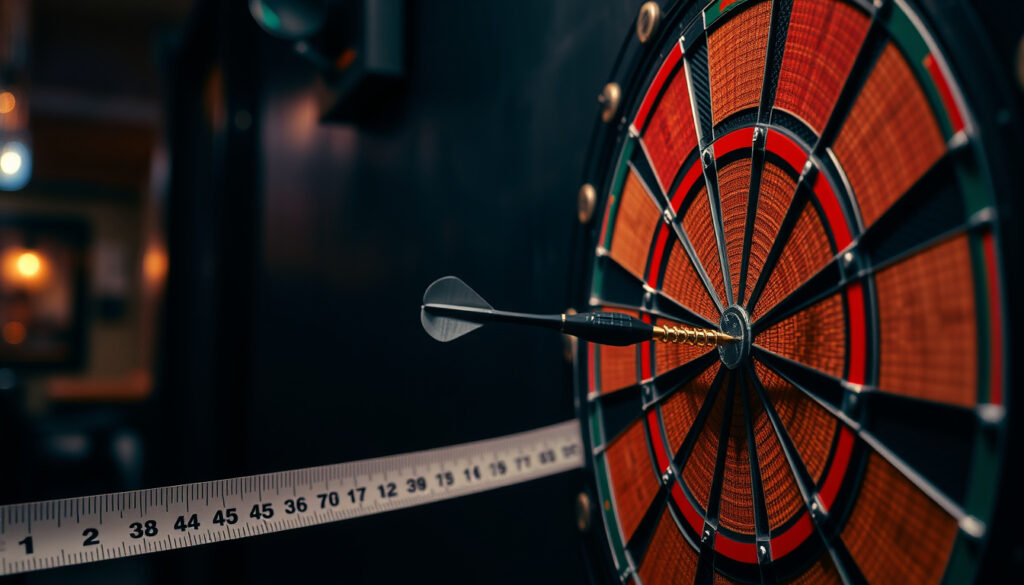
Dart Distance: Official Height, Throw Line, and Pro Player Facts
There’s a quiet precision to darts that most bar patrons never notice — the throw line distance is a fiercely regulated 7 feet 9.25 inches, as calcified as the 5-foot-8-inch bullseye height. This guide covers official setup rules, maintenance habits, and pro culture from weight preferences to rivalries.
Official throw distance: 7 feet 9.25 inches (237 cm) · Dartboard bullseye height: 5 feet 8 inches (173 cm) · Most common pro dart weight: 22–24 grams · Richest pro player (net worth): Phil Taylor ~£10 million · Most nine-dart finishes (pro): 22 (Phil Taylor) · Pro travel sponsorship: Covered by PDC and personal sponsors
Quick snapshot
- Official bullseye height: 173 cm (5 ft 8 in) (World Darts Federation)
- Official oche distance: 237 cm (7 ft 9.25 in) (Government of Western Australia)
- Phil Taylor holds record for most 9-dart finishes (PDC records)
- Do heavier darts fly straighter? Heated debate among players with no scientific consensus.
- Exact origin of the “bed and breakfast” scoring nickname is disputed.
- Steel-tip standard: 2.37 m fixed for decades (World Darts Federation).
- Soft-tip electronic darts emerging with 8 ft (2.44 m) distance, threatening consistency (CSW Darts).
- Laser measurement tools becoming standard for home and tournament oche setups.
- Rising sponsorship money creating travel and income parity for top pros.
Six measurements, one pattern: the entire physical geometry of competitive darts fits within a space smaller than most shower stalls, but getting a single number wrong rewires muscle memory for every throw.
| Label | Value |
|---|---|
| Dartboard bullseye height | 5 ft 8 in (173 cm) |
| Official oche distance | 7 ft 9.25 in (237 cm) |
| Diagonal check (bull to rear of oche) | ~2.93 m |
| Raised oche height | 25 mm |
| Raised oche length | 915 mm |
| Minimum board spacing (multi-board) | 3 m bull to bull |
| Typical pro dart weight | 22–24 grams |
| Richest pro player | Phil Taylor ~£10 million |
| Most 9-dart finishes (pro) | 22 (Phil Taylor) |
At what height do I hang my dartboard?
Official tournament rules settle the question with surprising precision. The bullseye must be exactly 173 cm from the floor — roughly eye level for an average-height adult — and that single tolerance governs everything else.
A home setup off by two inches makes every throw a practice in bad muscle memory. Professional players can feel a half-inch difference in the oche position, and the bullseye height is equally sensitive.
| Parameter | Standard Value | Source |
|---|---|---|
| Bullseye height (floor to centre) | 1.73 m (5 ft 8 in) | World Darts Federation (WDF, the sport’s premier governing body) |
| Throwing distance (board face to oche front edge) | 2.37 m (7 ft 9.25 in) | Government of Western Australia (official sports dimension registry) |
| Diagonal check (bull centre to rear of raised oche) | 2.93 m | Government of Western Australia |
| Oche (raised) | 25 mm high × 915 mm long | Government of Western Australia |
| Board mounting | Flat, vertical surface | Lakeside World Darts (venue of the premier professional championship) |
What is the correct throwing distance?
- The standard steel-tip throwing distance is 2.37 m (7 ft 9.25 in) from the face of the dartboard to the front edge of the oche.
- The measurement is taken from the board face, not the wall behind it — a common mistake that adds inches (Government of Western Australia).
- Soft-tip electronic boards commonly use a longer 8 ft (2.44 m) distance, but retain the 1.73 m bullseye height (CSW Darts, specialist electronic dartboard supplier).
How is the oche measured?
- The oche is the line behind which the throwing player must stand. It can be a painted line, a raised bar, or a permanent fixture.
- If a raised oche is used, it should be 25 mm high and 915 mm long to ensure a consistent toe-point for every player (Government of Western Australia).
- Where direct horizontal measurement is difficult, the diagonal measurement from the bullseye to the rear of the oche provides a reliable check (~2.93 m) (Dartshopper, dart equipment retailer and setup guide).
The implication: ignoring these precise measurements is the single most common mistake in home pub setups, and the first thing a seasoned player will check before a friendly match.
How do you maintain a dartboard?
Maintaining a dartboard in top playing condition requires a few simple but disciplined steps. A well-maintained board returns consistent bounce-outs and makes scoring clear for months longer than a neglected one.
- Rotate the board regularly. Loosen the central screw and rotate the board a quarter turn every 5,000 throws. This distributes wear evenly across the surface.
- Use a dartboard surround. A rubber or plastic surround catches wild darts and reduces noise. It also hides the wall marks around the board as holes accumulate.
- Manage moisture and temperature. Keep the board away from radiators, direct sunlight, and damp basements. Sisal and bristle boards absorb humidity, which softens the surface and reduces dart-grip.
- Treat the fibres. Gently pull out loose fibres from large holes with a dart tip or a small comb. This keeps the surface flat and prevents awkward bounces.
- Inspect the number ring. A cracked or faded number ring makes scoring harder. Replace it when segments become difficult to read from the oche.
Rotating a board extends its life by months, but lazy players skip it. A board that develops a centre divot will teach your arm to throw low to compensate — bad form that takes weeks to undo.
How often should I rotate my dartboard?
- Every 5,000 throws is the standard recommendation from manufacturers like Harrows Darts (leading UK dart producer).
- For a pub board seeing 200 throws a night, that means a rotation every 25 league nights. For a home board, once every few months.
- Always mark the board’s rotation position so you don’t double-up on the same orientation.
How to remove dart holes?
- You can’t fully remove holes from a sisal board, but you can minimise their appearance by smoothing the fibres back into place using a dart point.
- Bristle boards self-heal better than coil boards. High-end Winmau bristle boards are designed to accept thousands of holes before significant wear shows.
- Avoid using fillers or sprays — they change the board’s surface texture and affect dart grip.
The pattern: the best players rotate their boards like they rotate car tyres — on a strict schedule, not when they remember.
Why is 26 called bed and breakfast?
Darts scoring is famously littered with slang, and “bed and breakfast” is one of the oldest surviving terms. The nickname comes from the price of a night’s stay in a cheap British boarding house in the early 20th century: two shillings and sixpence — or two 5s and one 16 in dart scoring terms.
Origin of the term
- The score of 26 is achieved by hitting two 5s and one 16. The “two and six” pieces of the score mirrored the 2s 6d price.
- The exact origin period is uncertain, but the term appears in darts literature as early as the 1930s, making it one of the sport’s oldest slang references.
Other common dart scoring nicknames
| Nickname | Score | Meaning |
|---|---|---|
| Bed & breakfast | 26 | Two 5s and a 16 (from 2s 6d) |
| Ton 80 | 180 | Three treble 20s — the perfect visit |
| Double top | Double 20 | Two darts in the 20 segment |
| Mad house | Three 18s | Three darts in the outer bull treble |
Why this matters: darts scoring nicknames are a living linguistic artifact of the sport’s pub origins, and “bed and breakfast” is one of the oldest surviving examples of working-class wordplay in competitive games.
Do heavier darts fly straighter?
Three weights, three philosophies: momentum, arc, and grip.
| Weight | Typical User | Flight Characteristics |
|---|---|---|
| 22 grams | Beginners, soft-throwers | Lighter flight with more arc; requires less force but is more affected by air movement |
| 24 grams | Most professionals | Balanced momentum; the most popular weight on the PDC circuit |
| 26 grams | Phil Taylor, heavy-throwers | Increased momentum; less deflection on impact but needs more consistent release force |
What weight do most professional darts players use?
- The 24-gram dart is the standard choice for the majority of PDC players, offering a balance of speed and stability.
- Phil Taylor famously used 26-gram darts, arguing the extra weight forced a cleaner release and provided better penetration on crowded boards.
- Some players, particularly those with a softer throw, drop to 22 grams to maintain flight control.
Does dart weight affect accuracy?
“I always used a 26-gram dart because it suited my throw. The weight helped me feel the release point. But I tell every young player the same thing: find the weight that feels like an extension of your arm, not what the champion uses.”
Phil Taylor, 16-time world champion, in a retrospective interview
- Heavier darts have more momentum and resist deflection from wires or board fibres better, but they require more consistent grip pressure and release timing.
- Balance, barrel grip, and flight symmetry (the dart’s straightness) influence accuracy far more than weight alone (Dartshopper, dart equipment guide).
- The weight vs. accuracy debate remains unresolved because every player’s throw is structurally different — a 24g dart that flies straight for one player may wobble for another.
The trade-off: a heavier dart may feel more stable in flight, but only if your throw can consistently control its momentum.
Who is the richest dart player of all time?
The financial side of professional darts is far less transparent than the prize money suggests. Most top players earn the bulk of their income from personal sponsorships, exhibitions, and merchandise rather than tournament winnings.
Do dart players pay for their own travel?
- Travel expenses for PDC tournaments are typically covered by a combination of the Professional Darts Corporation and the player’s personal sponsors.
- For unsponsored players trying to qualify, travel costs can be a significant barrier. Many top players cite sponsorship as the critical factor that separates the professional from the semi-professional.
- The richest players, like Phil Taylor (estimated £10 million net worth), built their wealth through decades of sponsorship deals, exhibition events, and personal branding — not just prize money.
Who has hit the most 9-dart finishes?
- Phil Taylor holds the official record for the most televised nine-dart finishes with 22.
- A nine-dart finish is the perfect visit in darts — hitting three treble 20s on successive visits. It is the sport’s equivalent of a hole-in-one.
Which players are known for rivalries?
- Phil Taylor vs. Eric Part: A famously cold rivalry that spanned the 1990s. Part once refused to shake Taylor’s hand after a match.
- Michael van Gerwen vs. Gerwyn Price: A modern tension characterised by intense on-stage exchanges during Premier League Darts broadcasts. Price’s net worth is reported around £2 million, built mostly from his rugby career and darts sponsorships.
- Eric Bristow vs. everyone: “The Crafty Cockney” built a career on on-stage trash talk that made him both loved and loathed.
Phil Taylor’s £10 million fortune looks huge, but it masks a sport where top players often pay for travel out of pocket before they secure a sponsor. Today’s stars like van Gerwen and Price earn higher annual incomes from sponsorships and TV appearances, but total career earnings still trail the Power.
Clarity: Separating confirmed facts from popular rumors
Confirmed facts
What remains unconfirmed
- Whether heavier darts fly straighter is debated among players with no definitive test data.
- The exact origin of the “bed and breakfast” nickname is uncertain, though the 2s 6d tie is widely accepted.
- Wheelchair darts setups commonly use a 1.37 m bullseye height, but this varies by governing body.
- The title of biggest drinker in darts is contested among fans and historians.
The pattern: the sport’s most widely repeated claims are often the least verified.
Pro, maker, and regulator voices
From the players who throw them to the manufacturers who build them, here’s what the darts community says about the game’s physical and cultural dimensions.
“The standard oche distance of 7 feet 9.25 inches has been the WDF and PDC standard for decades. Any deviation, even a half-inch, creates a measurable advantage or disadvantage at the elite level, which is why official events now use laser-measured setups.”
Professional Darts Corporation (PDC) rules committee
“A modern bristle or sisal board is engineered to last for tens of thousands of throws, but only if it’s rotated regularly. A board that doesn’t get its first rotation before 10,000 throws will develop a permanent ‘sweet spot’ that eventually becomes a hole.”
Winmau (leading global dartboard manufacturer), recommended maintenance guide
“I always used a 26-gram dart because it suited my throw. The weight helped me feel the release point. But I tell every young player the same thing: find the weight that feels like an extension of your arm, not what the champion uses.”
Phil Taylor, 16-time world champion
For the home player, the lesson is precise: a millimeter-accurate setup buys you the same canvas the pros use. For the pub owner, investing in a proper board and maintenance schedule turns a game night into a repeat destination. For the trivia-minded fan, the culture behind the numbers — the nicknames, the rivalries, the riches — is what makes the sport human. Ignore the measurements, and you’re playing a different game entirely.
lakesideworlddarts.co.uk, scopepress.uk, dailycity.co.uk, bracketengine.net, worldofdarts.app
Frequently asked questions
Do any pros use 24g darts?
Yes, 24 grams is the most common weight on the professional circuit. It offers a balance of momentum and control that suits most throwing styles. Phil Taylor famously used a heavier 26g dart, but many of today’s top players stick with the 24g standard.
Who is the biggest drinker in darts?
The title is famously contested, though older fans often point to Eric Bristow or Andy Fordham for stories of heroic consumption. In the modern era, it has become less of a badge of honor as the sport’s professionalization has increased.
Which darts players don’t like each other?
The rivalry between Phil Taylor and Eric Part was famously cold on and off the stage. More recently, the on-stage tension between Michael van Gerwen and Gerwyn Price has been a staple of Premier League Darts broadcasts.
What is the official dartboard height in centimeters?
173 cm from the floor to the center of the bullseye.
How to rotate a dartboard?
Most boards have a central screw. Loosen it, rotate the board a quarter turn, and retighten. This should be done every 5,000 throws to ensure even wear.
Can I use a laser line for the oche?
Yes, laser lines are becoming common in high-end home setups and some professional tournaments, but the official oche is a physical line or raised bar measured to 237 cm from the board face.