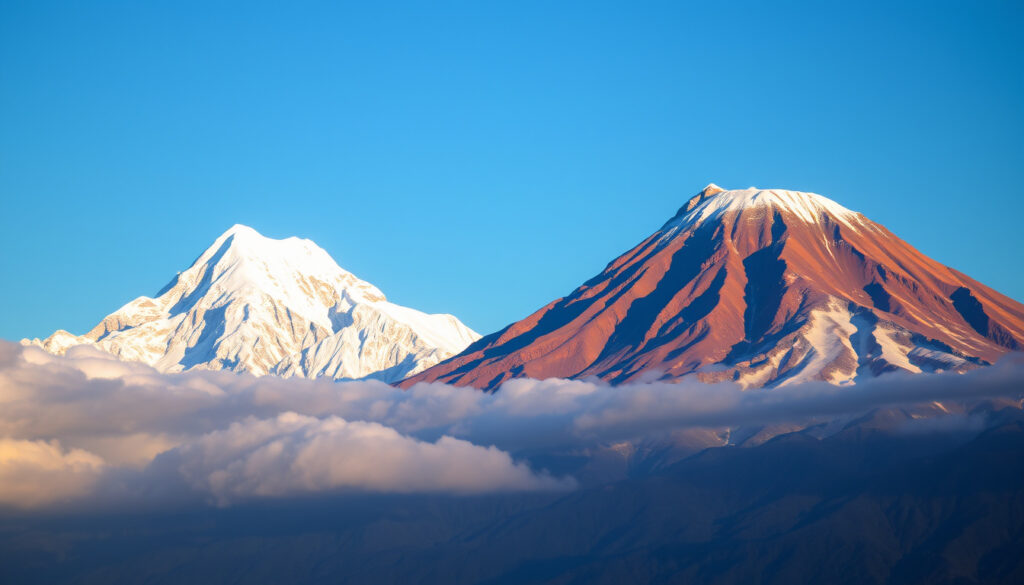
Tallest Mountain in the World: Highest vs Tallest Explained
Mount Everest claims the title of world’s highest peak—but the mountain world has a hidden twist. Mauna Kea in Hawaii actually towers taller when measured from its ocean-floor base, even though Everest sits higher above sea level. This distinction trips up even geography enthusiasts, so let’s clear it up with the numbers that matter.
Highest above sea level: Mount Everest at 8,848.86 m (29,032 ft) · Tallest from base to peak: Mauna Kea at 10,210 m (33,500 ft) · Second highest: K2 at 8,611 m (28,251 ft) · Eight-thousanders count: 14 peaks over 8,000 m
Quick snapshot
- Everest rises 8,848.86 m above sea level, per multiple surveys (Guinness World Records)
- Mauna Kea measures 10,210 m base-to-peak per NOAA (Geology In)
- Guinness World Records recognizes Mauna Kea as tallest from base (Guinness World Records)
- Exact fatality counts for unclimbed peaks like Gangkhar Puensum
- Minor variations in Mauna Kea base measurements (10,203 m vs 10,211 m)
- Whether geological surveys will revise Everest’s 2020 official height
- Everest formed ~60 million years ago from continental collision (Awesome Holidays Nepal)
- Mauna Kea is geologically younger at ~1 million years old (Awesome Holidays Nepal)
- Human ascents: Everest first summited 1953, K2 in 1954 (National Geographic)
- Gangkhar Puensum remains unclimbed due to climbing restrictions
- Scientists continue refining Everest’s exact elevation
- Mauna Kea hosts active astronomical observatories on its summit
Mount Everest’s elevation and Mauna Kea’s total height provide the key data points for comparing Earth’s tallest peaks.
| Measurement | Mountain | Value |
|---|---|---|
| Highest above sea level | Mount Everest | 8,848.86 m |
| Tallest from base to peak | Mauna Kea | 10,210 m |
| Second highest above sea level | K2 | 8,611 m |
| Third highest above sea level | Kangchenjunga | 8,586 m |
| Fourth highest above sea level | Lhotse | 8,516 m |
What is technically the tallest mountain on Earth?
The answer depends entirely on where you start measuring. Mount Everest wins the standard contest—height above sea level—because that’s the globally accepted benchmark. Encyclopædia Britannica confirms that Everest “stands as the world’s highest mountain at 8,849 metres above sea level.” The sea-level baseline gives every mountain a fair comparison, regardless of whether they erupt from a plateau, a plain, or the ocean floor.
Mauna Kea complicates the picture. Measured from its base on the Pacific seafloor to its summit, the Hawaiian volcano reaches 10,210 meters. That’s roughly 1,361 meters taller than Everest when you count the whole stack. The difference matters because Everest sits anchored to the Tibetan Plateau, which itself sits 4,500 meters above sea level. You’re not measuring from true bedrock.
Highest above sea level vs from base
The two measurement systems exist for good reasons. Sea-level elevation works for navigation, mountaineering, and comparing peaks across continents. Base-to-peak measurement matters for geology—it shows how much rock actually stacks above the Earth’s crust. Mental Floss explains that if you discard the water surrounding Mauna Kea and measure from its underwater base (a metric called “dry prominence”), the volcano surpasses Everest.
Mauna Kea details
Mauna Kea rises 4,207 meters above sea level—less than half of Everest’s visible height. But roughly 6,000 meters of the volcano hides beneath the Pacific. Guinness World Records (the official record keeper) recognizes Mauna Kea as the tallest mountain in the world, measured from submarine base to summit at 10,205 meters. The mountain is also a dormant volcano, last erupting approximately 4,600 years ago.
Mauna Kea’s submarine base in the Hawaiian Trough sits 5,500–6,000 meters below sea level—a depth that adds an enormous invisible foundation beneath the peak.
What mountain is actually taller than Everest?
Mauna Kea holds the crown when measuring base to summit. Guinness World Records explicitly states: “Contrary to popular belief, Everest is not the tallest mountain in the world—though it is indisputably the highest mountain above sea level.” The record organization confirms Mauna Kea’s total height at 10,205 meters from submarine base.
Everest’s advantage lies in its starting elevation. The Tibetan Plateau beneath Everest sits so high that when geologists measure “prominence”—how far a peak rises from its surrounding terrain—Everest still wins. But raw vertical relief from the planet’s crust to the sky belongs to Mauna Kea.
Mauna Kea from ocean floor
Mauna Kea’s base sits in the Hawaiian Trough, an oceanic depression 5,500 to 6,000 meters deep. The volcano extends 19,700 feet below the Pacific surface before emerging as an island. Geology In notes that Mauna Kea’s dry prominence (height above the surrounding seafloor) equals 30,610 feet—making it Earth’s most substantial mountain by vertical relief.
Other contenders
No other mountain seriously challenges Mauna Kea’s base-to-peak record. Mauna Loa, also in Hawaii, rivals Mauna Kea’s volume but not its height. Ecuador’s Chimborazo comes close in “prominence from Earth’s center” because the planet bulges at the equator—but that’s geodesy, not geology.
Mauna Kea hosts some of the world’s most powerful telescopes on its summit, yet most of the mountain remains invisible beneath the ocean.
What is the top 10 tallest mountain in the world?
By elevation above sea level, the “eight-thousanders” dominate the top ranks. These 14 peaks all exceed 8,000 meters and cluster in the Himalayan and Karakoram ranges. Everest leads at 8,848.86 m, but the list includes peaks most people have never heard of.
The table below lists the ten tallest mountains by elevation above sea level, with all heights confirmed by multiple surveys.
| Rank | Mountain | Height | Range |
|---|---|---|---|
| 1 | Mount Everest | 8,848.86 m | Himalayas |
| 2 | K2 | 8,611 m | Karakoram |
| 3 | Kangchenjunga | 8,586 m | Himalayas |
| 4 | Lhotse | 8,516 m | Himalayas |
| 5 | Makalu | 8,485 m | Himalayas |
| 6 | Cho Oyu | 8,188 m | Himalayas |
| 7 | Dhaulagiri I | 8,167 m | Himalayas |
| 8 | Manaslu | 8,163 m | Himalayas |
| 9 | Nanga Parbat | 8,126 m | Himalayas |
| 10 | Annapurna I | 8,091 m | Himalayas |
The pattern reveals that ten of the fourteen eight-thousanders cluster in the Himalayas alone, with the Karakoram hosting only K2 among the top peaks.
List of eight-thousanders
The 14 eight-thousanders attract mountaineers from around the world. Only Mount Everest and K2 exceed 8,600 meters. Wikipedia’s list of highest mountains on Earth tracks all peaks above 8,000 meters, including the 14th: Shishapangma at 8,027 meters in Tibet.
Full top 10
The remaining top-10 peaks all exceed 8,000 meters: Annapurna I (8,091 m), Manaslu (8,163 m), Dhaulagiri I (8,167 m), Cho Oyu (8,188 m), Makalu (8,485 m), Lhotse (8,516 m), and Kangchenjunga (8,586 m). Each sits in either the Himalayas or Karakoram ranges.
Is K2 the world’s highest peak?
No—Everest outranks K2 by 237 meters. Wikipedia confirms K2’s elevation at 8,611 meters, making it the world’s second-highest mountain. No measurement system places K2 above Everest.
K2 compensates for its height deficit with technical difficulty. The Karakoram peak is considered the world’s most dangerous climb, with a fatality rate around 23% among summit attempts. Everest, for all its dangers, is statistically safer.
K2 vs Everest comparison
Height difference aside, these mountains barely compare. Everest’s standard route (South Col from Nepal) is crowded, expensive, and logistically complex—but achievable for fit climbers with sponsorship. K2’s remote location, extreme weather, and technical routes deter all but elite alpinists.
Why Everest ranks higher
Everest sits on the Nepal-China border, accessible from both nations’ trekking routes. Britannica notes no significant base-to-peak measurement debate for K2—the peak is simply lower than Everest above sea level, and its submerged base doesn’t approach Mauna Kea’s depth. Everest’s Tibetan Plateau base, while elevated, doesn’t subtract enough vertical to change the ranking.
K2’s reputation as “deadly” stems from technical difficulty, not height. Climbers who survive K2 often call Everest a crowded walk in comparison.
Is Mount Everest the tallest mountain in the world?
Everest is the highest mountain by elevation above sea level—8,848.86 meters, confirmed by National Geographic and multiple survey missions. It is not the tallest from base to peak. That distinction belongs to Mauna Kea.
The confusion persists because most people encounter mountains through maps, climbing records, and news articles—all of which use sea-level elevation as the default metric. Guinness World Records explicitly draws this distinction: Everest is highest above sea level, not tallest overall.
Elevation definitions
Three metrics matter for mountain comparison:
- Above sea level: The classic measurement, used by cartographers, climbers, and most reference books.
- Base-to-peak: The total vertical relief from a mountain’s lowest foundational point to its summit.
- Prominence: How far a peak rises above its surrounding terrain, useful for identifying independent mountains.
Mauna Kea dominates base-to-peak measurements because most of it sits underwater. Everest leads prominence and sea-level rankings because it starts from the world’s highest plateau.
Common misconceptions
Many believe Everest is unambiguously the tallest mountain. The qualifier—highest, not tallest—rarely appears in casual conversation. Some also assume sea level is a universal baseline; in reality, geoid models vary, and some surveys measure from the geoid rather than mean sea level. Mental Floss clarifies that oceanic crust under Mauna Kea is less dense than continental crust, allowing the Hawaiian volcano to develop greater prominence from its oceanic base.
You can’t see most of Mauna Kea without diving equipment. Everest’s beauty lies in its visibility—you can photograph it from base camp. Both mountains are extraordinary; they simply rank differently depending on how you measure.
Confirmed facts
- Everest elevation is 8,848.86 m above sea level (multiple verified surveys) (Guinness World Records)
- Mauna Kea base-to-peak height is 10,210 m per NOAA measurements (Geology In)
- Guinness World Records recognizes Mauna Kea as tallest from base at 10,205 m (Guinness World Records)
- K2 is 8,611 m above sea level, second highest after Everest (Wikipedia)
- 14 peaks exceed 8,000 m elevation—all in the Himalayan/Karakoram ranges (Wikipedia)
- Mauna Kea’s underwater base sits in the Hawaiian Trough at 5,500–6,000 m depth (Guinness World Records)
What’s unclear
- Minor variations in Mauna Kea base measurements (10,203 m vs 10,211 m reported)
- Exact fatality counts for unclimbed peaks like Gangkhar Puensum
- Whether the 2020 Everest height revision (8,848.86 m) will be updated again
“Contrary to popular belief, Everest is not the tallest mountain in the world – though it is indisputably the highest mountain above sea level.”
— Guinness World Records (Official Record Keeper)
“If you discard the water that surrounds Mauna Kea and measure the mountain from its underwater base—a measurement known as the ‘dry prominence’—Mauna Kea is taller than Everest.”
— Mental Floss (Editorial Publication)
For curious travelers and aspiring mountaineers, the choice between Everest and Mauna Kea reflects what you value: Everest offers the prestige of the world’s highest visible peak, while Mauna Kea invites you to consider a different kind of scale—one that’s mostly hidden beneath the ocean. Neither mountain disappoints; they simply reward different perspectives.
Frequently asked questions
What are the 7 highest mountains in the world?
The top seven are: Mount Everest (8,848.86 m), K2 (8,611 m), Kangchenjunga (8,586 m), Lhotse (8,516 m), Makalu (8,485 m), Cho Oyu (8,188 m), and Dhaulagiri I (8,167 m).
What is the tallest mountain in the world from base?
Mauna Kea in Hawaii is the tallest from base to peak at 10,210 meters—measured from the Pacific Ocean floor to its summit. This exceeds Everest’s 8,848.86 meters.
What is the 2nd tallest mountain in the world?
K2 is the second highest mountain above sea level at 8,611 meters. It sits in the Karakoram range between Pakistan and China.
What is the 3rd tallest mountain in the world?
Kangchenjunga ranks third at 8,586 meters, located on the Nepal-India border in the Himalayas.
What is the tallest mountain in the world country?
Everest sits on the Nepal-China border. Nepal uses Everest as its national symbol. K2 is in Pakistan-China. Kangchenjunga spans Nepal-India.
What is the tallest mountain in the world underwater?
Mauna Kea is the tallest underwater mountain, with approximately 6,000 meters of its height submerged beneath the Pacific Ocean.
Why can’t planes fly over Mount Everest?
Planes can technically fly over Everest, but most avoid it due to limited emergency landing options, unpredictable turbulence from mountain winds, and the thin atmosphere making emergencies more dangerous.
What mountain is forbidden to climb?
Gangkhar Puensum in Bhutan remains unclimbed because Bhutan prohibits climbing peaks above 6,000 meters for spiritual reasons. It is the world’s highest unclimbed mountain at 7,570 meters.
Related reading: UK nature reserves for hiking · current UK weather forecasts
kilimanjarosunrise.com, himalayan-masters.com, geographyworlds.com, youtube.com
While Mauna Kea claims tallest from base, Mount Everest’s Everest height facts at 8,848.86 meters cements its highest above-sea-level supremacy.
More related posts
 Sarah Vine: Hair Loss, Wig Use, Marriage & Career Explained
 Glasgow Royal Concert Hall Tickets 2026: Seating & Events
 Rosie Bentham: Emmerdale’s Gabby Thomas – Biography
 Fara Williams Biography: Career, Net Worth, Partner & More
 The I-Land: Netflix’s Divisive Miniseries Explained
 Ross King: Age, Wife, Children, Net Worth, and Career
 John Frusciante: Sobriety, Guitar Genius, and RHCP Departures