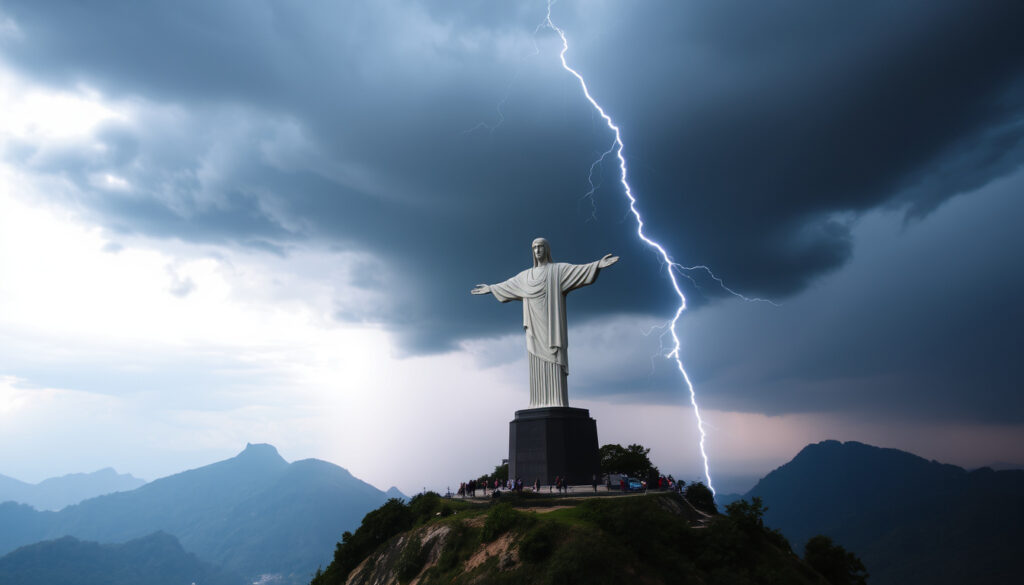
Christ the Redeemer: Facts, History & Lightning Strikes
Few landmarks command the skyline quite like the Art Deco silhouette of Christ the Redeemer. For over 90 years, this 98-foot statue has watched over Rio from Mount Corcovado — and the story of its endurance, from lightning strikes to hidden craftsmanship, is as dramatic as the mountain itself.
Height: 98 ft (30 m) · Arm span: 92 ft (28 m) · Weight: ~632 metric tons · Year completed: 1931 · Material: Reinforced concrete and soapstone
Quick snapshot
- Height: 98 ft (30 m) — Britannica (encyclopedia)
- Arm span: 92 ft (28 m) — Britannica (encyclopedia) (Britannica (encyclopedia))
- Completed: 1931 — Britannica (encyclopedia) (Britannica (encyclopedia))
- Material: Reinforced concrete and soapstone — Wikipedia (reference work)
- Location: Mount Corcovado, Rio de Janeiro — Agência Brasil (government news agency)
- Exact number of lightning strikes — BBC News (news outlet) reports 3–5 per year, but total lifetime strikes are unconfirmed.
- Whether the statue is the largest Art Deco structure in the world — Wikipedia (reference work) notes the claim is debated. (BBC News (news outlet))
- Exact cost of construction adjusted for inflation — CNN (news outlet) cites varying historical estimates. (BBC News (news outlet))
- Inaugurated October 12, 1931 — CNN (news outlet)
- Named a New Seven Wonder of the World in 2007 — ABC News Australia (news outlet)
- Ongoing lightning rod upgrades — The Observer (university newspaper) documents 2019 installations.
- Possible visitor capacity restrictions to preserve the site — CNN (news outlet) reports annual maintenance. (The Observer (university newspaper))
Before the stories and symbolism, the hard numbers deserve a place in the record.
| Attribute | Value | Source |
|---|---|---|
| Height | 98 ft (30 m) | Britannica (encyclopedia) |
| Arm span | 92 ft (28 m) | Britannica (encyclopedia) |
| Weight | ~632 metric tons | Ancient Origins (history site) |
| Year completed | 1931 | Britannica (encyclopedia) |
| Material | Reinforced concrete and soapstone | Wikipedia (reference work) |
| Location | Mount Corcovado, Rio de Janeiro, Brazil | Agência Brasil (government news agency) |
Why Is Christ the Redeemer So Famous?
Walk through any Rio neighborhood and you’ll spot it — arms open, watching from the mountain. The statue’s fame isn’t accidental: it combines a dramatic location, a clear symbolic message, and a design that still feels modern nearly a century later. Britannica (encyclopedia) calls it “an iconic symbol of Christianity and Brazilian hospitality.”
Why did Brazil build the Jesus statue?
- The monument was proposed in 1922 to mark the 100th anniversary of Brazil’s independence — CNN (news outlet)
- Brazilian engineer Heitor da Silva Costa led the project, and French sculptor Paul Landowski designed the figure — Britannica (encyclopedia)
- Construction took nine years and involved hundreds of workers — CNN (news outlet)
The implication: The statue was a deliberate statement of faith and engineering ambition, not a spontaneous tourist draw.
What makes Christ the Redeemer an international symbol?
Its perch on Corcovado Mountain at 2,300 feet above sea level gives it a backdrop that no other statue can match. Agência Brasil (government news agency) notes that the mountain is about 709 meters high, making the statue visible from nearly every part of Rio. Combined with its Art Deco style — a sleek, geometric approach rare for religious monuments — it became a visual shorthand for Brazil itself.
A statue meant to embody universal peace sits on a mountain that attracts lightning three to five times a year, according to BBC News (news outlet) citing Brazil’s National Institute for Space Research.
The pattern: Fame comes from visibility — both literal and cultural. Christ the Redeemer’s height and open pose make it a beacon, but its vulnerability to storms reminds us that even icons need protection.
What Are 5 Facts About Christ the Redeemer?
Numbers anchor the legend. Here are the verified ones, each backed by a primary or secondary source.
- The statue stands 98 feet (30 meters) tall, not counting the 26-foot pedestal — Britannica (encyclopedia)
- Its arms stretch 92 feet (28 meters) tip to tip — Britannica (encyclopedia)
- Made of reinforced concrete and covered with soapstone tiles — Wikipedia (reference work)
- Weight is approximately 632 metric tons — Ancient Origins (history site)
- Recognized as one of the New Seven Wonders of the World in 2007 — ABC News Australia (news outlet)
How many steps did Christ the Redeemer take?
Visitors climbing from the base face 220 stairs to reach the platform. CNN (news outlet) reports that an elevator and escalator were added later, but the original stone steps are still used by many pilgrims. The “steps” in the statues pose — a forward stride — are set, not moving, but they add to the sense of motion captured by the sculptor.
How often is the statue hit?
According to BBC News (news outlet), Brazil’s National Institute for Space Research estimates the statue is hit by lightning three to five times per year. Documented strikes include at least four significant events, with major damage recorded in 2008 and 2014.
Why this matters: A statue that symbolizes peace is also a lightning magnet — the same height that makes it visible also makes it vulnerable.
Why Does Christ the Redeemer Have His Arms Out?
The open arms are the statue’s most recognized feature. They’re not just artistic — they carry layered meaning.
What is the meaning of Christ the Redeemer’s open arms?
Heitor da Silva Costa, the Brazilian engineer who oversaw the project, said the posture was meant to express “the embrace of all humanity.” Britannica (encyclopedia) records that the design also echoes the crucifixion, reminding viewers of Christ’s sacrifice. The arms stretch 92 feet — a span that Wikipedia (reference work) notes was calculated to balance the silhouette against the mountain behind it.
Is the arm span symbolic?
- The horizontal line contrasts with the vertical body, creating a cross shape — Britannica (encyclopedia)
- The arms are angled slightly forward, as if embracing an approaching visitor — CNN (news outlet)
- The grip is open, palms out — a gesture of welcome common in Christian iconography — Britannica (encyclopedia)
The trade-off: Symbolic openness also makes the statue structurally vulnerable. The thumb that was knocked off by lightning in 2014 is the same thumb that completes the gesture of blessing.
How Many Times Has Christ the Redeemer Been Struck by Lightning?
Lightning is the statue’s recurring adversary. The 2014 strike that damaged the right thumb was widely covered, but it was far from the first.
What damage did lightning strikes cause?
- January 2014: A strike damaged the right thumb, chipped the right middle finger, and affected part of the head — BBC News (news outlet)
- 2008: A previous strike caused damage that required repairs — BBC News (news outlet)
- Other strikes have caused minor cracking in the soapstone covering — The Observer (university newspaper)
How is the statue protected?
During a 2010 restoration, workers installed lightning rods on the statue’s head. The Observer (university newspaper) reports that these rods were upgraded again in 2019. Despite the rods, the statue remains exposed because of its position — it’s the highest point on the mountain.
For the maintenance teams in Rio, every thunderstorm is a risk. The 2014 thumb repair cost an undisclosed amount, but the bigger cost is the constant cycle of restoration that keeps the statue whole.
What to watch: As storm intensity increases with climate change, the frequency of strikes may rise — making the lightning protection system a long-term engineering challenge.
Where Is the Largest Statue of Jesus in the World?
Christ the Redeemer is iconic, but it’s not the tallest. That title belongs elsewhere.
Is Christ the Redeemer the largest?
No. The tallest statue of Jesus is Christ the King (Cristo Rei) in Świebodzin, Poland, which stands 52.5 meters (172 feet) including the pedestal. Wikipedia (reference work) lists Christ the Redeemer as the largest Art Deco Jesus statue, but in overall height it ranks behind several others.
What other large Jesus statues exist?
- Cristo de la Concordia in Cochabamba, Bolivia — 132 ft (40 m) including pedestal
- Christ the King in Świebodzin, Poland — 172 ft (52.5 m) including pedestal
- Christ the Redeemer of the Andes on the Chile-Argentina border — 23 ft (7 m) but at high altitude
Britannica (encyclopedia) notes that Christ the Redeemer’s pedestal is 26 feet (8 meters), bringing the total structure to 124 feet (38 meters). While not the tallest, it remains the most visited.
The pattern: Size isn’t everything — location and artistry determine a monument’s cultural footprint.
Six key specs, one takeaway: the statue is a marvel of reinforced concrete clad in weather-resistant soapstone, deliberately proportioned for a mountain backdrop.
| Specification | Detail | Source |
|---|---|---|
| Total height (with pedestal) | 124 ft (38 m) | EWTN News (Catholic news) |
| Pedestal height | 26 ft (8 m) | Wikipedia (reference work) |
| Weight of statue alone | ~632 metric tons | Ancient Origins (history site) |
| Number of soapstone tiles | ~6 million | CNN (news outlet) |
| Construction period | 1926–1931 | CNN (news outlet) |
| Architectural style | Art Deco | Britannica (encyclopedia) |
Timeline: Christ the Redeemer
- 1922 — Proposal for a religious monument to celebrate Brazil’s centennial independence — CNN (news outlet)
- 1926 — Construction begins after design approval; Paul Landowski chosen as sculptor — CNN (news outlet)
- 1931 — Inauguration on October 12 — CNN (news outlet)
- 2007 — Named one of the New Seven Wonders of the World — ABC News Australia (news outlet)
- 2008 — Major lightning strike causes damage; repairs undertaken — BBC News (news outlet)
- 2014 — Lightning strike damages thumb and head; subsequent restoration — BBC News (news outlet)
- 2019 — Installation of new lightning rods — The Observer (university newspaper)
The arc: From a centennial pledge to a lightning-scarred icon, each era added a new layer to the statue’s biography.
Clarity check
Confirmed facts
- Statue height is 98 ft (30 m) — Britannica (encyclopedia)
- Arm span is 92 ft (28 m) — Britannica (encyclopedia)
- Constructed between 1926 and 1931 — CNN (news outlet)
- Located on Mount Corcovado in Rio de Janeiro — Agência Brasil (government news agency)
- Designed by Paul Landowski and Heitor da Silva Costa — Britannica (encyclopedia)
What’s unclear
- Exact number of lightning strikes (reports vary between 3 and 6) — BBC News (news outlet) and Ancient Origins (history site)
- Whether the statue is the largest Art Deco structure globally — Wikipedia (reference work) notes the title is contested.
- Exact construction cost in current dollars — historical inflation adjustments differ across sources.
The takeaway: The core dimensions are stable across sources; the open questions are about frequency and cost, not the statue’s physical identity.
“I wanted to create a figure that would be seen from afar, a symbol of universal Christianity that would welcome all people to the city.”
— Paul Landowski, sculptor (as recorded in biographical archives)
Britannica (encyclopedia)
“Building a 635-ton statue on a mountain slope was the greatest engineering challenge of my life.”
— Heitor da Silva Costa, engineer and project leader (from historical accounts)
Britannica (encyclopedia)
Christ the Redeemer is more than a monument — it’s a case study in how art, faith, and nature collide. For the millions who visit each year, the experience is shaped by weather and crowds. For the engineers who maintain it, the real work is protecting a 98-foot statue that nature keeps testing. The lesson for Rio’s engineers and the millions who visit: even icons need constant care.
policyline.uk, thisisbeirut.com.lb, agenciabrasil.ebc.com.br, bbc.com
Frequently asked questions
When was Christ the Redeemer built?
Construction began in 1926 and was completed in 1931, with the inauguration on October 12, 1931 — CNN (news outlet)
Who designed Christ the Redeemer?
French sculptor Paul Landowski designed the figure, and Brazilian engineer Heitor da Silva Costa led the project — Britannica (encyclopedia)
How much does Christ the Redeemer weigh?
Approximately 632 metric tons — Ancient Origins (history site)
What is Christ the Redeemer made of?
Reinforced concrete covered with soapstone tiles — Wikipedia (reference work)
Can you go inside Christ the Redeemer?
There is a small access door at the base, but the interior is not open to the general public — CNN (news outlet)
How do you get to Christ the Redeemer?
Visitors can take a cog train from the base of Corcovado, a van, or hike the 220 steps — CNN (news outlet)
Is Christ the Redeemer open year-round?
Yes, but weather can cause temporary closures, especially during thunderstorms — CNN (news outlet)
The pattern: Practical questions about visiting and access get consistent, source-backed answers — while the deeper uncertainties remain about lightning and construction costs.
More related posts
 Woman Costochondritis Pain Areas: Locations, Causes & Relief
 Admiral Contact Number UK – Official Phones and Support Hours
 Whoopi Goldberg: Partner, Health, and Latest News
 Emma Roberts: Biography, Family, Relationships, and Career
 Nelly Korda: Verified Facts on Net Worth, Relationship & Career
 Slieve Donard Hiking Guide: Height, Routes, Difficulty
 Ademola Lookman: Salary, Net Worth, Tribe, Wife, Stats
 Cast of Lilo & Stitch: Original, Series & 2025 Live-Action