Mad Hatter: Meaning, Mental Illness, and the 10/6 Hat Explained
There’s a reason the Mad Hatter’s tea party never seems to end — and it’s not just because the clock reads six forever; the character from Lewis Carroll’s Alice’s Adventures in Wonderland (1865) has become a cultural shorthand for delightful nonsense, but the real story behind his madness is darker and far more physical. This article unpacks the historical mercury poisoning that inspired the phrase ‘mad as a hatter’ and the meaning behind the 10/6 tag on his hat.
First appearance: Alice’s Adventures in Wonderland (1865) ·
Notable riddle: “Why is a raven like a writing desk?” ·
Hat price label: 10/6 (ten shillings and sixpence) ·
Real‑world condition: Mad hatter’s disease (mercury poisoning) ·
Original illustrator: Sir John Tenniel
Quick snapshot
- The Mad Hatter appears in Lewis Carroll’s Alice’s Adventures in Wonderland (1865) (Wikipedia – the crowd‑sourced encyclopedia).
- The hat label 10/6 means ten shillings and sixpence, the price of the hat (Alice‑in‑Wonderland.net – the dedicated fan resource).
- “Mad hatter disease” is chronic mercury poisoning from hat‑making (CDC NIOSH – U.S. occupational health authority).
- The phrase “mad as a hatter” became well known by the second quarter of the 19th century (Fine Arts Museums of San Francisco – museum research publication).
- The intended meaning of the Hatter’s riddle “Why is a raven like a writing desk?” has never been definitively answered (Alice‑in‑Wonderland.net – the dedicated fan resource).
- Whether Carroll intended the Hatter to represent a specific mental disorder remains a matter of speculation (CDC NIOSH – U.S. occupational health authority).
- In the original book, the Hatter’s moral status (hero or villain) is ambiguous (Wikipedia – the crowd‑sourced encyclopedia).
- Whether the Hatter’s personality was directly inspired by any known case of erethism is speculative. (Alice‑in‑Wonderland.net – the dedicated fan resource)
- The phrase “mad as a hatter” was in use by the 1830s, decades before Carroll’s book (Fine Arts Museums of San Francisco – museum research publication).
- From the 1700s to the early 1900s, hat factories used mercuric nitrate in fur‑felt production (American Museum of Natural History – science education resource).
- The CDC notes that neurological effects of occupational mercury exposure have been recognized since the mid‑19th century (ATSDR/CDC – federal public health agency).
- Modern pop culture continues to reinterpret the Mad Hatter, from Johnny Depp’s portrayal to mental‑health discussions about “mad hatter syndrome” (Healthline – health information publisher).
- Awareness of occupational mercury poisoning has led to stricter regulations, but historical cases still inform medical literature (CDC NIOSH – U.S. occupational health authority).
- The character remains a fixture in Halloween costumes, tea‑party themes, and academic analysis of Victorian society. (Healthline – health information publisher)
Seven key facts about the Mad Hatter span his literary origin, the real‑world disease behind the phrase, and the enduring symbol he has become.
| Label | Value |
|---|---|
| Full Name | Mad Hatter (also called the Hatter) |
| Story | Alice’s Adventures in Wonderland |
| Author | Lewis Carroll (Charles Lutwidge Dodgson) |
| First Illustration | John Tenniel (1865) |
| Hat Label | 10/6 |
| Real‑world basis | Mercury poisoning |
| Common Phrase | Mad as a hatter |
What is the meaning behind the Mad Hatter?
The Mad Hatter is one of the most recognizable characters from Lewis Carroll’s Alice’s Adventures in Wonderland (1865), illustrated by Sir John Tenniel. His name combines two threads: the literary eccentric who hosts a never‑ending tea party and the pre‑existing English idiom “mad as a hatter,” which referred to the neurological damage suffered by hat‑makers poisoned by mercury. Carroll wove the phrase into a character who embodies chaotic logic and surreal conversation.
< h3>Why did the Mad Hatter turn mad?
The character’s madness is not explicitly explained in the book — but the real‑world inspiration is well documented. Hat‑makers in the 18th and 19th centuries used hot solutions of mercuric nitrate to turn fur into felt, often in poorly ventilated rooms. Chronic inhalation of mercury vapor led to tremors, irritability, shyness, depression, and in severe cases hallucinations — a condition doctors called erethism, or “mad hatter disease” (CDC NIOSH – U.S. occupational health authority). Carroll likely borrowed the phrase to give his character a quirky, dangerous edge without intending a clinical diagnosis.
< h3>What is the Mad Hatter famous for saying?
The Hatter’s most famous line is his riddle: “Why is a raven like a writing desk?” It appears during the tea party and has no definitive answer — Carroll himself later said he had no particular answer in mind (Alice‑in‑Wonderland.net – the dedicated fan resource). Other notable quotes — “If you knew Time as well as I do, you wouldn’t talk about wasting it” and “Your hair wants cutting” — showcase his aggressive, nonsensical style.
The Mad Hatter’s madness is not a literary invention — it’s a centuries‑old industrial health crisis that Carroll turned into a clever character trait, leaving modern readers to separate folklore from fact.
What mental illness does the Mad Hatter represent?
Readers often ask whether Carroll intended the Hatter to symbolize a specific psychiatric disorder. The answer is more historical than clinical.
< h3>What exactly is mad hatter syndrome?
“Mad hatter syndrome” is the informal name for erethism, a neurological condition caused by chronic mercury poisoning. Symptoms include slurred speech, pathological shyness, extreme irritability, tremors, and memory loss (Fine Arts Museums of San Francisco – museum research publication). Long‑term exposure to mercuric nitrate led many hat makers to act as if insane, according to the American Museum of Natural History (American Museum of Natural History – science education resource).
< h3>What condition did the Mad Hatter have?
In the original story, the Hatter displays traits such as agitation, rudeness, and disjointed speech — behaviors that loosely match erethism symptoms. However, Carroll never diagnosed the character. Modern interpretations sometimes link the Hatter to bipolar disorder or schizophrenia, but these are allegorical readings, not authorial intent (Healthline – health information publisher). The safest conclusion: the character was inspired by a real occupational illness, not a specific mental disorder.
The popular association of the Mad Hatter with mental illness overshadows the real tragedy: hundreds of workers suffered permanent neurological damage because of unsafe industrial practices. The character serves as a cultural echo of that forgotten public‑health failure.
The pattern: the Hatter’s fictional behaviors reflect actual symptoms of mercury poisoning, but linking him to a modern psychiatric label risks misreading Carroll’s intent.
Why is Mad Hatter a villain?
In Carroll’s original book, the Hatter is not a villain at all — he is an eccentric, rude, and confusing tea‑party host. The label “villain” comes from later adaptations.
< h3>What is a Mad Hatter personality?
The Hatter’s personality in the book is chaotic, confrontational, and utterly uncooperative. He argues with Alice, tells her she’s stupid, and changes topics mid‑sentence. This chaotic energy is central to the satire of Victorian social norms — the Hatter rejects politeness and logic (Wikipedia – the crowd‑sourced encyclopedia).
< h3>Why is Mad Hatter obsessed with Alice?
In the original story, the Hatter has no particular obsession with Alice — she is simply a guest who offends the March Hare and the Hatter by staying for tea. The romantic or obsessive subplot is a modern invention, most famously in Tim Burton’s 2010 film, where the Hatter (played by Johnny Depp) harbors feelings for Alice. That interpretation is not supported by the 1865 text.
The implication: the “villain” reading is a product of adaptation, not source material. The Hatter’s true literary role is as a destabilising force that challenges Alice’s — and the reader’s — assumptions about logic and order.
< h2>What does 10/6 on the Mad Hatter’s hat mean?
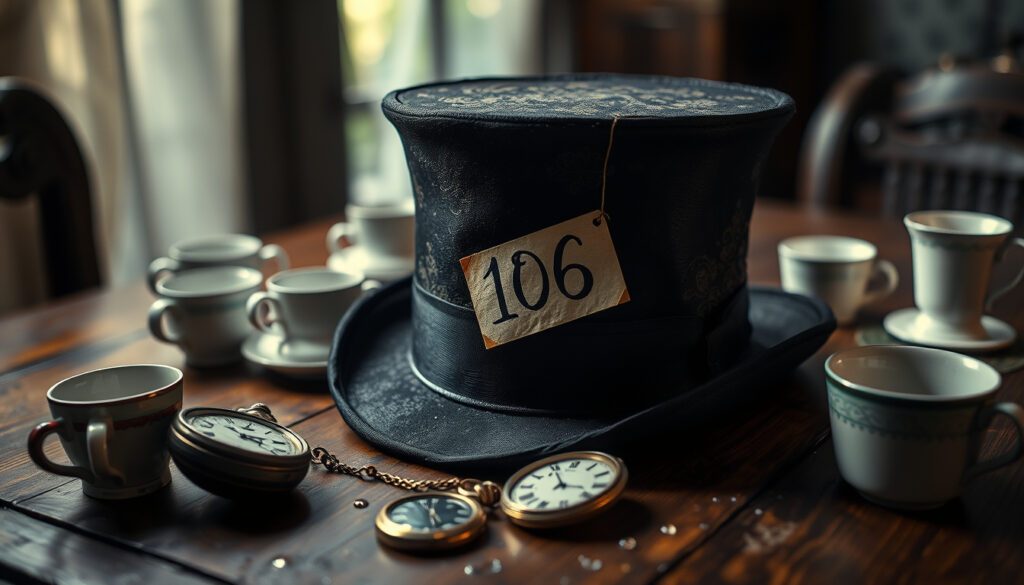
The 10/6 label on the Mad Hatter’s hat is one of the most recognizable costume details in literary history. It appears on the hatband in John Tenniel’s original illustration (Wikipedia – the crowd‑sourced encyclopedia). The meaning is straightforward: 10/6 denotes ten shillings and sixpence — the price of the hat in old British currency. That amount was half a guinea, considered relatively expensive for the mid‑1800s (Alice‑in‑Wonderland.net FAQ).
The tag reinforces the Hatter’s trade: he is a hatter by profession, and the hat he wears (or sells) carries a price tag — a subtle joke about commercialism and identity. The exact rendering in Tenniel’s illustration sometimes appears as “In this style 10/6,” indicating the hat’s price rather than a style number.
A simple price tag has become a symbol of the character’s eccentricity, often misinterpreted as a code or secret number. The reality is prosaic — it’s just the cost of the hat.
What disorder did Alice in Wonderland have?
Alice herself has been the subject of medical interpretations, particularly in relation to Alice in Wonderland syndrome (AIWS).
< h3>What mental disorder does the Cheshire cat represent?
Alice in Wonderland syndrome is a real neurological condition first described in 1955 by Dr. John Todd. It involves distortions of visual perception — objects appear smaller (micropsia) or larger (macropsia) than they are — and altered sense of time and body image. These symptoms mirror Alice’s experiences in the book, such as growing and shrinking after eating and drinking. The condition is often associated with migraines, epilepsy, or infections (NCBI Bookshelf – U.S. National Library of Medicine).
The Cheshire Cat’s iconic gradual disappearance — leaving only its grin — has been linked in modern allegory to depersonalization or schizophrenia. However, as with the Hatter, these are interpretive readings, not authorial intent. Carroll did not set out to depict mental illness — he wrote fantasy that happened to mirror neurological experiences.
The trade-off: modern readers gain a richer understanding of the story through a medical lens, but risk imposing diagnoses on characters that were never meant to be pathological.
Confirmed facts
- The Mad Hatter appears in Alice’s Adventures in Wonderland (1865) by Lewis Carroll.
- The hat label 10/6 indicates the price — ten shillings and sixpence (Alice‑in‑Wonderland.net FAQ).
- “Mad hatter disease” is chronic mercury poisoning from hat‑making (CDC NIOSH).
- Neurological symptoms of mercury exposure have been recognized since the mid‑19th century (ATSDR/CDC).
What’s unclear
- The intended answer to the Hatter’s riddle “Why is a raven like a writing desk?” remains unknown.
- Whether Carroll intended the Hatter to represent a specific mental disorder is speculative.
- Whether the Hatter is a hero or villain in the original text is ambiguous.
- Whether the Hatter’s personality traits were directly inspired by any known case of erethism is speculative.
“If you knew Time as well as I do, you wouldn’t talk about wasting it.”
— The Mad Hatter, Alice’s Adventures in Wonderland by Lewis Carroll (Project Gutenberg – full text of the book)
“You’re entirely bonkers. But I’ll tell you a secret: all the best people are.”
— The Hatter (Johnny Depp), Alice in Wonderland (2010), screenplay by Linda Woolverton
“The phrase ‘mad as a hatter’ was well known by the second quarter of the nineteenth century, long before Carroll wrote his famous book.”
— Fine Arts Museums of San Francisco, “Poisons Part I: The Mercurial World of Felt” (FAMSF – museum research publication)
For readers exploring the Mad Hatter’s legacy, the real story is less about whimsical nonsense and more about the hidden costs of industrial progress: thousands of hat‑makers sacrificed their nervous systems to produce fashionable felt. The character remains a lasting symbol of that hidden danger, and the next time you see someone dressed as the Hatter, you’ll know that 10/6 isn’t just a price — it’s a reminder of a public‑health lesson that took decades to learn.
Related reading: **Kerry Katona: Bipolar Disorder, Relationships & Net Worth** · **Jordan Peterson: Beliefs, Health, IQ, Controversies**
aliceinwonderland.fandom.com, medicalnewstoday.com, en.wikipedia.org, australianballet.com.au, en.wikipedia.org, digitalcommons.lib.uconn.edu
Frequently asked questions
What is the Mad Hatter’s real name?
In Alice’s Adventures in Wonderland, the character is simply called the Hatter or the Mad Hatter. No real name is given. In some adaptations he is named Tarrant Hightopp, but that is not from the original book.
Why does the Mad Hatter have a tea party?
In the story, the Hatter tells Alice that Time is stuck at 6 pm for him because he argued with Time. Therefore it is always tea‑time, and the Hatter and the March Hare are forced to perpetually have tea.
How many characters are at the Mad Hatter’s tea party?
In the original book, three characters are present: the Mad Hatter, the March Hare, and the Dormouse. Alice joins them briefly.
What are common Mad Hatter costume elements?
The iconic costume includes a tall top hat with a 10/6 price tag, a large bow tie, a mismatched suit (often green and purple), and wild hair. The look is based on John Tenniel’s original illustrations.
Is the Mad Hatter based on a real person?
There is no evidence that Carroll based the Hatter on a specific individual. The character is widely believed to be inspired by the “mad as a hatter” idiom, which referred to mercury‑poisoned hat‑makers.
How is the Mad Hatter portrayed in different adaptations?
Adaptations vary widely: in Disney’s 1951 animated film he is harmless and silly; in Tim Burton’s 2010 film he is a tragic hero; in comics and Batman media he is often a villainous madman. The original text presents him as rude and confusing but not evil.
More related posts
 Steve-O: Health, Sobriety, and Relationships Guide
 Max Mayfield Explained: Age, Relationships, and Vecna’s Target
 Compare Car Insurance Quotes Ireland: Best Sites & Savings
 Citroen Dispatch: Reliability, Common Problems & Price
 DJ Khaled: Biography, Nationality, Wife, and Net Worth
 Kia Sportage GT-Line: Price, Specs & Ireland Reviews
 One Piece Age Rating, LGBTQ & Streaming Guide