What Is Oppenheimer About – Plot Cast True Story Facts
Christopher Nolan’s 2023 biographical thriller Oppenheimer chronicles the life of theoretical physicist J. Robert Oppenheimer, centering on his leadership of the Manhattan Project to develop the first atomic bomb during World War II. The film examines the collision of groundbreaking quantum physics research, intense personal relationships, and the devastating ethical weight of creating weapons of mass destruction.
Released theatrically on July 21, 2023, the three-hour epic was shot primarily in IMAX 70mm to capture the visceral scale of the Trinity test and the psychological intensity of its subject. The film dominated the 96th Academy Awards, securing seven victories including Best Picture and Best Director.
Cillian Murphy stars as the conflicted physicist, delivering a performance that captures Oppenheimer’s transformation from ambitious academic to the reluctant “father of the atomic bomb,” haunted by the consequences of his creation.
What Is the Movie Oppenheimer About?
Christopher Nolan
Cillian Murphy as J. Robert Oppenheimer
3 hours
July 2023 (won 7 Oscars)
- Biographical thriller tracing the creation of the atomic bomb and its Cold War aftermath
- Employs three interwoven timelines covering the 1920s-1930s, 1942-1945, and postwar years
- Shot in IMAX 70mm for immersive visual impact during nuclear test sequences
- Examines the moral ambiguity of scientific discovery serving immediate military purposes
- Uses color cinematography for Oppenheimer’s subjective perspective and black-and-white for objective external viewpoints
- Adapted from the biography American Prometheus by Kai Bird and Martin Sherwin
- Rated R for some sexuality, nudity, and language
| Genre | Biographical thriller |
|---|---|
| Director/Writer | Christopher Nolan |
| Source Material | American Prometheus by Kai Bird and Martin Sherwin |
| Lead Actor | Cillian Murphy |
| Runtime | 180 minutes |
| MPAA Rating | R |
| Theatrical Release | July 21, 2023 |
| Primary Format | IMAX 70mm |
| Academy Awards | 7 wins (13 nominations) |
| Protagonist | J. Robert Oppenheimer |
| Cinematography | Hoyte van Hoytema |
Is Oppenheimer Based on a True Story?
The Manhattan Project and Historical Record
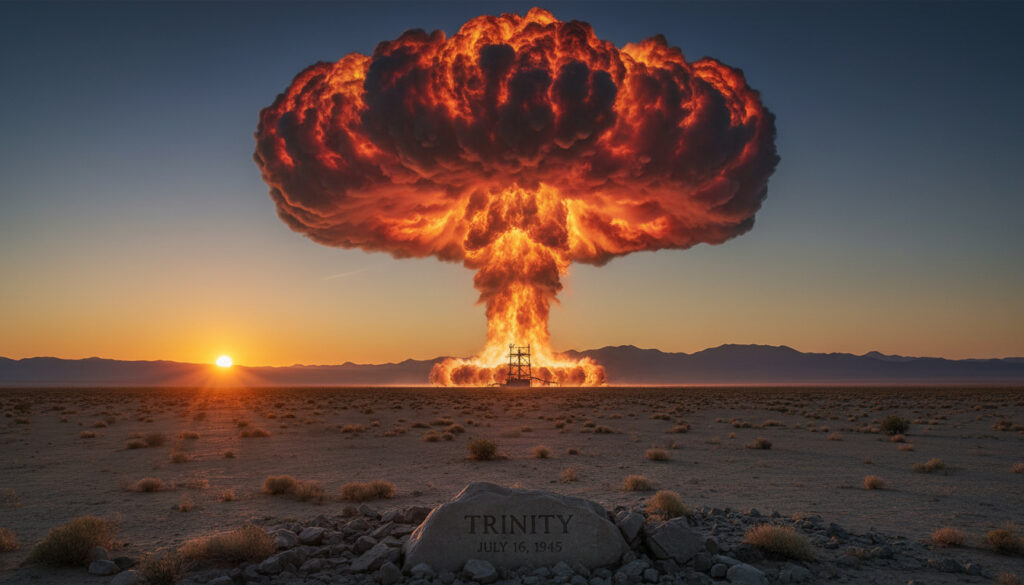
The film depicts verified historical events. Oppenheimer indeed led the Manhattan Project from 1942 to 1946, assembling scientists at Los Alamos, New Mexico. The Trinity test succeeded on July 16, 1945, followed by the bombings of Hiroshima and Nagasaki that ended World War II. Historical records confirm these foundational facts, while Britannica notes the film accurately portrays Oppenheimer’s Berkeley-era radicalism, though he was never an actual Communist Party member.
Dramatization vs. Documentary Reality
Nolan condenses certain timelines and dramatizes specific interactions for narrative cohesion. The feud with Lewis Strauss, while rooted in real clashes over hydrogen bomb development and isotope exports, receives compressed framing. Digital Spy notes that the specific Einstein conversation framing the narrative represents creative license, though the underlying scientific and political tensions remain historically grounded.
Nolan adapted the screenplay from Kai Bird and Martin Sherwin’s biography, emphasizing Oppenheimer’s quantum physics work and personal struggles while maintaining fidelity to the historical record of his security hearing.
Who Stars in Oppenheimer?
Cillian Murphy’s Transformation
Cillian Murphy anchors the film as J. Robert Oppenheimer, portraying the physicist’s evolution from theoretical scholar to conflicted architect of nuclear weapons. His performance earned the Academy Award for Best Actor.
The Supporting Cast
Emily Blunt appears as Kitty Oppenheimer, the biologist and Communist Party member who married the physicist in 1940. Matt Damon portrays General Leslie Groves, the military director of the Manhattan Project who recruited Oppenheimer despite his leftist associations. Robert Downey Jr. plays Lewis Strauss, chairman of the Atomic Energy Commission whose vendetta drives the film’s postwar tension. Toronto Film School notes the casting effectively captures the era’s political paranoia.
Florence Pugh appears as Jean Tatlock, Oppenheimer’s lover and Communist sympathizer whose 1944 suicide the film depicts accurately. Supporting roles include Josh Hartnett, Casey Affleck, Rami Malek, and Gary Oldman as President Harry S. Truman. Tom Conti portrays Albert Einstein.
What Happens at the End of Oppenheimer?
The Security Revocation of 1954
Following the war, Oppenheimer’s opposition to hydrogen bomb development and his past Communist associations alienated Washington leadership. The film depicts his 1954 security clearance hearing, where Lewis Strauss orchestrated the revocation of Oppenheimer’s Q-clearance amid McCarthy-era scrutiny. Digital Spy explains this hearing stripped him of classified access, effectively ending his government advisory role.
The 1959 Confirmation and Einstein Conversation
The narrative reveals Strauss’s 1959 Senate confirmation hearing for Commerce Secretary, where scientists exposed his personal vendetta against Oppenheimer, resulting in failed confirmation. A flashback clarifies Oppenheimer’s Princeton conversation with Albert Einstein, where he warned that the bomb had ignited an unstoppable nuclear arms race. Analysis confirms the final vision of worldwide atmospheric detonations represents metaphorical dread regarding nuclear proliferation rather than actual scientific prediction.
The film’s final sequence depicts imagined worldwide detonations representing fears of nuclear proliferation, not a literal scientific chain reaction capable of destroying Earth’s atmosphere.
Nolan employs color sequences for Oppenheimer’s subjective psychological experience and black-and-white for objective external perspectives, particularly during Strauss’s testimony sequences.
When Did the Real Events Behind Oppenheimer Take Place?
- : U.S. Army initiates the Manhattan Project; Colonel Leslie Groves recruits Oppenheimer as scientific director
- : The Trinity test successfully detonates the first atomic bomb in the New Mexico desert
- : Atomic bombs dropped on Hiroshima and Nagasaki, ending World War II
- : Jean Tatlock dies by suicide, depicted through flashback sequences
- : The Atomic Energy Commission conducts security hearings revoking Oppenheimer’s clearance
- : The Senate rejects Lewis Strauss’s nomination as Commerce Secretary
What Is Fact and What Is Fiction in Oppenheimer?
Established Facts
- The Manhattan Project existed from 1942-1946 under Oppenheimer’s leadership
- The Trinity test occurred on July 16, 1945
- Oppenheimer lost his security clearance in 1954
- He associated with Communist circles but never joined the CPUSA
- Jean Tatlock died in 1944
- Strauss clashed with Oppenheimer over hydrogen bombs
Dramatized Elements
- Specific dialogue at Los Alamos is dramatized
- The Strauss vendetta’s personal motivations are condensed
- The Einstein conversation framing represents artistic license
- Timeline compression for narrative flow
- Specific hallucination sequences visualize internal psychology
Why Did Oppenheimer Become a Controversial Figure?
Oppenheimer’s postwar stance against nuclear proliferation and his prewar associations with leftist causes collided with McCarthy-era politics. His opposition to the hydrogen bomb program alienated military and political leaders, including President Truman. Thematic analysis suggests the film portrays how scientific objectivity became entangled with loyalty tests and personal vendettas.
The film sparked debate regarding its Euro-American focus, with critics noting the underrepresentation of Hiroshima and Nagasaki victims’ perspectives. Meanwhile, those seeking different entertainment options might explore the Sky Princess Cruise Ship – Specs, Amenities and Itineraries.
What Sources Did Christopher Nolan Use for Oppenheimer?
Nolan aimed to connect Oppenheimer’s life to quantum themes and portray his Communist sympathies candidly, which impacted his fate.
How Does Oppenheimer Conclude Its Historical Epic?
The film ultimately positions Oppenheimer as a tragic figure whose scientific brilliance enabled a weapon that outpaced ethical frameworks, leaving him stripped of influence yet vindicated by history as a voice of restraint against nuclear proliferation. His personal destruction mirrors the larger existential threat created by his discovery. For additional viewing recommendations, see the Pirates of the Caribbean in Order – Complete Watch Guide.
Frequently Asked Questions
What is Oppenheimer rated?
The film carries an R rating for some sexuality, nudity, and language.
How long is the Oppenheimer movie?
The runtime is 180 minutes, or three hours.
When was Oppenheimer released?
The theatrical release date was July 21, 2023.
Does Oppenheimer have an IMAX release?
Yes, Christopher Nolan emphasized the IMAX 70mm format for immersive bomb visuals.
What book is Oppenheimer based on?
The screenplay adapts the biography American Prometheus by Kai Bird and Martin Sherwin.
What is Barbenheimer?
The term refers to the internet phenomenon where audiences watched Oppenheimer and Barbie on the same day as a double feature experience.
More related posts
 Frank Sinatra Biography: Life, Death, and Relationships
 Falklands War: Causes, Casualties, and Outcome
 Drew McIntyre: Suspension, Career, and 2024 News
 MacKenzie Scott: Net Worth, Philanthropy & Divorce
 Sarah Beeny 2025: Net Worth, Career, Husband, and Cancer Update
 Safe (TV Series): Worth Watching? Episodes, Reviews & Plot
 Nathan Fillion Biography: Health, Relationships, Career