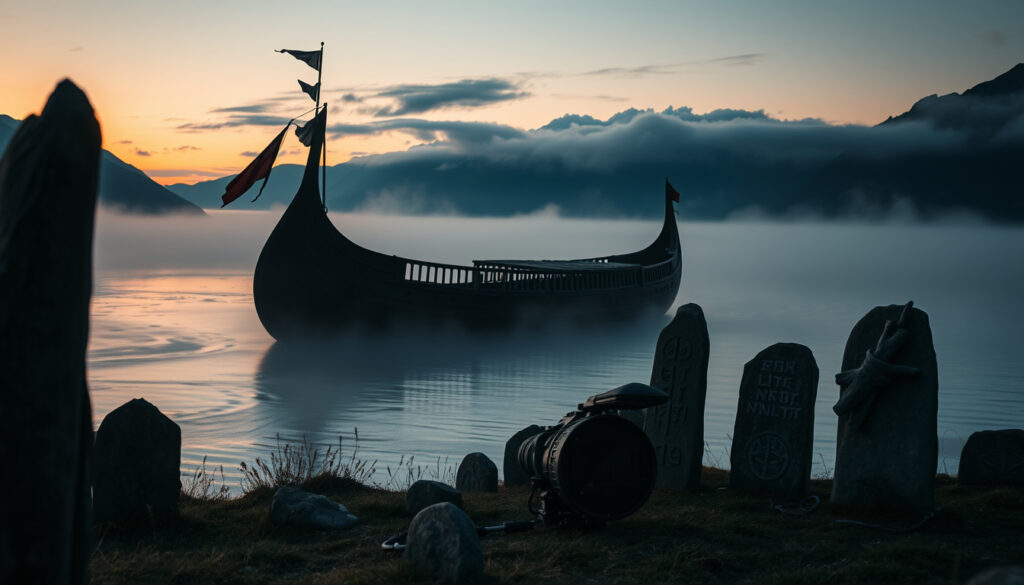
Ragnar Lothbrok: Real Viking, Legend, or TV Character
No contemporary 9th-century chronicle names Ragnar Lothbrok, leaving scholars to sift through legend and television fiction. Most of what we think we know comes from medieval Icelandic sagas written centuries after the 9th-century raids they describe.
Century of activity: 9th century AD ·
Number of sons in legend: at least 4 ·
Mentioned in sagas: Ragnarssona þáttr, Tale of Ragnar’s Sons ·
TV series episodes: 4 seasons (Season 1–4) ·
Primary source type: medieval Icelandic sagas
Quick snapshot
- Ragnar appears in 13th-century Icelandic sagas (Encyclopaedia Britannica (reference work))
- No contemporary record names him as a historical person (Grimfrost (historical retailer))
- Whether a single historical Ragnar ever existed
- Exact number of wives (legends vary between 2 and 3)
- Accuracy of bloodline descent claims
- 9th century: Viking raids linked to composite figure
- c. 1200: Earliest saga text written
- 2013–2016: TV series popularises Ragnar character
- Continued scholarly debate on legendary vs historical
- New archaeological findings may provide further context
Five key facts, one pattern: the earliest written testimony for Ragnar comes from saga manuscripts, not from annals of his own era.
| Attribute | Value |
|---|---|
| Earliest written mention | 12th–13th century Icelandic sagas |
| Number of known wives in legend | 2 (Lagertha, Aslaug) |
| Famous sons in saga | Ivar, Björn, Hvitserk, Sigurd, Ubba |
| Death in legend | Thrown into a pit of snakes by King Ælla |
| TV debut | History Channel’s Vikings (2013) |
Was Ragnar Lothbrok a real Viking?
What the 9th-century chronicles say
- No contemporary chronicle from England, Francia, or Scandinavia names “Ragnar Lothbrok” as a known individual. The Encyclopaedia Britannica (reference work) describes him as a Danish king and Viking warrior who flourished in the 9th century, but notes the person is “known chiefly through medieval tales”.
- The character likely composites several historical Viking leaders active in the 860s, including those who led the Great Heathen Army that invaded East Anglia (Historic UK (history publication)).
- The name “Lothbrok” itself may be a later nickname meaning “Hairy-Breeches” or a similar descriptor — no 9th-century record uses it.
The implication: the name is absent from every primary source of his supposed lifetime. What we call Ragnar Lothbrok is a literary persona, not a documentary file.
The legendary sagas and their invention
- The earliest written accounts come from Iceland in the 13th century — roughly 400 years after the events they claim to describe. The Wikipedia (user‑edited encyclopedia) characterises him as a Viking hero from Old Norse poetry and sagas, which are literary rather than documentary sources.
- The sagas portray Ragnar as the son of King Sigurd Hring, a Swedish and Danish ruler, and build a full biography including raids and a dramatic death in a snake pit (History Hit (history media outlet)).
- Historic UK notes that the legend likely built upon the reputation of a real raider, but that the surviving narrative is a blend of memory and invention.
What this means: we have a fully formed medieval fiction written centuries later, not a historical biography. The line between fact and lore is deliberately blurred by the saga authors themselves.
How many wives did Ragnar have?
Lagertha: the first wife
- In the saga tradition, Ragnar’s first wife is the shieldmaiden Lagertha. Their union is part of the legendary cycle, with Lagertha bearing him several children according to some versions. No external historical source corroborates her existence.
Aslaug: the second wife
- According to Historic UK (history publication), Ragnar had three wives in legend, with Aslaug as the third. Other accounts (such as the Tale of Ragnar’s Sons) mention only two. Aslaug is said to have born Ivar the Boneless and Bjorn Ironside.
- The number varies by saga version — some traditions also mention a daughter or additional partners, but the core in later popular culture is Lagertha and Aslaug.
Other legendary unions
- A few later Scandinavian chronicles, like Saxo Grammaticus’ Gesta Danorum (13th century), mention a different set of wives and children, further complicating the count. The inconsistency is a hallmark of oral legend, not a stable genealogical record.
The pattern: wives multiply across retellings. What starts as one or two partners in early sagas grows to three in later works. There is no consensus because there is no primary evidence.
Does the bloodline of Ragnar Lothbrok exist?
Claims of descent in medieval Europe
- Several medieval European noble families, including the House of Munsö in Sweden and various English earls, claimed lineage from Ragnar’s sons — particularly Björn Ironside and Ivar the Boneless. These genealogies appear in later chronicles and were politically useful.
- History Hit notes that the Ragnar narrative is one of the best‑known Viking legends, but that genealogical certainty is not established by any primary documentation.
Modern genetic speculation
- Some modern Y‑chromosome studies have attempted to trace Viking‑age lineages, but they rely on broad regional patterns rather than any documented connection to a specific individual. As Grimfrost (historical retailer) points out, the name Ragnar Lothbrok does not appear in the major historical sources that do exist for the period.
- No verified genealogical line can be proven. The historical record is too thin and the legendary embellishments too thick.
The trade‑off: claiming descent from a semi‑legendary figure was common among medieval aristocrats, but no family today can produce a credible paper trail to Ragnar Lothbrok. The bloodline exists only in the pages of saga manuscripts.
Why was Ragnar removed from Vikings?
Plot reasons in the TV series
- The television character Ragnar, played by Travis Fimmel, died in Season 4 as a planned narrative arc. The show’s creator, Michael Hirst, intended the death to shift focus to Ragnar’s sons, mirroring the saga’s own structure after the father’s demise.
- The death scene in the snake pit is drawn directly from the legend, though the TV version adds dramatic dialogue and character beats not present in the sagas. As IMDb (film database) states, the story centres on Ubbe Lothbrok recounting the legend of his father.
Travis Fimmel’s departure
- The actor chose to leave the show after four seasons, a decision that dovetailed with the narrative plan. No behind‑the‑scenes conflict was publicised; Fimmel has said in interviews that he felt the character’s arc was complete.
- The departure reshaped the series, which continued for two more seasons focusing on the sons. The Britannica entry notes that the TV portrayal popularised Ragnar as a farmer‑turned‑king, a storyline that is not historically documented.
Why this matters: Ragnar’s removal was both a creative and business decision. The show used the legendary death as a pivot point, and the actor’s choice aligned with a narrative that had exhausted its original protagonist.
Who was the most brutal Viking?
Reputation of Ragnar’s sons
- Among Ragnar’s sons, Ivar the Boneless is most often singled out for ruthlessness. Sagas describe him as a vicious leader who employed extreme tactics in battle and in punishment.
- Historic UK treats Ivar and Björn Ironside as semi‑historical figures, meaning their reputations are coloured by saga exaggeration.
Ivar the Boneless’ brutality
- The label “most brutal” is subjective and based on saga accounts that aim to glorify or vilify. In some sources, Ivar is portrayed as a ruthless strategist; in others, as a crippled schemer. No single Viking can be historically verified as the most brutal — the question itself reflects popular fascination more than scholarly consensus.
- Other Viking leaders such as Erik Bloodaxe or Harald Hardrada also have claims to the title, but they fall outside the Ragnar legend proper.
The catch: brutality ratings are a function of surviving texts and modern media, not objective metrics. The question is better aimed at understanding why a particular figure captures the cultural imagination.
The label “most brutal” attaches most often to Ivar the Boneless because his saga reputation is the most colourfully violent. But that reputation serves a literary purpose — it makes him a memorable antagonist. For anyone researching Viking history, the lesson is to treat each claim as a product of its source.
Timeline
- 9th century: Historical Viking raids on England and France attributed to leaders later conflated as Ragnar (Britannica links the legend to the 865 invasion of East Anglia).
- c. 1200: Ragnarssona þáttr (Tale of Ragnar’s Sons) written in Iceland.
- 13th century: Gesta Danorum by Saxo Grammaticus includes a version of Ragnar’s life.
- 2013–2016: TV series Vikings airs with Ragnar as the main character for four seasons.
- 2026: Britannica entry updated (source date from SERP).
The gap between the 9th‑century events and the 13th‑century sagas is four hundred years — as far back for the saga writers as the Elizabethan era is for us. That distance is where legend was woven into story, and where the historical Ragnar became a lost figure.
The implication: the four-century gap makes it impossible to separate fact from legend with any certainty.
Clarity section
Confirmed facts
- Ragnar Lothbrok appears in medieval Icelandic sagas written from the 13th century onward (Encyclopaedia Britannica).
- The TV series ended his character in Season 4 (planned narrative arc).
- Björn Ironside is a figure in both saga and some historical records (annals mention a Viking leader named Björn).
- The legendary tradition places Ragnar’s death in a snake pit — a famous story element, not a confirmed death record (History Hit).
What’s unclear
- Whether a single historical person named Ragnar Lothbrok ever existed.
- Exact number of wives (legendary sources differ).
- Accuracy of bloodline descent claims made by medieval noble families.
- Whether the legendary Ragnar was a real king or a composite of several raiders.
What remains certain is that the legend of Ragnar Lothbrok has outlived any historical figure it may have been based on.
Perspectives from historians
Ragnar is described as a semi-legendary sea king — his life passed into legend so thoroughly that few facts survive.
— History Hit (history media outlet)
Ragnar Lothbrok flourished in the 9th century, but his story is so interwoven with legend that separating fact from fiction is nearly impossible.
— Encyclopaedia Britannica (reference work)
The legend likely built upon the reputation of a real raider, but the surviving narrative is a blend of memory and invention.
— Historic UK (history publication)
The common thread across these sources: everyone agrees the figure is a legend, but experts differ on whether a real man lies underneath. For the reader trying to decide, the safest conclusion is that the name “Ragnar Lothbrok” is a label we give to a bundle of stories — not a single historical biography.
youtube.com, youtube.com, facebook.com, goodreads.com, reddit.com, reddit.com, raportinfo.pl
The article explores who Ragnar Lothbrok really was, and for those seeking a deeper dive into the historical truth about Ragnar Lothbrok, this piece separates fact from fiction in the sagas.
Frequently asked questions
Did Ragnar Lothbrok have any daughters?
Legendary accounts occasionally mention daughters, but the primary saga tradition focuses on his sons. No daughter is consistently named across sources.
What is the meaning of Lothbrok?
The name “Lothbrok” or “Loðbrók” is Old Norse for “Hairy‑Breeches” or “Shaggy‑Breeches”, a nickname of unclear origin — possibly a reference to a piece of clothing or a battle trophy.
Where did Ragnar Lothbrok live?
In the legends, he is portrayed as a king of Denmark and Sweden. No archaeological evidence pins down a specific residence.
Did Ragnar Lothbrok fight in the Battle of Hastings?
No. The Battle of Hastings occurred in 1066, well after the 9th‑century period associated with his legend.
Is Ragnar Lothbrok related to the Vikings TV show characters?
The TV show uses the legendary figure as its basis, but the relationships and events are heavily fictionalised. The show is not a documentary account.
How tall was Ragnar Lothbrok?
No physical description from the sagas gives a precise height. In the TV series, actor Travis Fimmel is 1.82 m (6′0″), but that is a casting choice, not history.
Which actors played Ragnar Lothbrok?
Travis Fimmel portrayed Ragnar in the History Channel series Vikings (2013–2016). Other actors have voiced him in video games and documentaries.
For the reader trying to separate the warrior from the myth, one thing is clear: the story of Ragnar Lothbrok tells us more about the people who told it than about any single Viking chieftain. Whether the name belongs to a real man or a literary invention, its power lies in the centuries of retelling — and the modern audiences who still want to know if he was real. The question itself is a reminder that history and legend are not always opposites; sometimes they are the same story told by different sources.
More related posts
 Jane Seymour: The Queen and the Actress – Myths vs Facts
 Linda Hogan: Life After Hulk Hogan, Divorce, and Current Life
 Billy Joel: Health, Marriages, Fortune, and Music
 Simon MacCorkindale: Death, Wife and Career Facts
 Marian Keyes Books in Order: Which One Should You Start With
 John Wick 5 Coming? Everything You Need to Know About the Franchise
 Matt Damon: Biography, Family, and the Movie That Broke Him
 KT Tunstall: Biography, Partner, Net Worth & Chinese Heritage