I Saw the TV Glow – Plot Cast Ending Explained
I Saw the TV Glow arrives as a 2024 psychological horror drama that immediately distinguished itself at the Sundance Film Festival before securing a national release through A24 on May 17, 2024. Directed by Jane Schoenbrun, the film constructs a surreal narrative around two troubled teenagers who find solace in a mysterious late-night television series, only to confront blurred boundaries between fiction and reality as their lives diverge across decades.
Justice Smith and Brigette Lundy-Paine anchor the central performances as Owen and Maddy, high school outsiders from difficult home environments who bond over their obsession with The Pink Opaque. The narrative tracks not merely their adolescent connection but the lasting psychological impact of media consumption, isolation, and the courage required to embrace authentic identity.
Schoenbrun, working from an original screenplay that attracted producers Emma Stone and Dave McCary in 2021, employs horror and surrealism to examine how suburban isolation intersects with questions of gender identity and self-discovery. The film represents a significant achievement as an A24 production offering substantial creative control to an openly transgender filmmaker working within the mainstream horror genre.
What Is I Saw the TV Glow About?
Jane Schoenbrun
Justice Smith, Brigette Lundy-Paine
May 17, 2024 (A24)
Psychological Horror Drama
- Critically acclaimed as a breakout hit at the 2024 Sundance Film Festival
- Explores transgender identity and the psychological impact of media obsession
- A24 production marking unprecedented creative control for an openly trans filmmaker
- Features a 1990s aesthetic inspired by Buffy the Vampire Slayer
- Produced by Emma Stone and Dave McCary under their Fruit Tree banner
- Follows suburban isolation across decades with surreal, reality-bending sequences
- Based on an original screenplay that circulated among six production companies before A24 attachment
| Attribute | Details |
|---|---|
| Runtime | 101 minutes |
| Rating | PG-13 |
| Premiere | Sundance Film Festival 2024 |
| Distributor | A24 |
| Director/Writer | Jane Schoenbrun |
| Producers | Emma Stone, Dave McCary |
| Production Company | Fruit Tree |
| Based On | Original screenplay |
| Country | United States |
| Language | English |
Who Stars in I Saw the TV Glow?
Justice Smith portrays Owen for the majority of the film, capturing the character’s transformation from hesitant teenager to isolated adult working in an arcade. Ian Foreman appears as the younger Owen during the film’s opening sequences. Brigette Lundy-Paine delivers a pivotal performance as Maddy, whose sudden disappearance catalyzes the narrative’s examination of abandonment and self-realization.
The ensemble features Helena Howard, Lindsey Jordan, Conner O’Malley, Emma Portner, and Danielle Deadwyler in supporting roles. Fred Durst appears in a notable casting choice that reinforces the film’s 1990s cultural landscape. The casting deliberately bridges generations, with younger performers embodying the past and established actors populating Owen’s fragmented present.
Understanding the film’s exploration of identity benefits from familiarity with What Is Non Binary – Meaning, Pronouns, Flag and History, given the production’s significant transgender creative leadership and thematic concerns.
Is I Saw the TV Glow Scary?
The film operates within psychological horror parameters rather than relying on conventional jump scares or graphic violence. Schoenbrun constructs dread through atmospheric unease, the dissolution of reality, and the amplification of existential isolation. The horror emerges from emotional suppression and the terror of recognizing one’s authentic self too late, not from supernatural threat in the traditional sense.
Director Jane Schoenbrun describes their work not as straight-up horror but rather as films about the love of horror and genre cinema. The director characterizes horror specifically as “a controlled chaos” and “a safe place where the world could be a little different than what everyone else agreed it had to be.” Source
Critical reception acknowledges the film’s unsettling qualities while noting its accessibility. Paste Magazine characterized the work as “a really easy film to want to root for,” praising the atmospheric dread while recognizing that some viewers might find the metaphorical approach sacrifices narrative substance for symbolic resonance. Source
What Is the Ending of I Saw the TV Glow?
The narrative culminates decades after the central friendship dissolves, with Owen working in an arcade while maintaining his isolation. The reality-bending elements that began as subtle “pink shimmer” at the edges of scenes escalate into full psychological fragmentation. In the climactic sequence set in an arcade party room, Owen experiences a complete break from consensus reality, screaming out desperation while surrounding party-goers remain frozen and unaware of his distress.
The film’s most iconic image arrives when Owen cuts through his own skin to reveal a glowing television inside his chest. The moment carries no blood and functions purely as metaphor. This visual represents the fundamental tension between internal identity and external presentation, with the television’s glow symbolizing both inner beauty and the loss of authentic self through media consumption and denial. Source
The reality-bending sequences throughout the finale communicate inner emotional reality rather than literal supernatural events. These moments express the existential struggle to live on one’s own terms, with the boundaries between suburban existence and television fiction evaporating to reveal the protagonist’s authentic psychological state. Source
Maddy’s return after years of absence forces Owen to confront the choice he failed to make in adolescence. The ending refuses definitive resolution, instead offering a meditation on the cost of remaining in spaces that deny one’s fundamental identity, and the possibility of liberation through self-recognition.
When Was I Saw the TV Glow Produced and Released?
- : A24 announces production with Jane Schoenbrun directing; Emma Stone and Dave McCary attach immediately after the script captivates them during initial readings. Source
- : The screenplay circulates among six potential production partners before securing final backing under the Fruit Tree banner. Source
- : World premiere at Sundance Film Festival as a breakout entry, generating immediate critical attention for its formal daring and thematic depth. Source
- : Schoenbrun receives the Coolidge Breakthrough Artist Award at Boston’s Coolidge Corner Theatre during a special screening event. Source
- : National theatrical release through A24 across the United States. Source
Is I Saw the TV Glow Based on a True Story?
Established Information
- Fictional narrative based on original screenplay by Jane Schoenbrun
- Not adapted from real events, true crime, or existing literary properties
- The Pink Opaque explicitly modeled on Buffy the Vampire Slayer, which helped Schoenbrun survive adolescence
- Title borrowed from The Cocteau Twins during scripting, never replaced
- Script developed independently before 2021 production attachment
What Remains Unclear
- Specific streaming platform windows and international availability expiration dates
- Exact budget figures and complete box office returns
- Whether secondary characters represent composites of specific real individuals
- Precise viewership data from streaming vs. theatrical exhibition
What Themes Does I Saw the TV Glow Explore?
Themes of Identity and Transness
The film operates as an explicit exploration of transgender identity and self-discovery. According to The AV Club, Owen’s narrative arc demonstrates “what happens to a trans person when the world makes the prospect of transitioning too terrifying to ever look at straight-on.” The characters Owen and Maddy represent pre- and post-realization stages of gender identity, directly mirroring director Schoenbrun’s own journey. Source
Horror Through Nostalgia
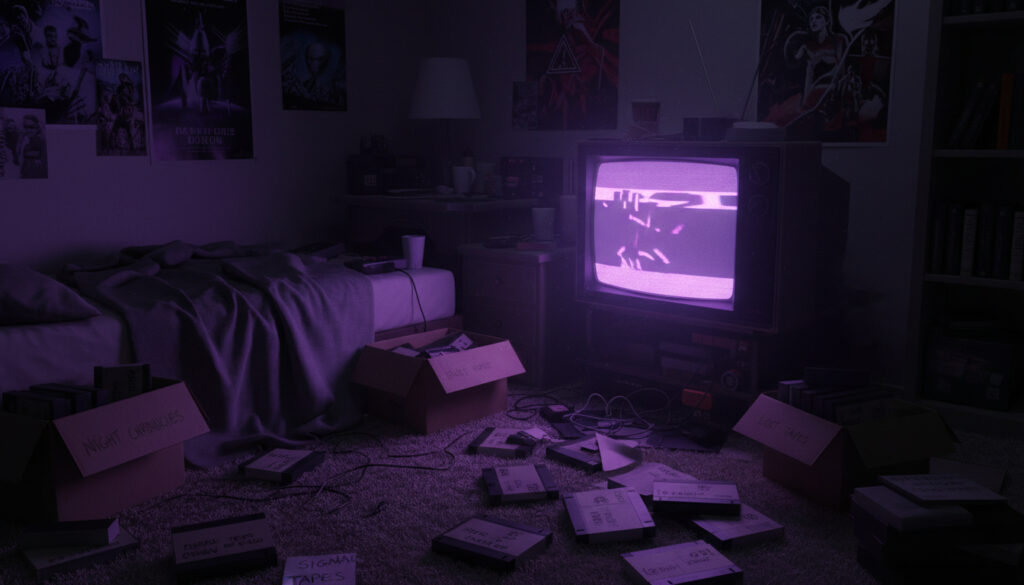
Schoenbrun examines how media perception shifts as individuals mature, using the fictional show The Pink Opaque to represent childhood buffers against dysphoria and shame. Growing up as “a child of suburbia and video stores of the 1990s,” the director filters horror through the specific aesthetic of late-night television and VHS culture. The horror emerges not from supernatural threat but from the dissolution of protective fictions and the confrontation with authentic selfhood.
Cultural Impact and Reception
Critics have recognized the film as marking a watershed moment for transgender filmmakers in mainstream horror. Paste Magazine noted Schoenbrun received “an almost unprecedented amount of creative control for an openly transgender filmmaker on a major platform,” while acknowledging that some viewers found the metaphorical approach could have achieved greater narrative substance. Source
What Have Critics and the Director Said About I Saw the TV Glow?
“I think it will always be the case that my work will be inspired by whatever journey I’m on in my life, which is not uncommon for an artist. But I’m trying to interrogate it in real-time. I’m excited to [now] make work about becoming yourself.”
— Jane Schoenbrun, Director
“What happens to a trans person when the world makes the prospect of transitioning too terrifying to ever look at straight-on.”
— The AV Club (thematic characterization)
“A really easy film to want to root for… given an almost unprecedented amount of creative control for an openly transgender filmmaker on a major platform.”
— Paste Magazine
Final Take on I Saw the TV Glow
I Saw the TV Glow succeeds as a formally adventurous examination of identity suppression and the media we use to construct alternate realities for ourselves. Through Owen’s decades-spanning isolation and the film’s unforgettable imagery of internalized light, Schoenbrun creates cinema that functions simultaneously as psychological horror and intimate memoir. For audiences interested in how contemporary filmmakers adapt historical approaches to sensitive autobiographical material, the film offers a necessary counterpoint to works like What Is Oppenheimer About – Plot Cast True Story Facts, demonstrating how surrealist techniques can illuminate truths that traditional narrative realism obscures.
Frequently Asked Questions
Where can I watch I Saw the TV Glow?
The film received theatrical release through A24 on May 17, 2024. Streaming availability continues rolling out across major platforms, though specific regional availability varies by distribution agreement.
Is I Saw the TV Glow based on a book?
No. The film is based on an original screenplay written by Jane Schoenbrun. While the fictional television show The Pink Opaque within the film draws inspiration from Buffy the Vampire Slayer, the narrative itself is not adapted from existing literature.
How long is I Saw the TV Glow?
The film has a runtime of 101 minutes and carries a PG-13 rating for thematic elements, brief violent imagery, and suggestive material.
What is The Pink Opaque?
The Pink Opaque is a fictional late-night television series within the film, modeled on Buffy the Vampire Slayer. The title was borrowed from The Cocteau Twins. It serves as the bonding element between protagonists Owen and Maddy.
Will there be a sequel to I Saw the TV Glow?
No sequel has been announced. Schoenbrun has indicated plans for a third feature film exploring “coming into yourself in a post-transition realm,” along with a long-form fantasy epic, but neither project continues the I Saw the TV Glow narrative.
Is the film appropriate for children?
The PG-13 rating suggests parental guidance. While the film avoids graphic gore, its psychological intensity, themes of isolation, and exploration of gender dysphoria may prove distressing for younger viewers without proper context.
When did production begin?
The project was announced in October 2021 after the script attracted Emma Stone and Dave McCary. Principal photography and post-production occurred between 2022 and early 2024.
More related posts
 Green and Blacks Chocolate – Organic Fairtrade Pioneer
 Slieve Donard Hiking Guide: Height, Routes, Difficulty
 Jack Wilshere: Career, Retirement, Net Worth & Current Role
 Pizza Place Near Me: Ireland Delivery & Takeaway Guide
 Kayvan Novak: Biography, Ethnicity, Career & Updates
 Amber Davies: From Love Island to West End Stardom
 Max Mayfield Explained: Age, Relationships, and Vecna’s Target
 Emily Fairn Biography: Age, Career, and Key Film Roles