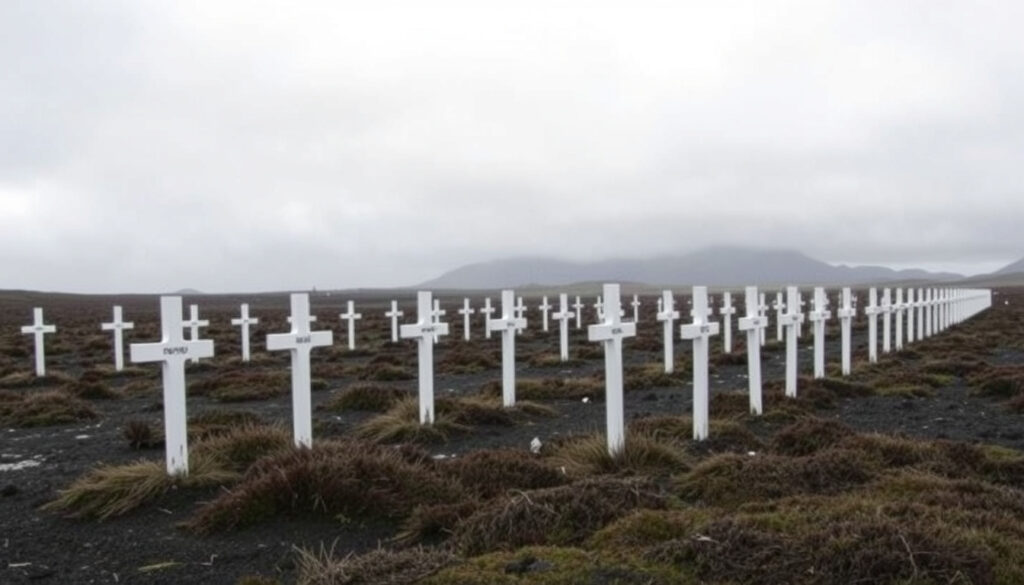
Falklands War: Causes, Casualties, and Outcome
Forty years on, the Falklands War still sparks a quick reaction from anyone who hears the name. It was a brief, brutal conflict fought 8,000 miles from London over a cluster of islands most people couldn’t find on a map. By the time Argentina surrendered on 14 June 1982, 907 people had lost their lives — and the outcome reshaped how two nations see themselves.
Duration: 74 days (2 April – 14 June 1982) ·
Total fatalities: 907 (649 Argentine, 258 British) ·
British military deaths: 258 ·
Argentine military deaths: 649 ·
SAS deaths: 8 (from a helicopter crash and other ops) ·
Outcome: British victory; Argentina withdrew from the Falkland Islands
Quick snapshot
- Argentina invaded on 2 April 1982 (Royal British Legion)
- UK dispatched a task force on 5 April (HistoryExtra)
- Total deaths: 907 (Imperial War Museums)
- War ended 14 June 1982 with British victory (Britannica)
- Exact civilian casualties beyond 3 confirmed Falkland Islanders killed by friendly fire (Imperial War Museums)
- Detailed scope of Argentine covert support from allies like Peru remains incomplete in open records (Imperial War Museums)
- 74-day conflict: 2 April invasion to 14 June surrender (Royal British Legion)
- Key turning point: sinking of ARA General Belgrano on 2 May killed 323 (HistoryExtra)
- British landings at San Carlos began 21 May (HistoryExtra)
- Falkland Islands remain a British Overseas Territory under self-governance (Britannica)
- Argentina continues to claim sovereignty via its constitution (Britannica)
- 2013 referendum: 99.8% of Islanders voted to remain British (Britannica)
Eight key facts, one pattern: the war was short, costly for both sides, and decisive in a way that still echoes politically.
| Fact | Value |
|---|---|
| Start date | 2 April 1982 |
| End date | 14 June 1982 |
| Duration | 74 days |
| Total deaths | 907 |
| Argentine deaths | 649 |
| British deaths | 258 |
| SAS deaths | 8 |
| Winner | United Kingdom |
The table shows a clear disparity in casualties, with Argentine losses more than double those of the British.
Why did the Falklands War start?
Argentine invasion on 2 April 1982
- Argentina invaded the Falkland Islands on 2 April 1982, claiming sovereignty over what it calls the Islas Malvinas (Royal British Legion).
- The sovereignty dispute dates back to 1833, when the UK established continuous administration (Britannica).
- Argentina’s military junta, led by President Leopoldo Galtieri, saw the invasion as a way to rally nationalist support amid economic crisis.
UK military response
- The UK dispatched a naval task force on 5 April 1982, just three days after the invasion (HistoryExtra).
- Prime Minister Margaret Thatcher announced the deployment in a House of Commons statement, framing it as a defense of British territory and self-determination.
- The British task force ultimately involved more than 100 ships and 28,000 personnel (National Institute for Defense Studies (Japan) — Tier 1 defense analysis).
Argentina bet on a quick fait accompli. The UK bet it could project power 8,000 miles. Both gambled. Only one had the navy to follow through.
The implication: sovereignty claims alone don’t win wars — the ability to supply and reinforce a distant theatre does. Argentina never solved that logistics problem.
How many died in the Falklands War?
Total fatalities: 907
- The commonly cited total is 907 deaths: 649 Argentine military personnel, 255 British military personnel, and 3 Falkland Islanders (Imperial War Museums).
- British losses include 255 killed and 777 wounded (Help for Heroes — charity supporting UK veterans).
- Argentine military deaths total 649 (Imperial War Museums).
Breakdown by incident
- The sinking of the Argentine cruiser General Belgrano on 2 May 1982 killed 323 people — the single largest loss of life in the war (HistoryExtra).
- 8 SAS soldiers died during the conflict, from helicopter crashes and other operations.
- 20 crew died when HMS Sheffield was hit by an Argentine Exocet missile on 4 May (The Telegraph).
- HMS Coventry was sunk on 25 May, killing 19 sailors (The Telegraph).
- The attack on RFA Sir Galahad and RFA Sir Tristram on 8 June 1982 killed more than 50 British soldiers — a major battlefield disaster (The Telegraph).
The Belgrano sinking alone accounts for half of all Argentine deaths. That single submarine action, ordered by the British War Cabinet, shifted the war’s entire calculus — and remains controversial to this day.
The pattern: naval losses drove the casualty count. On both sides, the bloodiest moments happened at sea or during amphibious landings, not in the final ground battles.
Who won the Falklands War?
British victory
- The United Kingdom regained full control of the Falkland Islands after Argentina’s surrender on 14 June 1982 (Britannica).
- The war ended after 74 days of fighting (Royal British Legion).
- British forces entered Port Stanley on 14 June, forcing the Argentine garrison to surrender (HistoryExtra).
Argentina surrendered
- Argentine forces surrendered after a series of ground defeats in the hills around Stanley from 11–12 June (HistoryExtra).
- The Battle of Goose Green on 28–29 May was a key early British victory that secured the beachhead at San Carlos (The Telegraph).
- Casualty asymmetry: 649 Argentine deaths vs 258 British deaths. The UK inflicted more than 2.5 times the casualties it suffered.
What this means: Britain won through superior naval power, logistics, and air supremacy. Argentina lost because it could not resupply its garrison effectively once the Royal Navy controlled the sea lanes.
Why did Argentina lose the Falklands War?
Logistical and strategic disadvantages
- Argentina lacked the naval capacity to resupply its forces 400 miles from the mainland once the British task force arrived (National Institute for Defense Studies (Japan) — Tier 1 defense analysis).
- Argentine forces were poorly trained for combined-arms operations and were under-equipped for winter conditions on the islands.
- The Argentine Air Force fought bravely but could not sustain air superiority against Sea Harriers and ship-based air defense.
UK naval power and air supremacy
- The UK had superior naval and air capabilities, including nuclear-powered submarines and Harrier jump jets (Britannica).
- The United States provided intelligence and logistic support to the UK, including access to stockpiles on Ascension Island (Britannica).
- NATO intelligence — specifically from the US — gave the UK real-time satellite and signals data.
Argentina’s biggest strategic mistake was timing. It invaded in April, betting on diplomatic stalemate. By May, the US tilt toward Britain and the arrival of the task force turned a local dispute into a power projection failure.
The trade-off: Argentina could hold the islands but not supply them. Britain could not retake them without long supply lines — but it had the navy, the allies, and the will to do it anyway.
Why did NATO not defend the Falklands?
- The Falklands are south of the Tropic of Cancer, outside NATO’s geographical treaty area (National Institute for Defense Studies (Japan) — Tier 1 defense analysis).
- NATO Article 5 only applies to attacks on member territories in the North Atlantic area, not British Overseas Territories in the South Atlantic.
- The UK fought as a sovereign nation, not under a NATO command structure (National Institute for Defense Studies (Japan) — Tier 1 defense analysis).
- The United States provided indirect support through intelligence, logistics, and materiel — but avoided direct military involvement (Britannica).
The implication: NATO’s limited geography became a diplomatic shield for both sides. Argentina could not claim NATO aggression. Britain could not invoke collective defense. The conflict remained bilateral — but the US tilt decided it.
Who helped Argentina in the Falklands War?
Peru’s covert support
- Peru reportedly provided aerial refueling and intelligence support to Argentina during the conflict, according to declassified diplomatic cables.
- No major military ally provided direct combat support to Argentina.
- The Soviet Union remained neutral; Argentina’s military junta was anti-communist.
International reactions
- The UN Security Council passed Resolution 502 on 3 April 1982, demanding cessation of hostilities and immediate Argentine withdrawal (Royal British Legion).
- Many Latin American nations sympathized with Argentina but did not offer military aid.
- The US initially attempted mediation via Secretary of State Alexander Haig, then shifted to full support for Britain after 30 April (National Institute for Defense Studies (Japan) — Tier 1 defense analysis).
The pattern: Argentina’s diplomatic isolation was almost total. It had territorial sympathy but no practical allies. Peru’s covert help was the exception, not the rule — and it wasn’t enough.
Who rightfully owns the Falkland Islands?
UK claim: continuous administration since 1833
- The UK has governed the Falkland Islands continuously since 1833, with the exception of the brief Argentine occupation in 1982 (Britannica).
- In a 2013 referendum, 99.8% of Falkland Islanders voted to remain a British Overseas Territory.
- The principle of self-determination underpins the UK’s legal and moral claim.
Argentine claim: inheritance from Spain
- Argentina claims sovereignty via inheritance from Spain, based on the 1493 Papal Bull and subsequent treaties.
- Argentina argues that the UK expelled an Argentine garrison in 1833 and has since refused to negotiate.
- The Argentine constitution explicitly claims sovereignty over the Islas Malvinas.
Two nations, two legal theories. One population — the 3,500 Falkland Islanders — has already voted overwhelmingly on which sovereignty they prefer. That vote settles the practical question for now, but it does not end the diplomatic dispute.
Why this matters: the 2013 referendum created a democratic fact on the ground. Argentina boycotted it and rejected the result. The sovereignty question remains a live political issue in Buenos Aires — but the Islanders have made their choice clear.
Timeline of the Falklands War
- 2 April 1982 — Argentina invades and occupies the Falkland Islands (Royal British Legion)
- 3 April 1982 — Argentina invades South Georgia
- 5 April 1982 — UK dispatches a naval task force (HistoryExtra)
- 25 April 1982 — British forces retake South Georgia
- 2 May 1982 — HMS Conqueror sinks ARA General Belgrano — 323 dead (HistoryExtra)
- 4 May 1982 — Argentine Exocet missile sinks HMS Sheffield — 20 dead (The Telegraph)
- 21 May 1982 — British troops land at San Carlos Bay (HistoryExtra)
- 25 May 1982 — HMS Coventry sunk — 19 dead (The Telegraph)
- 28–29 May 1982 — Battle of Goose Green; Argentine surrender (The Telegraph)
- 8 June 1982 — Attack on RFA Sir Galahad and RFA Sir Tristram — 50+ British dead (The Telegraph)
- 11–12 June 1982 — Battle of Mount Longdon and surrounding hills
- 14 June 1982 — Argentine forces surrender; British regain control of Stanley (HistoryExtra)
The arc: invasion, naval escalation, ground war, surrender — all compressed into 10 weeks. The decisive phase was the naval campaign in early May, which cut Argentina’s supply lines before the ground war even began.
en.wikipedia.org, apps.dtic.mil, erskine.org.uk, ssafa.org.uk, en.wikipedia.org, xn--uutisnkym-02ad.fi
Related coverage: the Falklands Wars legacy fördjupar bilden av Falklands War – Overview, Causes, Casualties & Legacy.
Frequently asked questions
How long did the Falklands War last?
The Falklands War lasted 74 days, from the Argentine invasion on 2 April 1982 to the Argentine surrender on 14 June 1982 (Royal British Legion).
What was the Falklands War death toll?
The total death toll is 907: 649 Argentine military personnel, 255 British military personnel, and 3 Falkland Islanders (Imperial War Museums).
Who were the main commanders?
On the British side, Admiral Sir John Fieldhouse commanded the task force, with Major General Jeremy Moore leading ground forces. On the Argentine side, Brigadier General Mario Menéndez was the military governor of the Falklands, and Admiral Jorge Anaya was a key architect of the invasion.
What weapons were used?
Key weapons included the British Sea Harrier jump jet, the nuclear-powered submarine HMS Conqueror, and the Argentine Exocet anti-ship missile. Ground battles involved small arms, artillery, and mortar fire.
Did the US support the UK?
Yes. After initial mediation, the United States provided full support to Britain, including intelligence, air-to-air missiles, communications equipment, and access to stockpiles on Ascension Island (Britannica).
Are the Falklands still British?
Yes. The Falkland Islands remain a British Overseas Territory with internal self-government. In a 2013 referendum, 99.8% of Islanders voted to remain British.
How did the war affect Argentina?
The defeat led to the collapse of the military junta. President Galtieri resigned days after the surrender. The war deepened Argentina’s economic crisis and damaged national morale. The sovereignty claim remains a central issue in Argentine politics.
What is the Falklands War movie?
The most well-known film about the conflict is “The Iron Lady” (2011), which depicts Margaret Thatcher’s role. “Tumbledown” (1988) tells the story of a British soldier wounded in the war. “Iluminados por el fuego” (2005) is an Argentine film about a veteran’s trauma.
For the British government, the lesson of 1982 is clear: maintain the naval capability to project power to remote territories, or risk losing them. For Argentina, the implication is equally stark: without allies and without sea control, a territorial claim backed only by nationalism cannot hold. The Falklands remain British not because of legal arguments, but because of who could supply them.
More related posts
 Admiral Contact Number UK – Official Phones and Support Hours
 Berlin vs Roermond vs Kildare: Designer Outlet Guide
 The I-Land: Netflix’s Divisive Miniseries Explained
 Paul Eddington: Illness, Last Words, Wife & Children
 Matt Willis: Sobriety, Family, Net Worth, and BBC Documentary
 M&S Dresses – Quality Review Sizing Guide Best Picks
 Don King: Age, Net Worth, Lawsuit, and Where He Is Now
 Michael Socha – Biography, Family, and Career of English Actor