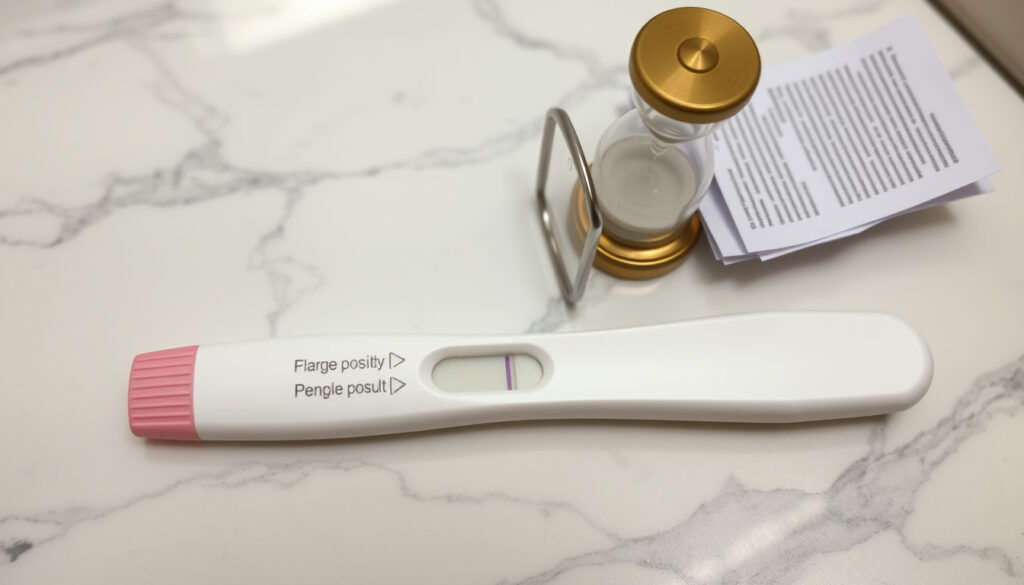
False Positive Pregnancy Test: Causes and Odds
Few moments are as confusing as seeing a positive pregnancy test when you weren’t expecting one — or when you already know it shouldn’t be possible. False positives are rare (less than 1% of home tests), but they do happen, and the reasons range from early pregnancy loss to medication interference.
False positive rate for home pregnancy tests: less than 1% (0.5-1%) ·
Common cause: chemical pregnancy: accounts for 50-75% of early miscarriages ·
hCG threshold for most tests: 20-25 mIU/mL ·
User error contribution: one of the most common reasons ·
Types of pregnancy loss causing false positives: miscarriage, ectopic, molar
Quick snapshot
- Less than 1% of home tests give a false positive (Thomson Medical (women’s health clinic))
- Most positives that don’t continue are chemical pregnancies, not false positives (CCRM Fertility (fertility clinic))
- Test sensitivity (mIU/mL threshold) affects accuracy (Mayo Clinic (leading medical research center))
- Chemical pregnancy (very early miscarriage) (OhioHealth (healthcare system))
- Ectopic pregnancy (CCRM Fertility (fertility clinic))
- Ovarian cysts (Mayo Clinic (leading medical research center))
- Certain cancers (ovarian, testicular, lung) (CCRM Fertility (fertility clinic))
- Kidney disease (CCRM Fertility (fertility clinic))
- Pituitary tumors (CCRM Fertility (fertility clinic))
- User error (reading too late, expired test) (Bass Medical Group (medical group))
- hCG-containing medications (fertility treatments) (Mayo Clinic (leading medical research center))
- Recent pregnancy loss (hCG still present) (Bass Medical Group (medical group))
- Improper test storage or handling (Thomson Medical (women’s health clinic))
- Repeat test with a different brand (Mayo Clinic (leading medical research center))
- Visit a clinic for a blood test (quantitative hCG) (CCRM Fertility (fertility clinic))
- Ultrasound to confirm pregnancy location and viability (Mayo Clinic (leading medical research center))
- Track hCG levels over 48 hours (CCRM Fertility (fertility clinic))
Key facts at a glance
Five critical numbers that frame the false-positive conversation.
| Fact | Value |
|---|---|
| False positive rate | 0.5% to 1% of home pregnancy tests (Clearblue (pregnancy test manufacturer)) |
| Most common non-user-error cause | Chemical pregnancy (very early miscarriage) (CCRM Fertility (fertility clinic)) |
| hCG threshold for most home tests | 20-25 mIU/mL |
| Medications that can cause false positive | hCG injectables (e.g., Pregnyl, Novarel), some anti-seizure drugs (rare) (Mayo Clinic (leading medical research center)) |
| Cancers associated with hCG production | Ovarian, testicular, lung, breast, and pituitary tumors (NCBI (National Center for Biotechnology Information)) |
What are the odds of getting a false positive pregnancy test?
The chance of a false positive from a home pregnancy test sits below 1% when the test is used correctly, according to Thomson Medical (women’s health clinic). Clearblue (pregnancy test manufacturer) echoes that number, adding that false negatives are far more common when testing early. But that low rate assumes no user error — and user error is one of the most frequent reasons for a misleading result.
Statistics on false positive rates
- When used correctly, home pregnancy tests are about 99% accurate (Mayo Clinic (leading medical research center)).
- Chemical pregnancy — an early loss soon after implantation — accounts for most positive tests that don’t lead to a viable pregnancy (CCRM Fertility (fertility clinic)).
- The false positive rate is so low that when you see a positive, it is very likely correct — but that doesn’t guarantee the pregnancy will continue.
How test sensitivity affects false positives
Most home tests detect hCG at 20-25 mIU/mL. More sensitive tests (10 mIU/mL) may pick up very early hCG from a chemical pregnancy, increasing the chance of a fleeting positive. Less sensitive tests reduce false positives but may miss early pregnancies. The implication: test sensitivity trades off between catching early pregnancies and creating anxiety from transient hCG.
The key takeaway: a positive test before a missed period carries a higher risk of being a fleeting positive, meaning the timing of the test heavily influences the likelihood of seeing a non-viable result.
The pattern: Testing early increases the chance of detecting a chemical pregnancy, which can be mistaken for a false positive.
What can trigger a false positive pregnancy test?
True false positives — where hCG is present but not from an ongoing pregnancy — have several known triggers. Mayo Clinic (leading medical research center) lists recent pregnancy loss, fertility drugs containing hCG, and problems with the ovaries or menopause. CCRM Fertility (fertility clinic) adds certain cancers, chronic kidney disease, and pituitary tumors to the list.
Medical conditions that cause false positives
- Chemical pregnancy (very early miscarriage) — hCG rises briefly then falls (OhioHealth (healthcare system)).
- Ectopic or molar pregnancy — abnormal pregnancies that produce hCG but are not viable.
- Ovarian cysts — some can produce hCG (Mayo Clinic (leading medical research center)).
- Cancer — ovarian, testicular, lung, breast, and pituitary tumors can secrete hCG (CCRM Fertility (fertility clinic)).
- Kidney disease — impaired clearance of hCG can keep levels detectable (CCRM Fertility (fertility clinic)).
Medications and drugs that interfere with hCG detection
- hCG injections for fertility (e.g., Pregnyl, Novarel) — can cause positives for 10-14 days (Mayo Clinic (leading medical research center)).
- Some anti-seizure drugs (rare) — may cross-react with test antibodies (OhioHealth (healthcare system)).
- Other medications like antihistamines, antianxiety drugs, antipsychotics, diuretics, Parkinson’s meds, and methadone are sometimes associated, but evidence is not strong (OhioHealth (healthcare system)).
User error and expired tests
- Reading the test after the recommended window (typically 3-5 minutes) can show an evaporation line that looks positive (Bass Medical Group (medical group)).
- Expired, damp, or poorly stored tests can give incorrect results (Thomson Medical (women’s health clinic)).
- Drinking too much water before testing dilutes urine and can cause a false negative — but rarely a false positive.
User error is the most common reason for a misleading positive — and it’s also the easiest to fix. Follow the package instructions exactly, and always read the result within the time window.
What this means: The list of medical and drug-related causes is long, but each is relatively rare. For most women, a positive that doesn’t make biological sense is more likely a chemical pregnancy than a rare cancer.
How do I know if it’s a false positive pregnancy test?
You can’t tell from the line alone — but you can systematically verify. Mayo Clinic (leading medical research center) recommends repeating the test with a different brand and visiting a clinic for a quantitative blood hCG test. Here is a step-by-step flow.
Steps to confirm or rule out false positive
- Wait 48 hours and retest with a different brand. If the positive disappears, it was likely a chemical pregnancy or early loss.
- Go to a clinic for a blood test — quantitative hCG can measure exact levels (CCRM Fertility (fertility clinic)).
- If hCG is rising normally (>66% in 48 hours), it’s likely a viable pregnancy. If falling, it’s a loss.
- Ultrasound can confirm pregnancy location and rule out ectopic or molar pregnancy.
- If hCG is persistently positive without a visible pregnancy, investigate rare causes like cancer or pituitary tumor.
When to see a doctor
- If the test remains positive but you get your period
- If you have abdominal pain or bleeding along with a positive test
- If the positive persists despite a negative follow-up from a different brand
The takeaway: A single positive test is not a diagnosis. Two consecutive positives from different brands, plus rising hCG on blood work, confirm pregnancy. Everything else needs a doctor’s evaluation.
What do false positive lines look like?
A false positive line looks exactly like a real positive — that’s the problem. But one common visual trap is the evaporation line, which can appear after the test dries. Bass Medical Group (medical group) warns that evaporation lines are typically colorless or gray, while true positives have the same color and width as the control line.
Evaporation lines vs. true positive
- Evaporation lines are thin, colorless, or gray — often appear near the test line area when the urine dries.
- True positive lines are noticeable within the 3-5 minute window and match the control line in color and width.
Faint positive vs. false positive appearance
- A faint positive may mean early pregnancy with low hCG — not necessarily a false positive.
- If the line appears after the time window, ignore it. It’s likely an evaporation line (Bass Medical Group (medical group)).
The pattern: The visual appearance alone can’t tell you if it’s a false positive — only the timing of the result and subsequent tests can.
What are the symptoms of a false pregnancy?
A false positive test does not cause pregnancy symptoms. If you experience nausea, breast tenderness, or fatigue with a positive test, you are either pregnant or experiencing a psychological phenomenon called pseudocyesis (false pregnancy).
Phantom pregnancy symptoms
- Pseudocyesis involves real symptoms like missed periods, bloating, and even weight gain, despite no pregnancy (CCRM Fertility (fertility clinic)).
- True false positive hCG from a medical condition rarely causes pregnancy symptoms.
Difference between false positive test and false pregnancy
- False positive test: the test detects hCG from a non-pregnancy source, but you don’t feel pregnant.
- False pregnancy (pseudocyesis): you feel pregnant and have symptoms, but no pregnancy and no hCG.
Why this matters: If you have both a positive test and pregnancy symptoms, the most likely explanation is an ongoing pregnancy — not a false positive. A blood test and ultrasound will confirm either way.
Confirmed facts
- Home tests are about 99% accurate when used correctly (Mayo Clinic)
- Chemical pregnancy is the most common cause of a positive that doesn’t continue (CCRM Fertility)
- User error (reading too late) can produce false results (Bass Medical Group)
- hCG injections cause false positives for up to 14 days (OhioHealth)
What’s unclear
- How often very low-level hCG from benign conditions causes false positives is not precisely quantified
- The role of cross-reacting molecules (e.g., certain hormones) in causing false positives is still partially understood
- The prevalence of false positives specifically from ovarian cysts is not well-documented in large-scale studies
- The exact proportion of false positives caused by specific medications (e.g., antihistamines) remains unclear
“False-positive results are extremely rare, but when they do happen, the most common culprit is a chemical pregnancy — a very early loss that happens right after implantation.”
— Clearblue medical team (Clearblue (pregnancy test manufacturer))
“Home pregnancy tests are very accurate when used correctly, but they can give a false-positive result if you have a chemical pregnancy or if you take fertility medications that contain hCG.”
— Mayo Clinic (leading medical research center)
“The four main causes of a false-positive pregnancy test are chemical pregnancy, recent miscarriage, medication, or a defective test.”
— OhioHealth (healthcare system)
“If you get a positive test and then your period arrives a few days later, that was likely a chemical pregnancy — not a false positive from the test.”
— CCRM Fertility (fertility clinic)
A false positive test is a rare event, but the anxiety it creates is real. For most women, the path forward is simple: retest, see a doctor, and let blood work and ultrasound provide the definitive answer. For those whose positive doesn’t lead to a baby, the loss — however early — deserves recognition and support. Understanding the biology behind the result is what truly empowers you to navigate the path forward.
Frequently asked questions
Can a false positive pregnancy test mean I have cancer?
It can — but it is extremely rare. Certain cancers (ovarian, testicular, lung, breast, pituitary) can produce hCG. If your test stays positive and no pregnancy is found, your doctor will investigate these possibilities, but they are not the first explanation (CCRM Fertility).
How soon after a miscarriage can I get a false positive?
hCG can remain in your system for up to several weeks after a miscarriage or abortion. Testing too soon after a loss can give a false positive. Retest after two weeks or wait until your hCG is confirmed zero by a blood test (Bass Medical Group).
Does a faint line always mean I am pregnant?
A faint line within the test window usually indicates pregnancy — just low hCG. It is not necessarily a false positive. Retest in 48 hours to see if the line darkens (Mayo Clinic).
Can stress cause a false positive pregnancy test?
No. Stress does not make your body produce hCG. If you get a positive test and are under stress, the test is likely correct — or there is a medical reason for the hCG. Stress alone will not cause a false positive (Clearblue).
What is the difference between a false positive and a chemical pregnancy?
A false positive means the test detected hCG that does not come from a pregnancy at all (e.g., medication, cancer). A chemical pregnancy is a true pregnancy that implants and begins producing hCG but stops very early — the test was correct, but the pregnancy did not continue (CCRM Fertility).
Can alcohol affect a pregnancy test result?
No. Alcohol does not contain hCG and does not interfere with the test chemicals. Drinking alcohol will not cause a false positive (Thomson Medical).
Are digital pregnancy tests more accurate than line tests?
Digital tests use the same technology and have similar accuracy. Some digital tests have a higher threshold (25 mIU/mL) to reduce false positives. However, both types are about 99% accurate when used correctly (Clearblue).
More related posts
 Tom Sturridge: Sandman Actor Height, Age, Relationship Facts
 Paddy Considine Biography: Nationality, Fame & Key Roles
 Marty McFly: Character Biography and Actor Connection
 Kieffer Moore: Age, Height, Stats, Wife, Net Worth & Injury History
 What Is Non Binary – Meaning, Pronouns, Flag and History
 Ariana DeBose – Biography, Partner, Ethnicity, Awards & More
 Travis Fimmel: From Vikings to Dune Prophecy