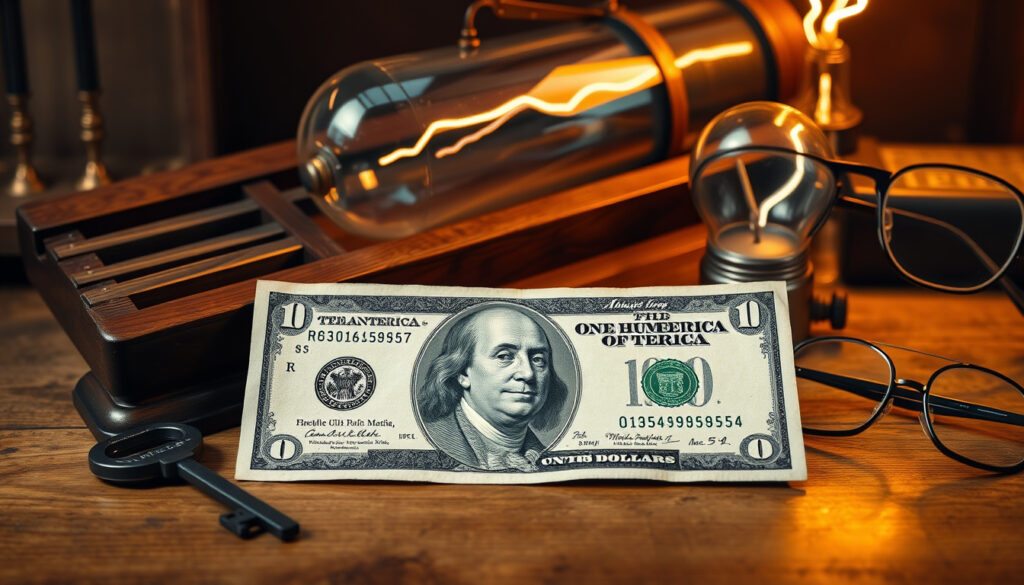
Benjamin Franklin: Inventions, $100 Bill & Presidency Myth
Pull a $100 bill out of your wallet and you’re holding Benjamin Franklin’s most familiar portrait — the same man who signed the Declaration of Independence, helped draft the Constitution, and invented the lightning rod. His face has been on the note since 1914 (U.S. Currency Education Program (federal currency authority)), which raises a question most people never stop to ask: why him, and why not a president? The answer ties a printer, a diplomat, and a scientific tinkerer to some of the rarest bills in U.S. history.
Born: January 17, 1706, Boston · Died: April 17, 1790, Philadelphia · Key role: Founding Father, signatory to Declaration of Independence & Constitution · Inventions: At least 10, including lightning rod, bifocals, Franklin stove · On the $100 bill: Since 1914
Quick snapshot
- Born January 17, 1706, in Boston; died April 17, 1790, in Philadelphia; signatory of the Declaration of Independence and the U.S. Constitution (Wikipedia’s Benjamin Franklin biography)
- Portrait on the $100 Federal Reserve note since 1914 (U.S. Currency Education Program (federal currency authority))
- The exact number of Franklin’s inventions is debated; the common estimate is at least 10 (Wikipedia’s Benjamin Franklin biography)
- The precise number of surviving $100,000 bills has not been publicly confirmed (APMEX’s education desk (numismatics and bullion retailer))
- 1727: Franklin opens his first printing house (Interesting Engineering (science and technology publication))
- 1914: the first $100 Federal Reserve Note is issued with Franklin on the obverse (U.S. Currency Education Program (federal currency authority))
- Now: the note carries a 3-D Security Ribbon and a color-shifting Bell in the Inkwell (U.S. Currency Education Program, $100 note page)
- The $100 note remains in production with layered anti-counterfeit features (Interesting Engineering (science and technology publication))
- Rare high-denomination notes now surface mainly at auction (APMEX’s education desk)
Seven rows capture the arc in miniature: a Boston-born printer who became a diplomat, a scientist, and a Founder — then landed on the largest bill Americans spend.
| Full name | Benjamin Franklin |
|---|---|
| Born | January 17, 1706 |
| Died | April 17, 1790 |
| Profession | Printer, scientist, diplomat, philosopher |
| Key achievement | U.S. Founding Father |
| Notable invention | Lightning rod |
| Currency appearance | $100 bill |
The table compresses a life that spanned printing, science, diplomacy, and currency design into one row each — but the man who signed both the Declaration and the Constitution refused to stay in a single category.
What is Benjamin Franklin most famous for?
Franklin is the rare Founder whose fame spans science, diplomacy, printing, and the paper currency in your wallet. His double signature — on the Declaration of Independence and the Constitution — is the starting point, not the whole story.
A Founding Father and the American Revolution
Franklin signed both the Declaration of Independence and the U.S. Constitution — a double signature that anchors his place among America’s most influential Founding Fathers (Wikipedia’s Benjamin Franklin biography).
His diplomatic résumé was just as heavy. He served as ambassador to France during the Revolutionary War and, at 81, was the oldest delegate at the Constitutional Convention, where he proposed the Great Compromise.
Scientific experiments and discoveries
- The 1752 kite experiment made his scientific reputation and led, the same year, to the lightning rod.
- Bifocals came around 1784, with distance and reading lenses combined in a single frame.
- The Franklin stove, invented in 1742, was a circulating fireplace built to heat a room more effectively than an open hearth.
The experiment that turned a colonial printer into an international scientific name was dangerous and dramatic, but Franklin’s follow-through was always practical: he converted each discovery into a device other people could use.
Contributions to printing and publishing
- 1727: Franklin opened his first printing house (Interesting Engineering (science and technology publication))
- He printed banknotes for Pennsylvania, Delaware, and New Jersey, and in 1729 wrote A Modest Enquiry into the Nature and Necessity of a Paper Currency, arguing the colonies needed more paper money (U.S. Currency Education Program (federal currency authority))
- He also helped found the University of Pennsylvania
What 10 things did Benjamin Franklin invent?
The honest answer is that Franklin invented more than ten things; the exact count depends on whether you count improvements, instruments, and finished devices. According to Wikipedia’s Benjamin Franklin biography, the inventions most often cited are consistent: the lightning rod, bifocals, the Franklin stove, and the glass armonica, with at least ten credited in total.
The Lightning Rod
- 1752: Franklin designed the lightning rod after his kite experiment, giving buildings a safe path for the charge to reach the ground.
- The kite experiment had shown that lightning is a form of electricity; the rod was the practical payoff.
Bifocal Lenses
- Around 1784: one frame, two focal lengths — distance lenses on top, reading lenses below.
- The design is credited to Franklin, who was in his late seventies at the time.
The Franklin Stove
- 1742: a circulating fireplace designed to heat a room more evenly than an open hearth while producing less smoke.
Other inventions
- Glass armonica (a musical instrument)
- Flexible urinary catheter
- Swim fins
- Odometer
These round out the commonly cited list — a reminder that Franklin treated daily annoyances as design problems (Wikipedia’s Benjamin Franklin biography).
The implication: Franklin invented for the same reason he edited a newspaper — to fix what was in front of him. The result is a list that reads less like a patent library and more like a household catalogue.
Is Benjamin Franklin a US president?
No — but the confusion is fair. Franklin held many titles, and one of them actually began with the word “president.”
Franklin’s Political Career
- President of the Supreme Executive Council of Pennsylvania — the top executive position in the state, not the nation.
- U.S. ambassador to France during the Revolutionary War.
Both roles are documented in Wikipedia’s Benjamin Franklin biography; neither one was the presidency.
The Constitutional Convention
- Oldest delegate at the Constitutional Convention.
- Proposed the Great Compromise.
At 81, Franklin was helping design the office of the presidency itself — an office he would never hold (Wikipedia’s Benjamin Franklin biography).
Why He Was Never President
Franklin spent the 1780s in diplomacy and state government, and he died in 1790 just as the new federal government was taking shape. He belonged to the generation that created the presidency, not the one that occupied it.
Why this matters: Franklin’s absence from the presidential list is not a demotion. He helped design the executive branch while serving in a different office — and that is exactly the résumé that earns a place on the $100 bill.
Why is Benjamin Franklin on a $100 bill?
The short answer: the designers of U.S. currency chose the founder who best embodied the nation’s self-image, and the choice stuck. The longer answer follows the note’s evolution from Civil War financing to modern anti-counterfeiting.
The History of the $100 Bill
- 1862: the first $100 U.S. Note is issued (Wikipedia’s $100 bill article)
- 1914: the first $100 Federal Reserve Note debuts with Franklin on the obverse; the early large-size note measured roughly 7.375 by 3.125 inches (U.S. Currency Education Program note-features PDF (federal currency authority))
- Series 1990 added a security thread and microprinting; the current design adds a 3-D Security Ribbon and a color-shifting Bell in the Inkwell (U.S. Currency Education Program, $100 note page (federal currency authority))
The $100 note traces back to Civil War-era Demand Notes and United States Notes — the paper system the federal government created out of financial necessity (U.S. Currency Education Program).
Franklin’s Symbolism
- The current note layers Franklin-era American symbols, including a quill pen and the Syng inkwell, the Liberty Bell, and a stylized Declaration of Independence (Wikipedia’s $100 bill article)
- A portrait watermark of Franklin sits in the paper, visible from both sides when held to light (U.S. Currency Education Program (federal currency authority))
- Franklin himself printed banknotes for Pennsylvania, Delaware, and New Jersey before the Revolution (U.S. Currency Education Program, “Bank on Benjamin” podcast)
The symbolism is almost too clean: the man who printed colonial money argued in 1729 that the colonies needed more paper currency, then experimented with leaf impressions to make his notes harder to counterfeit (U.S. Currency Education Program, “Bank on Benjamin” podcast (federal currency authority)).
Comparison with Other Presidents on Currency
- Franklin is one of only two non-presidents on currently circulating U.S. paper currency — Alexander Hamilton on the $10 bill is the other — and the U.S. Treasury and the Federal Reserve are the ones who decide those portrait choices (APMEX’s education desk (numismatics and bullion retailer))
The Bureau of Engraving and Printing’s rationale for Franklin rested on his standing as a Founding Father and his contributions to the nation — a rationale that has survived every redesign since 1914.
The trade-off: putting a non-president on the biggest bill was an identity statement, not a historical accident. Every president who followed has been paid in Franklin’s portrait.
Who was on the $1000 bill?
Before the $100 bill became the largest note in Americans’ wallets, the Treasury printed much bigger paper — and Franklin wasn’t on any of it.
$1000 Bill: Salmon P. Chase
- The $1,000 bill carried the portrait of Salmon P. Chase, a former U.S. Treasury Secretary who also appeared on the $10,000 bill (APMEX’s education desk (numismatics and bullion retailer))
Chase’s double appearance is a reminder that early U.S. currency honored the officials who built the country’s financial machinery, not just its political leadership.
Other High-Denomination Notes ($500, $5,000, $10,000, $100,000)
- $500 bill: William McKinley (APMEX’s education desk)
- $5,000 bill: James Madison
- $10,000 bill: Salmon P. Chase
- $100,000 bill: Woodrow Wilson
Why These Bills Were Discontinued
- These large-size notes were designed mainly for large transactions, not everyday spending.
- They were phased out after World War II (APMEX’s education desk)
- The $100,000 bill is the rarest of the group, and the exact number still in existence has never been publicly confirmed (APMEX’s education desk)
What this means: America’s biggest notes celebrate presidents and treasury officials, while Franklin — no president at all — anchors the one bill people actually use. Rarity and fame, it turns out, live in different wallets.
What is the rarest bill in the world?
Ask numismatists for the rarest U.S. note and one answer keeps coming back: the 1890 $1,000 Treasury Note known as the “Grand Watermelon” (APMEX’s education desk (numismatics and bullion retailer)).
The 1890 $1,000 Treasury Note (Grand Watermelon)
- Issued in 1890.
- Only a few examples are known to survive (APMEX’s education desk)
- It remains a benchmark in U.S. paper-money collecting.
Its rarity is defined by the same three factors that govern all collectible paper: historical context, print run, and survival rate.
High-Value Rarities
- The $100,000 bill — the highest U.S. denomination ever printed — is the rarest type of all (APMEX’s education desk)
- The exact number of surviving $100,000 bills is not publicly confirmed.
- Nineteenth-century $500 and $1,000 notes also survive in tiny numbers.
Factors That Make a Bill Rare
- Historical context: when, why, and at what moment in U.S. history a note was issued.
- Print run: how many notes came off the presses.
- Survival rate: how many were redeemed, destroyed, or survived in collectible condition (APMEX’s education desk)
The pattern: the rarest U.S. bills are scarce for unglamorous reasons — small print runs, government redemption, and simple attrition. Franklin’s hundred is common for a cultural reason: it works, and it keeps working.
Confirmed facts vs. open questions
Confirmed facts
- Franklin was born in Boston on January 17, 1706, died in Philadelphia on April 17, 1790, signed both the Declaration of Independence and the U.S. Constitution, and is credited with the lightning rod, bifocals, and the Franklin stove (Wikipedia’s Benjamin Franklin biography)
- His portrait has been on the $100 Federal Reserve note since 1914 (U.S. Currency Education Program (federal currency authority))
What’s unclear
- The exact number of Franklin’s inventions is debated; “at least 10” is the common estimate, not a precise count (Wikipedia’s Benjamin Franklin biography)
- The precise number of surviving $100,000 bills has not been publicly confirmed, and the “world’s rarest bill” title shifts with auction results and collector censuses (APMEX’s education desk)
- How many “Grand Watermelon” examples remain is a collector-census estimate, not an official government tally (APMEX’s education desk)
Perspectives on Franklin’s legacy
“Franklin’s image has been on the $100 Federal Reserve note ever since they were first issued in 1914.”
— U.S. Currency Education Program (federal currency authority), “Bank on Benjamin” podcast transcript
“The U.S. Treasury and the Federal Reserve determine the design and portrait choices for U.S. currency.”
— APMEX’s education desk (numismatics and bullion retailer)
“Benjamin Franklin is described as one of America’s most influential Founding Fathers and is honored on the U.S. $100 bill.”
— Wikipedia’s Benjamin Franklin biography
The verdict
Franklin never needed the presidency, and his legacy never needed a rare banknote. For collectors, the implication is clear: the scarcest Franklin artifacts are the colonial notes he printed and the 1729 pamphlet arguing for paper money — not the bills in everyone’s wallet. For the rest of us, the $100 bill is the everyday reminder: the most interesting Founder is the one you can spend.
Related reading
- Nelson Mandela: Biography, Imprisonment, and Legacy
- Mao Zedong: Fame, Controversy, and Legacy Explained
en.wikipedia.org, uscurrency.gov, jmbullion.com, tvtropes.org, oldcoinonline.com, uscurrency.gov, americanspaces.state.gov, facts.net
Frequently asked questions
Where was Benjamin Franklin born?
In Boston, Massachusetts, on January 17, 1706 (Wikipedia’s Benjamin Franklin biography).
What was Benjamin Franklin’s profession?
He trained as a printer and ran a successful printing business before becoming a scientist, diplomat, and state official (Wikipedia’s Benjamin Franklin biography).
Why was Franklin put on the $100 bill instead of a president?
Because the U.S. Bureau of Engraving and Printing chose him for his status as a Founding Father and his contributions to the nation. His portrait has appeared on the $100 Federal Reserve note since 1914 (U.S. Currency Education Program (federal currency authority)).
What is the history of the $100 bill?
The first $100 U.S. Note appeared in 1862, and the first $100 Federal Reserve Note followed in 1914 with Franklin’s portrait. Series 1990 added a security thread and microprinting, and the current design adds a 3-D Security Ribbon and a color-shifting Bell in the Inkwell (Wikipedia’s $100 bill article; U.S. Currency Education Program).
Is the $100 bill still being printed?
Yes. The $100 is a circulating denomination, and the current design described by the U.S. Currency Education Program remains in production with layered security features (U.S. Currency Education Program, $100 note page).
Who designed the $100 bill?
The design and portrait choices are determined by the U.S. Treasury and the Federal Reserve, which oversee U.S. currency (APMEX’s education desk (numismatics and bullion retailer)).
More related posts
 King Mansa Musa: Gold, Empire, and the Richest Man Ever
 Iran President Masoud Pezeshkian: Latest Verified News (2026)
 Amanda Knox Case: Innocence, Compensation, and Aftermath
 Lucy Chen The Rookie: Biography, Age Gap, Relationship & FAQs
 Jermaine Jenas: From BBC Sacking to Public Rebuilding
 Ulrika Jonsson on Sobriety and Ageing Face
 Glasgow to London Flights: Ryanair vs EasyJet from €34