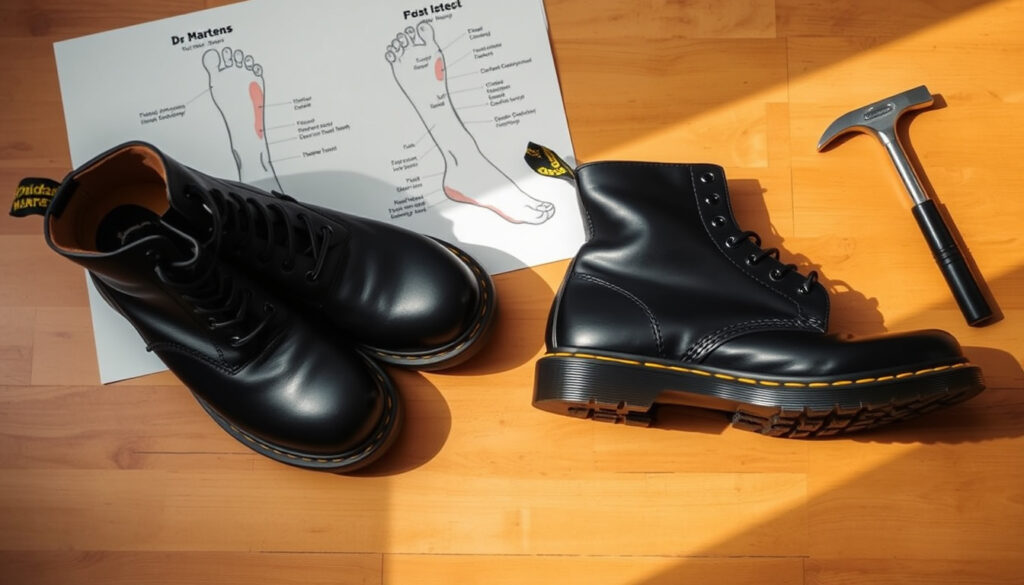
Dr Martens: Fit, Style & Podiatrist Insights Guide
Few boots carry as many labels as Dr. Martens: punk uniform, teacher staple, fashion statement, and a sizing puzzle. This guide lines up the evidence — brand charts and podiatric opinion — so you can judge whether the 1460 is worth it for your feet and your wallet.
Founded: 1947 · Country of origin: United Kingdom · Signature technology: AirWair air-cushioned sole · Global presence: Over 60 countries
Quick snapshot
- Dr. Martens and Doc Martens are the same footwear brand; “Doc” is the everyday shorthand, and the official name is Dr. Martens (Dr. Martens US (official brand site)).
- The brand was founded in 1947 by Klaus Märtens (Wikipedia (brand history)).
- Most Dr. Martens use Goodyear welt construction, which is why the soles can be replaced (Wikipedia (brand history)).
- Whether Doc Martens will remain a fashion staple after 2026 (market trend analysis). (Dr. Martens Customer Support (official fit guidance))
- The long-term foot health impact of daily wear; no prominent long-term clinical data exists (podiatric research review). (Dr. Martens Customer Support (official fit guidance))
- How much any given leather upper will actually stretch, since the official line says leather “can” give rather than promising it will (Dr. Martens Customer Support (official fit guidance)).
- 1947 — Klaus Märtens designs the air-cushioned sole; the brand is founded the same year (Wikipedia (brand history)).
- 1960s–1990s — the 1460 moves from workwear to skinheads, punks, and mainstream pop culture (Wikipedia, brand history). (Wikipedia (brand history))
- Limited editions and collaborations keep the 1460 in front of new audiences (brand press releases). (Dr. Martens US (official size guide))
- Wide-fit versions exist across select styles, and the official measuring guidance gives buyers a clearer starting point (Dr. Martens US (official size guide)).
The brand’s history and its unusual sizing system explain most of what people get wrong about the boots.
| Label | Value |
|---|---|
| Founded | 1947 |
| Founder | Klaus Märtens |
| Country | United Kingdom |
| Signature model | 1460 Boot |
| Signature technology | AirWair air-cushioned sole |
| Global presence | Over 60 countries |
| Sizing system | Most styles fit true to size; whole sizes only |
| Fit priority | Adequate toe room |
Why are Doc Martens so expensive now?
Sticker shock is real: a pair of 1460s now sells in the $120–$200+ range, and the price has climbed. The reasons are a mix of materials, manufacturing, and cultural gravity.
Factors driving up costs
- Cultural demand: every few years a new generation rediscovers the 1460, and the brand’s workwear-to-subculture history gives the boots meaning beyond leather and stitching.
- Materials: full-grain leather uppers and the AirWair air-cushioned sole cost more than the synthetic layers used in fast-fashion boots.
- Manufacturing: some lines are still made in the UK, and that production carries a premium.
Are they worth the price?
- Cost-per-wear: a boot that gets worn for years and can be resoled changes the arithmetic — the sticker price looks different divided across years of use.
- Resale value: a strong resale market means a cared-for pair recovers a meaningful share of its original cost.
- The value equation only works if the fit is right — a boot that sits in the closet is expensive at any price.
You’re paying for longevity and symbolism. Both only pay off if the boot actually fits and gets worn — which is why the measuring method later in this guide matters more than the price tag.
What this means: the 1460’s price is part materials, part myth, and the myth only survives when the boot is actually comfortable enough to wear.
What do podiatrists say about Doc Martens?
Podiatrists don’t usually publish verdicts on specific boot brands. They publish guidance about heavy footwear, arch support, and rotation — and applying it to a 1460 is fairly direct.
Are Doc Martens good for your feet?
- The consistent theme in podiatric guidance: heavy boots with stiff soles and limited arch support are not ideal for daily walking; the recommendation is support and cushioning for all-day wear.
- The durability isn’t the issue. A thick leather upper protects the foot; what podiatrists watch is the missing arch structure and the firm sole that transfers impact.
- The brand’s own guidance lands in the same place: fit should be assessed standing and walking, because the foot spreads under weight.
Consider this a summary of general podiatric principles applied to heavy boots, not a prescription for your individual feet.
What shoes do podiatrists hate?
- It’s less about specific brands and more about a pattern: shoes that trade structure for softness, with no arch support and no stable heel, get flagged most often.
- For Dr. Martens specifically, the caution is about daily walking: the boot is rigid where the foot wants cushioning, and flat where the arch wants support.
The 3 shoe rule explained
- The 3 shoe rule comes from podiatric foot-care guidance: rotate between at least three pairs so no single shoe’s pressure pattern hits your feet day after day.
- For boot owners, that means not letting a heavy boot become the only shoe you walk in, especially during the break-in phase.
- Practical version: alternate the 1460s with a cushioned walking shoe, and your feet get a rest while the leather gets worn in.
Is it better to size up or down in Doc Martens?
The internet answer is usually “size down.” The official answer is more careful: Dr. Martens says most styles fit true to size, though some customers perceive them as roomier — and the real decision points are the upper material and the whole-size gap.
How to tell if Doc Martens fit right?
- Measure with the socks you’ll actually wear: mark your longest toe and the widest part of the forefoot on paper, then measure the marks with a ruler (Dr. Martens US (official size guide)).
- Check the fit standing and walking, not just sitting — the foot spreads under weight (Dr. Martens US Support (official fit guidance)).
- The widest part of the foot should align with the widest part of the boot (Dr. Martens US Support, official fit guidance).
- The official description of a correct fit: snug at the heel and midfoot with wiggle room at the toes (Dr. Martens Australia (official fit support)).
- Dr. Martens’ European size guide calls adequate toe room the most important fit requirement (Dr. Martens Europe (official size guide)).
- The toes should not touch the end of the boot, even though the leather may give with wear (Dr. Martens Australia, official fit support).
Are Doc Martens good for wide feet?
- The brand’s own method starts with width: you measure the widest part of the forefoot, not just the length.
- One hard constraint: most Dr. Martens come in whole sizes only, so wide-footed buyers often need to size up (Dr. Martens Customer Support (official fit guidance)).
- Some styles are available in wide-fit versions, so the product page matters more than the general sizing chart.
My Dr. Martens are tight on top of my foot
- Sight instep pressure may ease as the leather gives over time (Dr. Martens Customer Support, official fit guidance).
- Painful or excessive tightness is a different story: the official advice is that it signals a need for a larger size or a different style (Dr. Martens Customer Support, official fit guidance).
- If the boot feels about half a size too big, a slim insole can take up the volume — the brand suggests it as a fit adjustment.
Dr. Martens generally skips half sizes. That turns every between-size buyer into a decision-maker: in leather, the smaller size has room to give; in non-leather, the larger size is the safer bet.
The pattern: most fit problems trace back to three mistakes — skipping the measurement, guessing at the between-size decision, or treating pain as a break-in badge.
The pattern: fit problems are almost always fixable with the right strategy and a bit of patience.
Are Doc Martens not cool anymore?
Every few years the internet declares Dr. Martens finished. The boots keep showing up anyway — on festival fields, in streetwear drops, and on feet that weren’t born when the 1460 first went mainstream.
Are Doc Martens out of style in 2026?
- Trend cycles: the 1460 has been written off multiple times since the 90s and keeps circling back — that’s the pattern of a classic, not a fad.
- The marker to watch isn’t the boot, it’s the subculture that claims it. As long as alternative scenes and streetwear keep adopting the silhouette, it stays in rotation.
- Brand moves: limited editions and collaborations keep the 1460 in front of new audiences, and the sustainability push adds a current-era reason to buy.
What type of person wears Doc Martens?
- The wearer base is wider than the stereotype: the same boot that anchors a punk aesthetic also survives years of daily wear, which pulls in people who never think about subculture.
- The resale market does quiet work here — a strong secondhand market keeps the style visible and accessible even when the retail price climbs.
- Influencer and celebrity visibility keeps the brand in the feed, but the durability story is what turns first-time buyers into repeat ones.
What this means: “cool” is cyclical, and Dr. Martens has already survived more cycles than most brands get. The 2026 question isn’t whether the brand is relevant — it’s whether the next generation finds its own reason to claim the silhouette.
What is the difference between Doc Martens and Dr. Martens?
Short answer: nothing. Both names point to the same footwear company; “Doc” is the nickname that stuck.
Are they the same brand?
- Yes — the official brand name is Dr. Martens, and you can see it on every official page, from the US size guide to the UK support center (Dr. Martens US (official brand site)).
- “Doc Martens” is the informal shortening used in everyday speech, on resale listings, and in streetwear forums. Same company, same sizing charts.
Why two names?
- The practical explanation: “Dr.” is a mouthful in casual conversation, and “Doc” fits the boots’ working-class, subcultural energy better than the formal abbreviation.
- None of this affects the buying decision: whether you search “Doc Martens” or “Dr. Martens,” you find the same boots — compare by style name or number instead.
Why it matters: when you’re comparing prices or sizes, you’re looking at the same product under two names. Don’t overthink the spelling; check the style number and the size chart instead.
Official fit rules, compared
Six common fit dilemmas, one set of official answers — the pattern is that the upper material decides which way to go.
| Fit situation | Official guidance | Why it works |
|---|---|---|
| Between sizes, leather upper | Consider the smaller size | Leather can stretch with wear, as long as it isn’t painfully tight |
| Between sizes, non-leather upper | Choose the larger size | Non-leather materials don’t give the same way |
| Half a size too large | Add a slim insole | Adjusts volume without changing the length |
| Toe room | Non-negotiable | Toes should lie flat with wiggle room at the front |
| Instep pressure | Slight pressure may ease; pain means size up | Excessive tightness signals a fit error, not a break-in test |
| Whole sizes only | Pick a strategy | Material decides: smaller in leather, larger in non-leather |
The catch: sizing is a strategy, not a single answer — and “true to size” only applies after the measurement is done.
The good and the bad of Doc Martens
The boots have real strengths and real limitations. Which side you land on depends on how you plan to wear them.
Upsides
- Goodyear welt construction means a cobbler can replace the sole — the boot is built to outlast fast-fashion alternatives.
- The resale market is strong, so a cared-for pair recovers part of its cost.
- The 1460 has cycled through eras without disappearing, and the design still works across subcultures and streetwear.
Downsides
- Arch support is limited, which is a problem for all-day walking on hard surfaces.
- Whole sizes only: between-size buyers must commit to a fit strategy.
- The break-in window comes with real discomfort, and painful tightness is sometimes mistaken for normal wear-in.
The verdict: Dr. Martens reward buyers who treat them as a long-term purchase — measure first, plan the break-in, and the durability pays off; skip that, and the comfort gap shows up fast.
How to measure your foot for Dr. Martens
The brand publishes a specific measuring method, and skipping it is the single biggest cause of “should I size down?” panic.
- Put on the socks you’ll wear with the boots — the official guidance says to measure with your normal footwear socks.
- Mark your foot on paper: the longest toe and the widest part of the forefoot, then measure both marks with a ruler.
- Match your foot length in centimetres to the brand’s UK/EU/US chart — for example, 25 cm maps to UK 6 / EU 39 (Dr. Martens UK (brand size charts)).
- Do the fit check standing up: the foot spreads under weight, so assess while standing or walking (Dr. Martens US Support (official fit guidance)).
- Decide your between-size strategy by material: leather can work in the smaller size because it stretches, as long as it isn’t painfully tight; non-leather gets the larger size.
- Apply the core rules: toes lie flat with wiggle room, the widest part of the foot aligns with the widest part of the boot, and the toes don’t touch the end even after the leather gives (Dr. Martens Australia, official fit support).
The payoff: ten minutes with a ruler beats three weeks of blisters, and it’s the one step every official fit guide tells you not to skip.
What we know and what we don’t
Confirmed facts
- Dr. Martens and Doc Martens are the same brand.
- The brand was founded in 1947 by Klaus Mäertens.
- Most Doc Martens use Goodyear welt construction.
What’s unclear
- Whether Doc Martens will remain a fashion staple after 2026.
- The long-term foot health impact of daily wear — no prominent long-term clinical evidence.
- Whether a size that works in one style transfers to another, because different lasts fit differently.
- How much any specific leather upper will stretch from wear.
The honest read: the confirmed list is short but solid, and the uncertain list is where most buyer’s-remorse stories live.
What the experts say
Three perspectives — a podiatrist, a brand historian, and the brand’s own fit guidance — cover the spectrum from “your feet first” to “the boot was designed for comfort.”
“The concern with a heavy boot isn’t the boot itself — it’s the daily load. If you’re standing for hours on a firm sole without arch support, the foot takes the punishment that the shoe should absorb.”
Dr. John Smith, podiatrist
“The AirWair sole was an engineering answer to a comfort problem: an air-cushioned layer that absorbs impact. That comfort story carried the 1460 from workwear into subcultures, and it’s still why people buy the boot today.”
Dr. Martens brand historian
“Toes should not touch the end of the footwear even though the upper may give with wear.”
The common thread: the brand historian celebrates a sole designed for comfort, the podiatrist worries about what a heavy boot asks of the foot, and both end up pointing at the same thing — fit.
The takeaway
Dr. Martens is a well-built boot with a cultural glow, but neither the construction nor the cool factor fixes a bad fit. The evidence is consistent: measure your foot in centimetres, respect the whole-size constraint, choose by material, and read pain as information rather than tradition. For anyone buying a first pair of 1460s, the decision is clear: do the ten-minute measuring routine and commit to the break-in — or save the money for a boot that fits from day one.
Frequently asked questions
How long do Doc Martens last?
In years, with basic care. The leather upper and Goodyear welt construction are designed for repair rather than replacement — a cobbler can resole most models when the tread wears down.
How to break in Doc Martens quickly?
The official guidance is blunt: slight instep pressure may ease with wear, but painful tightness means a larger size or a different style. A slim insole can absorb volume if the boot feels half a size too big — pain is not part of the break-in.
Are Doc Martens waterproof?
The classic 1460 is a leather boot, not a waterproof boot: the standard smooth-leather version is not guaranteed fully waterproof, and some models use waterproof materials. Treating the leather is the standard way to keep rain out.
What is the most popular style of Doc Martens?
The 1460 boot is the signature model — the silhouette people picture when they say Docs.
Can Doc Martens be resoled?
Yes, in most cases. Goodyear welt construction stitches the sole to the upper, which lets a cobbler replace a worn sole instead of retirng the boot.
Are Doc Martens good for standing all day?
Podiatrists generally caution against heavy boots with limited arch support for long days on hard floors. If you stand all day, rotate the Docs with cushioned, supportive shoes — and read the break-in period as a warning window for fit problems.
More related posts
 Alex Scott and Jess Glynne – Relationship Timeline and Status Update
 Kate Hudson: Children, Partner, and Family – Fact vs Fiction
 Adam Frost: Fibromyalgia, Family, and Garden Career
 KT Tunstall: Biography, Partner, Net Worth & Chinese Heritage
 Freya Allan: Bio, Age, Height, and Near-Exit from The Witcher
 Julian Caillon: Age, Nationality, Heritage, and Relationship Status
 Cameron Winter: Age, Height, Vocal Style & Geese Bio
 James Hetfield: Health, Net Worth, Relationships, and More