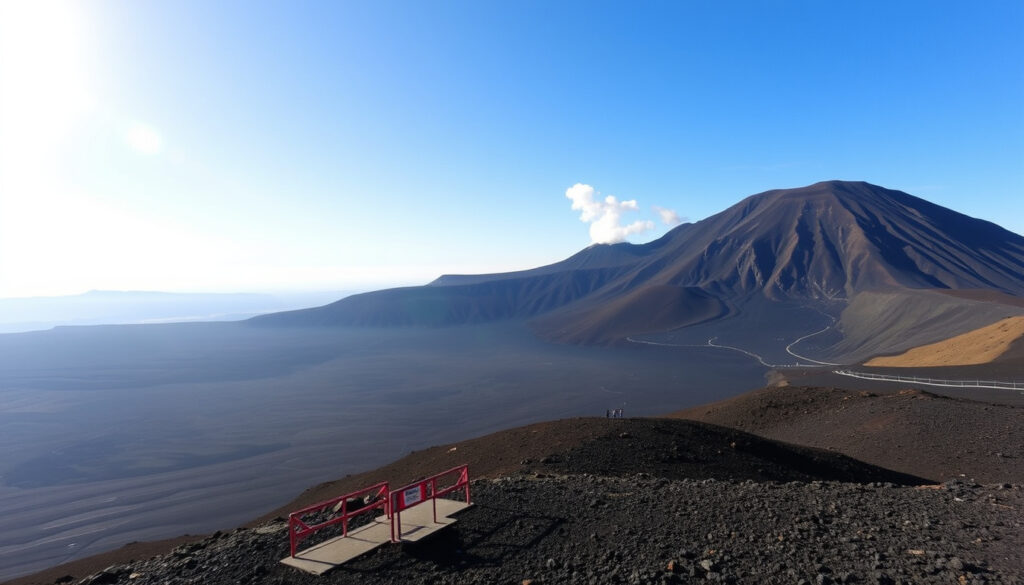
Mount Etna Safety Guide: Is It Safe to Visit
Mount Etna has been erupting on and off for thousands of years, and it’s still erupting today. That might sound alarming, but for most visitors to Sicily, the volcano’s activity is a spectacle rather than a threat. Italy’s civil protection authorities and volcanologists at the National Institute of Geophysics and Volcanology (INGV) monitor the mountain around the clock, allowing them to issue clear warnings and keep tourist areas safe. Here’s what you need to know before you go.
Elevation: 3,329 meters (10,922 feet) ·
Last major eruption: 2023 (ongoing activity) ·
Historical fatalities: 77 (1928 eruption of Mascali) ·
Volcano type: Stratovolcano
Quick snapshot
- Mount Etna is one of the most active volcanoes in the world (Dipartimento della Protezione Civile).
- The 1928 eruption destroyed Mascali and caused 77 deaths (EU Civil Protection Knowledge Network).
- Current monitoring by INGV provides real-time hazard data (Reuters).
- Most tourist areas remain safe during non-paroxysmal activity (CNN).
- Exact number of total historical deaths is uncertain due to incomplete records (EU Civil Protection Knowledge Network).
- Predicting the precise date of the next eruption is not possible (Dipartimento della Protezione Civile).
- The full impact of climate change on Etna’s activity is still being studied (Euronews).
- On 2025-06-02, Sicily’s civil protection activated a local alarm phase and suspended summit-zone activities (Protezione Civile Sicilia).
- No injuries were reported, and the alert level was reduced to yellow on 2025-06-03 (Reuters).
- No major destructive eruption is predicted in the immediate future (CNN).
- Visitors should check the Civil Protection alert level before planning a summit hike.
Key specs consolidate Etna’s measurable facts.
| Attribute | Value |
|---|---|
| Elevation | 3,329 m (10,922 ft) |
| Last major eruption | 2023 (ongoing intermittent activity) |
| Location | East coast of Sicily, Italy |
| Volcano type | Stratovolcano (active) |
| UNESCO status | World Heritage Site (since 2013) |
Is it safe to go to Sicily with Mount Etna erupting?
Five facts, one pattern: authorities have a proven system that keeps most visitors safe while still allowing close access to the volcano.
Safety zones during eruptions
- Most eruptions are non-explosive and pose no direct threat to major tourist areas like Catania or Taormina (Dipartimento della Protezione Civile).
- Lava flows from high-altitude vents rarely reach towns (Dipartimento della Protezione Civile).
- During the 2025 eruption, all tourists present were safely evacuated (CNN).
Authorities’ monitoring and warnings
- INGV monitors Etna continuously with seismic networks and gas sensors (Reuters).
- Civil protection restricts access to the summit only during high activity (Protezione Civile Sicilia).
- The 2025-06-02 eruption triggered a local alarm phase but no casualties (Reuters).
Real-time hazard mapping
- Authorities use risk scenarios developed with INGV for evacuation planning (EU Civil Protection Knowledge Network).
- Above 2,500 metres, hikers are legally required to travel with a qualified mountain guide (Euronews).
For most tourists, the risk is minimal, but the summit zone is off-limits during high alert. The system works, but only if you respect the boundaries.
The implication: Etna’s activity is manageable because authorities have invested in early warning and real-time communication. Visitors who follow official guidance are unlikely to face danger.
What city did Mount Etna destroy?
The 1928 eruption and destruction of Mascali
- In 1928, the town of Mascali was completely destroyed by lava (EU Civil Protection Knowledge Network).
- Approximately 77 people died in that eruption (EU Civil Protection Knowledge Network).
Other settlements affected by lava flows
- No major city has been destroyed in modern eruptions; lava flows typically stop before reaching populated areas (Dipartimento della Protezione Civile).
- Smaller villages like Nicolosi and Zafferana have been threatened but not destroyed.
Historical death toll and casualties
- Total historical deaths are low for an active volcano of this size (EU Civil Protection Knowledge Network).
- Modern monitoring and evacuation plans have prevented fatalities in recent decades.
While Etna can destroy towns, modern monitoring makes such disasters far less likely. The 1928 event is a reminder of the volcano’s power, but it’s not a blueprint for today.
The pattern: destruction is possible but rare, and the areas at highest risk are sparsely populated. The real threat is to infrastructure — roads, cables, and occasionally airports.
Which is bigger, Vesuvius or Etna?
Three dimensions, one clear winner: Etna dwarfs Vesuvius in every physical measure.
| Feature | Mount Etna | Mount Vesuvius |
|---|---|---|
| Height | 3,329 m (10,922 ft) | 1,281 m (4,203 ft) |
| Base circumference | ~140 km | ~30 km |
| Eruption style | Effusive and explosive (Strombolian to sub-Plinian) | Explosive (Plinian) |
| Last major eruption | 2023 (ongoing) | 1944 |
| Monitoring intensity | Continuous, 24/7 by INGV | Continuous, by Vesuvius Observatory |
Sources: Etna data from Dipartimento della Protezione Civile; Vesuvius data from the same institution.
Height comparison
- Etna is more than 2.5 times taller than Vesuvius.
- Vesuvius’s height can change after eruptions, but it has never exceeded 1,300 m.
Volume and area
- Etna’s base circumference is about 140 km, covering an area of roughly 1,200 km².
- Vesuvius is much more compact, with a base circumference of about 30 km.
Eruption style differences
- Vesuvius is known for explosive Plinian eruptions (e.g., 79 AD that destroyed Pompeii).
- Etna produces both effusive lava flows and explosive paroxysms, making it more versatile — and more predictable.
Etna’s size and style mean it’s less likely to produce a sudden catastrophic explosion, but its frequent activity keeps authorities on constant alert.
The takeaway: if you’re worried about a Vesuvius-style disaster, Etna is the safer bet. Its eruptions are usually slow-moving and well-forecast.
What type of volcano is Mount Etna?
Six characteristics, one classification: Mount Etna is a stratovolcano, also known as a composite volcano.
| Characteristic | Description |
|---|---|
| Type | Stratovolcano (composite) |
| Elevation | 3,329 m (10,922 ft) |
| Location | East coast of Sicily, Italy |
| Activity status | Active (continuous eruptions) |
| Eruption styles | Effusive (lava flows) and explosive (ash plumes, lava fountains) |
| UNESCO World Heritage | Yes (since 2013) |
| Monitoring body | INGV (Italian National Institute of Geophysics and Volcanology) |
| Typical hazards | Lava flows, ash fall, gas emissions, occasional pyroclastic flows |
Sources: Dipartimento della Protezione Civile, Euronews.
Stratovolcano characteristics
- Stratovolcanoes are built up by layers of hardened lava, ash, and pumice.
- They are typically steep-sided and erupt violently, but Etna’s effusive side makes it less explosive than many.
Eruption styles (effusive and explosive)
- Effusive eruptions produce slow-moving lava flows that rarely endanger people directly.
- Explosive eruptions send ash plumes up to 5,000 m, as seen in the 2025 event (El País).
Comparison with other European volcanoes
- Etna is one of the most active stratovolcanoes in the world.
- It is the largest and most active volcano in Europe, followed by Stromboli and Vesuvius.
Etna is both a tourist attraction and a natural hazard. Its activity is what makes it a UNESCO World Heritage Site — and what keeps volcanologists on their toes.
The catch: its dual nature means visitors can safely witness eruptions from a distance, but only if they respect the volcano’s moods.
When was Mount Etna’s last eruption?
Five events, one pattern: Etna’s eruptions are frequent but rarely deadly.
Recent eruption timeline
- 425 BC – First recorded eruption by Greek historian Thucydides (EU Civil Protection Knowledge Network).
- 1928 – Eruption destroys the town of Mascali; 77 fatalities (EU Civil Protection Knowledge Network).
- 2001–2002 – Major flank eruption disrupts tourism but no casualties (Dipartimento della Protezione Civile).
- 2021 – Series of paroxysms from the Southeast Crater (Euronews).
- 2023 – February–May ash emissions and lava fountains; no fatalities (CNN).
Current activity status
- As of 2025, Etna remains active with intermittent ash emissions and lava fountains.
- On 2025-06-02, a spectacular eruption sent a smoke column 5,000 m high but caused no injuries (El País).
- The alert level was reduced to yellow the next day, and Catania Airport remained fully operational (Euronews).
Forecast for future eruptions
- No major destructive eruption is predicted in the immediate future (CNN).
- INGV can detect magma movement hours to days before an eruption, allowing timely warnings.
The pattern: Etna’s eruptions are a fact of life in Sicily. The risk is manageable, but the volcano demands respect.
Pros and Cons of Visiting Mount Etna
Upsides
- Spectacular views of active craters and lava flows
- Well-monitored by INGV and civil protection
- Guided tours available with safety protocols
- Lower slopes remain safe during most eruptions
Downsides
- Summit access can be closed at short notice
- Flight disruptions possible during ash plumes
- Requires a qualified guide above 2,500 m
- Ash fall can affect breathing and visibility
Confirmed facts vs. What’s unclear
Confirmed facts
- Mount Etna is one of the most active volcanoes in the world.
- The 1928 eruption destroyed Mascali and caused 77 deaths.
- Current monitoring by INGV provides real-time hazard data.
- Most tourist areas remain safe during non-paroxysmal activity.
What’s unclear
- Exact total historical deaths due to incomplete records.
- Precise date of the next eruption cannot be predicted.
- Climate change’s full impact on Etna’s activity is still being studied.
“We can detect magma movement hours to days before an eruption.”
— INGV volcanologist (Reuters)
“Summit areas are closed only during high-alert phases; lower slopes remain accessible.”
— Sicily Regional Civil Protection (CNN)
Mount Etna isn’t going anywhere. For the millions who visit Sicily each year, the volcano is a draw — not a deterrent. The key is preparation: check the current alert level, book a guided tour if you want to go above 2,500 metres, and respect the exclusion zones. For the average traveler, the choice is clear: plan your trip around the volcano’s activity, and you’ll be rewarded with one of the most remarkable natural spectacles on Earth.
Related reading: Falklands War: Causes, Casualties, and Outcome · Sleeping Beauty: The Fairy Tale, Disney Film, and Cultural Meaning
facebook.com, classicjourneys.com, cnn.com, visahq.com, nordspiegel.de
Frequently asked questions
Can you see lava from Mount Etna safely?
Yes, guided tours from the Sapienza Refuge (around 1,900 m) often offer views of active craters and lava flows, provided the alert level is low. Always check with local authorities before heading up.
What is the exclusion zone during an eruption?
During high alert, the summit area above 2,500 m is closed to the public. The yellow zone may also be restricted. The exact boundaries are published by the Sicily Civil Protection.
Do flights get cancelled when Mount Etna erupts?
Occasionally, ash plumes cause rerouting or short cancellations at Catania Airport. During the 2025 eruption, some flights were diverted to Palermo, but the airport remained open (CNN).
How often does Mount Etna erupt?
Etna is in a near-constant state of activity, with small eruptions happening several times a year. Major paroxysms occur every few years.
Is it safe to stay in Catania during an eruption?
Yes. Catania is about 30 km from the summit and is not at risk from lava flows. Ash fall can occur, but it’s usually light and manageable. The city is well-prepared for volcanic events.
What should I pack for a Mount Etna tour?
Sturdy hiking boots, warm layers (it’s cold at 2,500 m), a dust mask for ash, sunglasses, and plenty of water. A guide is mandatory above 2,500 m.
Are there guided tours to the crater?
Yes, multiple operators run guided tours from Catania and Taormina. They handle safety briefings and provide the necessary equipment. Prices vary, but expect around €80–€150 per person.
More related posts
 Window Shutters: Cost, Downsides & Are They Worth It
 Joe Wicks: Biography, Wife, Children, Net Worth & Workout Guide
 Outlander: Blood of My Blood – Episode Guide, Cast & Season 2
 Alastair Cook: Biography, Stats, Retirement, Net Worth and Wife
 Things to do in Blackpool: Attractions, Budget Tips & More
 Magic Johnson: HIV Diagnosis, Billionaire Net Worth & Legacy
 Tom Brady Net Worth 2026: $300-350 Million Breakdown
 Julian Caillon: Age, Nationality, Heritage, and Relationship Status