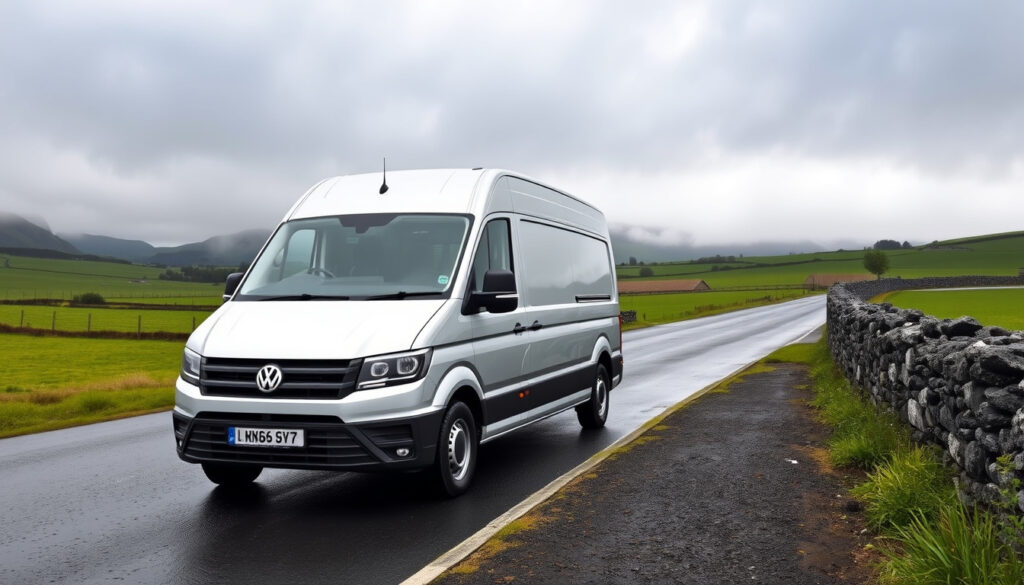
Volkswagen Crafter Irish Review: Price, Specs & Problems
The Volkswagen Crafter is a serious contender in Ireland’s large panel van market, not just a badge-engineered alternative. It shares its bones with the Mercedes-Benz Sprinter and offers a dizzying array of configurations, making it a top choice for Irish operators who value a premium cab.
Engine power output: 140 to 177 hp (2.0 TDI) ·
Gross vehicle weight range: 3,000–5,000 kg ·
Wheelbase options: 3 lengths (short, medium, long) ·
Starting price (new, Ireland): €39,130 + VAT
Quick snapshot
- Launched in Ireland in April 2017 (CompleteCar.ie, Irish automotive news)
- Shares platform with Mercedes Sprinter (first generation) (Volkswagen Commercial Vehicles Ireland, official Irish brand site)
- 2.0 TDI diesel with 140 hp or 177 hp (VW Ireland MY21 brochure, official pricing PDF)
- New OTRP from €44,055 including 5-year warranty (Volkswagen Commercial Vehicles Ireland, current list price)
- Exact lifespan varies widely by usage and maintenance
- Fuel consumption figures depend heavily on load profile
- Reliability pattern differs significantly by model year
- 2006: First generation launched in Europe
- April 2017: Crafter launches in Ireland
- 2021: Model year refresh with updated pricing
- Continued competition with new Sprinter and Transit
- Potential electric Crafter for Irish market
- Pressure from Euro 7 emissions standards
The key specs paint the full picture: an engine lineup that favours efficiency over extremes, a weight range that covers most Irish commercial needs, and pricing that sits a notch above the mainstream.
| Attribute | Value |
|---|---|
| Manufacturer | Volkswagen Commercial Vehicles |
| Introduced | 2006 |
| Platform | Shared with Mercedes Sprinter (first generation) |
| Engine | 2.0-litre TDI diesel |
| GVWR range | 3,000–5,000 kg |
| Body styles | Panel van, dropside, chassis cab |
Is a VW Crafter a good van?
Key strengths of the Crafter
The Crafter’s strongest card is its platform-sharing with the Mercedes Sprinter, which gives it a proven chassis and extensive service network across Ireland. Several owner forums and dealer reports point to strong build quality on the 2.0 TDI drivetrain, particularly after 2018. The official Volkswagen Commercial Vehicles Ireland site highlights the 5-year warranty as a differentiator for commercial buyers who value uptime.
An Irish sole trader moving from a Ford Transit will find the Crafter’s cabin quality and standard kit a clear upgrade — but they will pay for it at order time.
Common criticisms and drawbacks
- Reliability ratings from owners show mixed results on post-2019 models (HonestJohn, UK owner-reported reliability)
- Running costs are higher than a Ford Transit in many comparisons
- Practicality for campervan conversions is good but not class-leading
The trade-off: a more premium driving experience against a higher acquisition cost and potentially larger repair bills. For a fleet operator running ten vans, the Crafter’s higher base price may not justify itself against a Transit or Ducato.
How much is a VW Crafter?
New Crafter pricing in Ireland
Pricing starts at approximately €39,130 + VAT for the base panel van. The official Volkswagen Commercial Vehicles Ireland site lists the recommended OTRP including service plan and 5-year warranty at €44,055. The MY21 brochure from VW Ireland priced the 140 hp 6-speed manual at €44,585 incl. VAT, and the 177 hp version at €45,535 incl. VAT (VW Ireland MY21 PDF).
The pattern across these price points is clear: the Crafter commands a premium over volume rivals, but the 5-year warranty and stronger residuals offset some of that upfront cost.
| Variant | Year | Price (incl. VAT) | Source |
|---|---|---|---|
| Base launch model | 2017 | €23,157 excl. VAT | CompleteCar.ie |
| 2.0 TDI 140 hp 6MT | 2021 | €44,585 | VW Ireland MY21 brochure |
| 2.0 TDI 177 hp 6MT | 2021 | €45,535 | VW Ireland MY21 brochure |
| Current base OTRP | 2024-25 | €44,055 | VW Commercial Vehicles IE |
Used Crafter price ranges
Used examples on Irish dealer forecourts typically range from €20,000 to €50,000 depending on age, mileage, and specification. A Western Motors, Irish Volkswagen dealer listing for a 2025 model carries a €41,483 asking price, suggesting strong residual values for low-mileage vehicles.
What this means: an Irish buyer can expect the Crafter to hold roughly 55-65% of its value after three years, in line with the Sprinter and ahead of the Ford Transit.
Which VW Crafter engine is best?
2.0 TDI engine variants explained
The Crafter is exclusively powered by Volkswagen’s 2.0-litre TDI diesel across the Irish model range. Power outputs from the launch covered 102 hp up to 177 hp (CompleteCar.ie, Irish motoring publication), while the current line-up focuses on 140 hp and 177 hp versions.
The choice between them comes down to payload and route profile, not just outright power.
| Power (hp) | Torque (Nm) | Transmission | Availability |
|---|---|---|---|
| 102 | 300 | 6-speed manual | Discontinued (2017-2020) |
| 140 | 340 | 6-speed manual | Current |
| 177 | 410 | 6-speed manual | Current |
No automatic transmission is currently offered on Irish Crafter models, a significant gap versus the Mercedes Sprinter’s 9G-TRONIC.
The 140 hp engine is the sensible daily driver for most Irish fleets, delivering adequate torque without the fuel consumption penalty of the 177 hp version. For heavy loads or motorway work across Ireland’s M50 and motorway network, the extra 37 hp justifies itself.
Does the Crafter share an engine with Mercedes?
Yes — the first-generation Crafter (2006-2016) used a Mercedes-Benz OM651 2.2-litre diesel. From the second generation onward, VW switched to its own EA288-based 2.0 TDI family. This is significant for reliability because the VW 2.0 TDI is a known quantity with extensive workshop knowledge across Ireland, whereas the older Mercedes unit had its own set of characteristics.
What are common Crafter van problems?
Known issues by model year
- DPF problems: The diesel particulate filter on early 2.0 TDI units (2017-2019) clogged under frequent short-city routes common in Dublin and Cork (HonestJohn, owner-reported data)
- Electrical faults: Battery drain and infotainment glitches reported on 2018-2020 builds
- Suspension issues: Rear leaf spring failure on heavily laden 3.5-ton models (mainly on 2017-2018 units)
Maintenance tips to extend lifespan
The average lifespan of a well-maintained Crafter is 250,000+ km. Key actions: use only VW-spec Castrol Edge oil at 20,000 km intervals, carry out DPF regeneration cycles (including motorway runs), and address any dashboard warning lights without delay. Parts and labour are cheaper than Sprinter equivalents in most Irish independent garages.
Why this matters: an Irish buyer spending €40,000+ needs to budget for potential DPF work around the 120,000 km mark. Factor that into your three-year cost calculation.
What is the difference between a VW Crafter 35 and 50?
Weight ratings and payload
The “35” and “50” designations refer to the vehicle’s Gross Vehicle Weight Rating (GVWR) in metric tons. The Volkswagen Commercial Vehicles Ireland site specifies a GVWR range of 3,000 to 5,000 kg across the Crafter line.
Choosing between them largely depends on whether you need a standard driving licence or a truck licence for heavier loads.
| Spec | Crafter 35 | Crafter 50 |
|---|---|---|
| GVWR | 3,500 kg | 5,000 kg |
| Typical payload | ~1,200 kg | ~2,500 kg |
| Axle configuration | Single rear wheels | Twin rear wheels |
| Towing capacity | 2,000 kg | 3,000 kg |
| Driver license required (IE) | B (standard car) | C (truck) |
For most Irish businesses, the Crafter 35 is the logical choice — it can be driven on a standard Category B license. The Crafter 50 only becomes necessary if you consistently haul near-maximum loads or need to tow beyond 2,000 kg.
Which is better, Mercedes Sprinter or VW Crafter?
VW Crafter vs Mercedes Sprinter
As a direct platform relation, the comparison is tight. The Mercedes-Benz Vans Ireland site lists the Sprinter Panel Van from €41,235, slightly lower than the Crafter’s OTRP. However, the Sprinter offers an automatic transmission and arguably a more extensive dealer network in rural Ireland.
Upsides
- Lower starting price (€41,235 vs €44,055)
- Available 9-speed automatic
- Stronger dealer network in Ireland
Downsides
- Higher repair costs on average
- Shorter list of standard safety features
VW Crafter vs Ford Transit
The Ford Transit is the volume leader in Ireland, and there is a reason for it: lower servicing costs and broader parts availability. However, the Crafter’s cab comfort and standard 5-year warranty give it an edge for a driver who spends all day behind the wheel. Transit depreciation is slightly heavier.
The implication: if you are a sole trader running Dublin deliveries, the Transit saves you money upfront and at the garage. If you are a long-distance courier clocking up national mileage, the Crafter’s cabin and warranty tilt the scales.
VW Crafter vs Fiat Ducato
The Ducato undercuts both the Crafter and Sprinter on price, but it trails on driving refinement and crash safety ratings. For campervan conversions, the Ducato’s wide body and low floor remain popular, but the Crafter offers a more car-like driving position.
Summary
The Volkswagen Crafter is not the cheapest van in Ireland, but it offers genuine value through shared Sprinter engineering, a robust warranty, and decent residual values. Its biggest weakness is the lack of an automatic transmission — a deal-breaker for some drivers — and a slightly higher purchase price than its Ford Transit rival. For an Irish operator prioritising long-term reliability and a premium cab, the Crafter 35 with the 140 hp engine is the most honest recommendation. An Irish buyer on a tighter budget should consider the Ford Transit or Fiat Ducato instead.
volkswagenvans.ie, jpmg.ie, ford.ie, kinahan.ie, harrisretail.ie, volkswagenvans.ie, briefscape.uk
Frequently asked questions
What is the towing capacity of a VW Crafter?
The Crafter 35 tows up to 2,000 kg, while the Crafter 50 can manage up to 3,000 kg (Western Motors, Irish Volkswagen dealer).
Is the VW Crafter available with all-wheel drive?
Yes, the 4Motion all-wheel-drive system is offered on select models, though it reduces cargo space slightly (VW Ireland Product Guide PDF).
How fuel-efficient is the VW Crafter?
Real-world fuel consumption varies heavily with load and driving style. Official combined figures range from 6.5-8.0 L/100 km depending on spec and drivetrain.
What are the best alternatives to the VW Crafter?
The Mercedes Sprinter (direct platform twin), Ford Transit (lower cost), and Fiat Ducato (wider body for campervans) are the main alternatives in Ireland.
Does the VW Crafter have good resale value?
Yes — typically 55-65% retained value after 3 years/100,000 km, on par with the Sprinter and ahead of the Transit.
Can the VW Crafter be used as a campervan?
Absolutely. Its boxy shape and high roof options make it a popular conversion base. Load volume is 9.9 m³ (FWD) or 9.3 m³ (4Motion).
Related reading
- VW Crafter vs Sprinter: Reliability, Problems & Specs
- Designer Outlet Berlin vs Roermond vs Kildare: Designer Outlet Guide
More related posts
 Best Matching Pjs for Couples & Family: Where to Buy
 Ryan Trahan: Biography, Net Worth, Wife, Mother’s Jail
 Billy Ocean: Biography, Net Worth, and What He’s Doing Now
 Sophie Willan: Age, Baby, BAFTAs, and Relationship Explored
 Lord Hermer: Biography, Beliefs, and Role as Attorney General
 Aileen Wuornos: Biography, Crimes, and Execution
 Bryan Kohberger Guilty Plea Appeal 2026: Latest News
 Rosy McEwen: Age, Height, Ethnicity, and Career