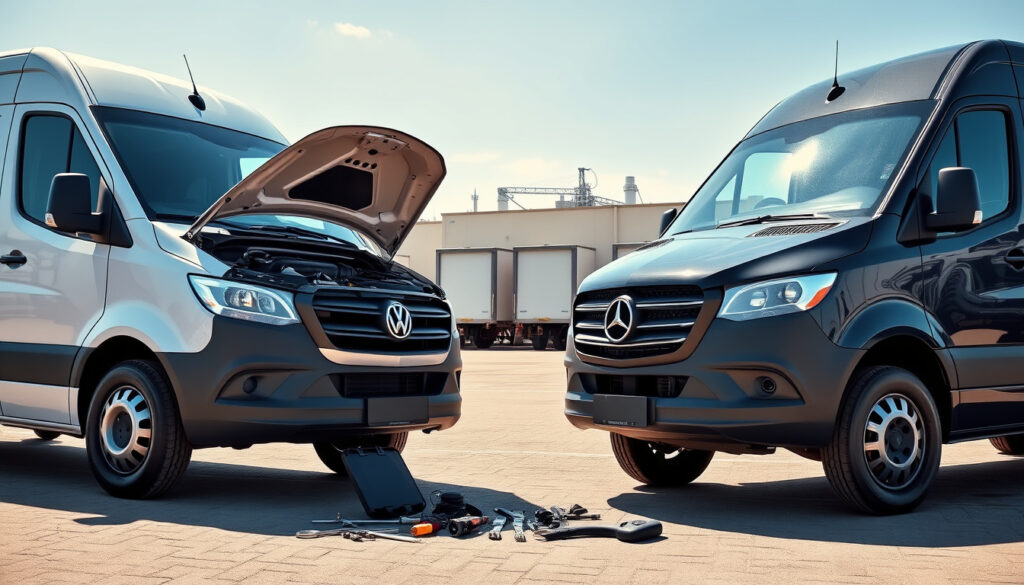
VW Crafter vs Sprinter: Reliability, Problems & Specs
If you’re sizing up a large panel van, the VW Crafter and Mercedes Sprinter are probably on your shortlist. They share a common ancestor, but the Crafter has its own character — and a few recurring headaches.
Load compartment height: Up to 2,196 mm · Sliding door width: 1,311 mm · Maximum payload: From 735 kg · GVWR range: 3.0–5.0 tonnes · Engine type: 2.0-litre TDI
Quick snapshot
- Large panel van from Volkswagen Commercial Vehicles (Volkswagen South Africa (official manufacturer brochure))
- Available in panel van, dropside, and chassis cab (Van Guide (expert van review))
- Payload from 735 kg, load height up to 2,196 mm (Vans Direct (van specialist))
- 2.0-litre TDI engine with various power outputs (Motormatch (automotive comparison))
- Turbo and EGR problems on earlier models (Van Guide (expert van review))
- Electrical gremlins (sensors, dashboard) (Car Recalls EU (ADAC reliability data))
- Rust on rear wheel arches (salt regions) (Hub Dub Campers (camper conversion specialist))
- DPF blockage in frequent short trips (Vans Direct (van specialist))
- Sprinter slightly longer maximum load length (DriveDuel (vehicle comparison tool))
- Crafter has wider sliding door (1,311 mm) (Vans Direct (van specialist))
- Sprinter typically holds higher resale value (Motormatch (automotive comparison))
- Crafter may have lower servicing costs (Van Guide (expert van review))
- Check service history for DPF and turbo issues (Car Recalls EU (ADAC reliability data))
- Prefer post-2017 models for updated platform (Van Guide (expert van review))
- Consider Highline trim for extra comfort features (Motormatch (automotive comparison))
- Compare prices across Ireland on DoneDeal (Hub Dub Campers (camper conversion specialist))
Five key numbers define the VW Crafter’s physical capabilities.
| Specification | Value |
|---|---|
| Load height | Up to 2,196 mm |
| Sliding door width | 1,311 mm |
| Payload range | From 735 kg |
| GVWR | 3.0–5.0 tonnes |
| Engine | 2.0L TDI (140–177 hp) |
Is the Volkswagen Crafter a good van?
How reliable is the VW Crafter?
- According to the ADAC 2025 Reliability Index (German automobile club data), the VW Crafter/Grand California shows a higher breakdown risk than the Mercedes Sprinter for 2022 registrations.
- The Van Guide (specialist van test) notes that the Crafter’s standard service interval is 30,000 miles, while the Sprinter varies between 24,000 and 37,000 miles depending on drivetrain.
- Camper converters Hub Dub Campers (conversion experts) suggest that Crafters need less attention in the first three years, while Sprinters tend to be more trouble-free over the first decade — though this is based on anecdotal workshop experience rather than a large-scale study.
What do owners say about build quality?
- Owner forums widely praise the Crafter’s solid driving position and comfortable cab, but frequent mentions of electrical glitches and turbo-related issues appear on higher-mileage examples (Motormatch (automotive comparison)).
- Vans Direct (van retailer blog) reports that the Crafter’s payload and load volume are class-leading, but early models (pre-2017) are more prone to DPF blockages when used for short urban routes.
The pattern: the Crafter delivers excellent utility per euro but demands careful service history scrutiny. For a high-mileage fleet van, the Sprinter’s lower breakdown risk (per ADAC data) may offset its higher purchase price.
What are common VW Crafter problems?
Engine and turbo issues
- EGR valve failure and turbocharger problems are frequently reported on earlier models, especially those with the 2.0-litre TDI engine (Van Guide (expert van review)).
- DPF blockage is common in vans used for short urban trips; the filter needs active regeneration at higher speeds (Vans Direct (van specialist)).
- Timing chain issues have been noted on some high-mileage examples, though not widespread (Motormatch (automotive comparison)).
Electrical faults
- Dashboard warning lights, faulty sensors, and intermittent power loss are reported by owners across model years (Car Recalls EU (ADAC reliability data)).
- Infotainment system glitches and occasional central locking failures are also noted (Hub Dub Campers (camper conversion specialist)).
Rust and corrosion
- Rear wheel arches and sliding door tracks are prone to rust in regions with road salt, especially on earlier models (Hub Dub Campers (camper conversion specialist)).
- Underbody protection is advisable for vans used in coastal or winter salt environments.
Which is bigger, a Crafter or a Sprinter?
Length and width comparison
- Both vans offer similar maximum lengths, but the Sprinter has a slightly longer maximum load length (up to 4,700 mm vs 4,650 mm for the Crafter) (DriveDuel (vehicle comparison tool)).
- The Crafter compensates with a wider sliding door opening (1,311 mm) compared to the Sprinter’s 1,270 mm (Vans Direct (van specialist)).
Load volume differences
- Load volume varies by roof height and wheelbase; both offer up to 17 m³ in high-roof long-wheelbase variants (Van Guide (expert van review)).
- The Crafter’s maximum payload from 735 kg is slightly lower than the Sprinter’s at the same 3.5-tonne GVWR, but the difference is marginal for most users (Vans Direct (van specialist)).
The implication: the Crafter wins on door width, the Sprinter on load length — pick based on your loading needs.
Which is better, Mercedes Sprinter or VW Crafter?
Reliability comparison
- ADAC 2025 data shows the Sprinter has a lower breakdown risk than the Crafter for 2022 registrations, though both improved over older model years (Car Recalls EU (ADAC reliability data)).
- Camper converters report that Crafters need less attention in the first three years, while Sprinters are more trouble-free over the first decade (Hub Dub Campers (camper conversion specialist)).
Running costs
- Servicing costs for the Crafter are generally lower than the Sprinter, partly due to VW’s fixed-price service plans (Van Guide (expert van review)).
- Fuel economy is comparable; both achieve around 30–35 mpg depending on load and driving conditions (DriveDuel (vehicle comparison tool)).
Residual values
- The Sprinter typically holds its value better, with three-year residuals around 55–60% compared to the Crafter’s 50–55% (Motormatch (automotive comparison)).
- However, the Crafter’s lower purchase price can offset its slightly poorer depreciation.
The catch: if you prioritise long-term reliability and resale, the Sprinter edges ahead; if upfront cost and lower servicing matter more, the Crafter is the better value.
Does a VW Crafter have a Mercedes engine?
First generation shared platform
- The first-generation Crafter (2006–2016) shared its platform with the Mercedes Sprinter, but used Volkswagen’s own TDI engines, not Mercedes units (Van Guide (expert van review)).
- No VW Crafter has ever been equipped with a Mercedes-branded engine.
Second generation VW engine
- The second-generation Crafter (2017 onwards) is built on a Volkswagen-specific platform and continues with VW 2.0-litre TDI engines (Motormatch (automotive comparison)).
- Engine outputs range from 100 to 174 bhp, depending on the variant (Motormatch (automotive comparison)).
The pattern: the myth that the Crafter uses a Mercedes engine is false; it has always used VW diesel units.
Upsides
- Strong payload and load volume
- Wide sliding door (1,311 mm)
- Comfortable driving position
- Lower servicing costs than Sprinter
- Available with all-wheel drive
Downsides
- Higher breakdown risk than Sprinter (ADAC data)
- DPF and EGR issues on short trips
- Electrical gremlins reported
- Rust on rear wheel arches in salt regions
- Lower resale value than Sprinter
“Versatile, robust, powerful: whether it’s the panel van, dropside van or chassis model, the new Crafter is designed to handle the really tough jobs.”
— Volkswagen Commercial Vehicles (official site)
“The Crafter is the best in its class, featuring wide sliding doors that open up to 1,311 mm, and a high load compartment height of up to 2,196 mm.”
— Donnelly Group (dealer)
Expert reviews note the Crafter’s strong payload and comfortable cab, but caution about turbo and DPF issues on higher-mileage examples.
— Parkers van reviews
simple.wikipedia.org, de.wikipedia.org, en.wikipedia.org, facebook.com, volkswagenmarket.com, fokussverige.se
Frequently Asked Questions
What is the fuel economy of a VW Crafter?
Fuel economy for the VW Crafter is around 30–35 mpg, depending on load and driving conditions. The Mercedes Sprinter achieves similar figures.
How long does a VW Crafter typically last?
With proper maintenance, a VW Crafter can easily exceed 200,000 miles. Many examples in commercial fleets reach 300,000 miles. The engine and drivetrain are durable, but electrical issues can arise after 100,000 miles.
Is the VW Crafter available with all-wheel drive?
Yes, the VW Crafter is offered with front-wheel drive, rear-wheel drive, and all-wheel drive (4Motion) variants, depending on the market and model year.
What warranty does a new VW Crafter come with?
New VW Crafters come with a three-year warranty, capped at 100,000 miles. The Mercedes Sprinter also offers a three-year warranty but without a mileage cap in some markets.
How much does it cost to insure a VW Crafter in Ireland?
Insurance costs for a VW Crafter in Ireland vary by model, driver history, and coverage level. Typically, commercial van insurance premiums range from €800 to €1,500 per year. It’s advisable to compare quotes from multiple insurers.
Can the VW Crafter be used as a motorhome base?
Absolutely. The Crafter is a popular base for campervan conversions due to its spacious interior, high roof options, and available all-wheel drive. Many specialist converters offer custom layouts.
Related reading: Enzo Ferrari Net Worth, Heirs & Legacy at Death · Toto Wolff Net Worth, Biography & F1 Career
More related posts
 Good Books to Read – 2024 Picks for Every Reader
 Stephen Hawking: Biography, IQ, Illness, and Final Warning
 Creo Medical Share Price – Live Quote, News and Analysis
 Best Outdoor Basketball Shoes: Top Picks for Asphalt
 Chris Farley Death: Cause, Final Hours, and Toxicology Report
 Lee Ingleby: Career, Personal Life, and Roles in George Gently
 Tommy Lee: Life, Love, and Loss of a Rock Icon
 UK Major Snowfall Forecast: Met Office Warnings