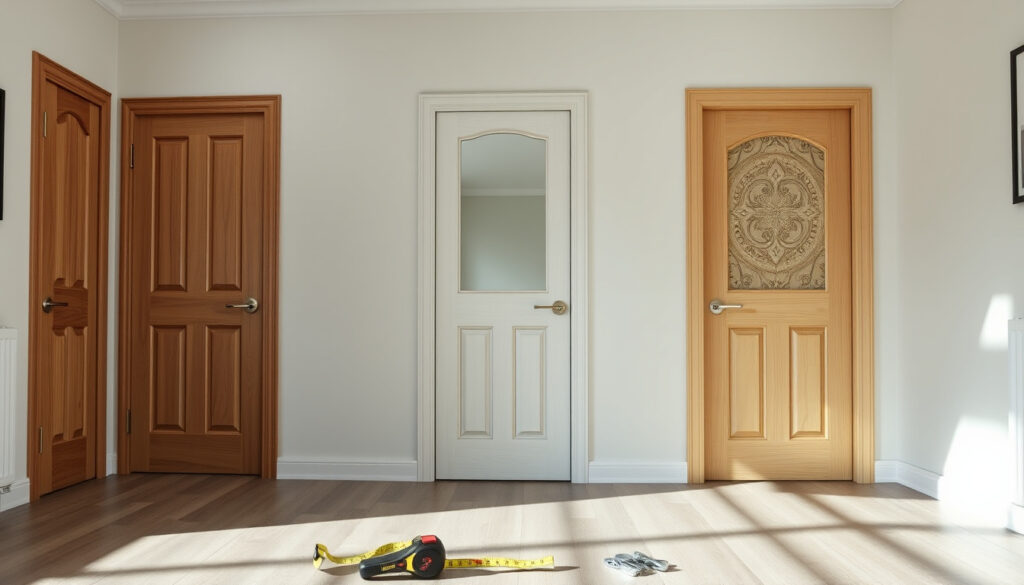
Internal Doors Ireland: Costs, Materials & Fitting
Anyone who’s ever tried to fit a new internal door into an old Irish house already knows the first rule: the frame is never quite square, and this guide exists to save you that headache. We’ll walk through materials, costs, and the distinct trade-offs Ireland’s damp climate forces on every choice, so you don’t end up with a door that swells shut after one wet winter.
“A pre‑hung door can be installed in 1–2 hours by a professional, cutting labour costs by half compared to a slab door.” — East Coast Doors (supply and fit specialist)
Average internal door cost in Ireland: €100 – €400 ·
Most popular material: MDF (medium-density fibreboard) ·
Standard door height in Ireland: 1981 mm (6’6″) ·
Common internal door width: 762 mm (30″) ·
Top supplier by online selection: Murphy Larkin
Quick snapshot
- Solid timber: natural finish, strong, heavy, expensive (Deanta Doors (Irish manufacturer))
- MDF: smooth, paintable, moisture-resistant, affordable (Chadwicks (builders’ merchant))
- Hollow core: lightweight, cheap, poor sound insulation (National Report (Irish consumer guide))
- Hollow core: €50 – €150 (National Report (Irish consumer guide))
- MDF pre-hung: €120 – €250 (DoorShop (Irish retailer))
- Solid timber: €250 – €600 or more (Premier Doors (Irish supplier))
- Fitting labour: €50 – €100 per door (East Coast Doors (supply and fit specialist))
- Slab door: requires cutting, cheaper door cost (MFM Joinery (Irish manufacturer))
- Pre-hung door: more expensive but faster to install (Murphy Larkin (Irish online retailer))
- DIY vs professional: figure 2-4 hours per door if experienced (East Coast Doors (supply and fit specialist))
- Frosted glass for privacy + light (East Coast Doors (supply and fit specialist))
- Clear glass for maximum light (Premier Doors (Irish supplier))
- Glass panels increase cost by 20-50% (National Report (Irish consumer guide))
Here are the key specifications for internal doors in Ireland.
| Attribute | Typical Value | Source |
|---|---|---|
| Standard internal door height (Ireland) | 1981 mm (6’6″) | National Report (Irish consumer guide) |
| Standard internal door width (Ireland) | 762 mm (30″) | National Report (Irish consumer guide) |
| Hollow core door weight | 8-15 kg | National Report (Irish consumer guide) |
| Solid timber door weight | 20-35 kg | Premier Doors (Irish supplier) |
| Typical labour cost to hang one door (Ireland) | €50 – €100 | East Coast Doors (supply and fit specialist) |
| Fire rated door requirement (Irish building regs) | FD30 (30 minutes) for certain internal rooms | Premier Doors (Irish supplier) |
Most Irish buyers focus on the cost of the door itself. But the real money is in the labour — €50 to €100 per door for fitting. A cheap slab door that needs three hours of routing and planing can end up costing more than a pre-hung unit that clicks in within an hour.
What are the best materials for internal doors?
Three materials dominate the Irish market, and each serves a different room and budget. Here is how they break down.
Solid timber doors
A solid timber door is a heavy, long-term investment. Manufacturers like Deanta Doors (Irish manufacturer) offer oak, walnut, and wenge finishes that can be stained to show natural grain. These doors weigh 20–35 kg — more than twice a hollow core — and provide noticeably better sound insulation and a denser, more substantial feel when they close. Expect to pay €250 to over €600, depending on wood species and design.
MDF (medium-density fibreboard) doors
MDF is the most common internal door material sold in Ireland, according to National Report (Irish consumer guide). Its smooth, paintable surface is a blank canvas, and it resists warping better than solid timber in the humidity typical of Irish homes — a real advantage in kitchens and bathrooms. Chadwicks (builders’ merchant) stocks MDF doors alongside timber and veneer options. Expect to pay €120–€250 for a pre-hung MDF door.
“MDF’s dimensional stability in humidity is not a marketing line; it is a structural necessity for rooms with direct moisture exposure.” — National Report (Irish consumer guide)
Hollow core vs solid core
Hollow core doors are the budget champion — lightweight (8–15 kg) and priced as low as €50–€100. They are fine for closets or utility rooms, but sound transmission is poor; you will hear conversation through them clearly. Solid core doors, by contrast, use a particleboard or timber core that adds weight and reduces sound by an estimated 30-50%. The trade-off is price (roughly double) and weight (harder hinges, stronger frame needed).
The pattern: If you are closing off a bedroom or home office, solid core MDF is the pragmatic middle ground — better acoustics than hollow, better moisture resistance than raw timber.
In Ireland’s damp climate, a solid timber door in a bathroom can cup or swell within two years. MDF’s dimensional stability in humidity is not a marketing line; it is a structural necessity for rooms with direct moisture exposure.
How much do internal doors cost in Ireland?
Pricing in Ireland is tiered by material, construction, and whether the door comes with a frame. Here is how the budgets stack up.
Budget internal doors
National Report (Irish consumer guide) notes that basic hollow-core slab doors can start around €65. DoorShop (Irish retailer) offers raw pine and primed options in this bracket. These are fine for non-critical rooms, but you get thin facings and minimal acoustic performance.
Mid-range internal doors
MDF pre-hung doors — the most popular category in Ireland — typically cost between €120 and €250. Murphy Larkin (Irish online retailer) carries a broad selection of white primed and oak-finished doors in this band. The pre-hung format includes the frame and hinges, cutting installation time by about half.
Premium internal doors
Solid timber, whether oak, walnut, or mahogany, runs from €250 to €600 or more. Premier Doors (Irish supplier) lists glass-panelled timber designs in the upper end. Add fitting labour at €50–€100 per door, and a solid timber door can cost €400–€800 fully installed.
The trade-off: Spending €250 on a solid timber door for a bedroom that stays 50% open most of the time is wasted money. Spend it on the door that closes — the home office or the master ensuite.
What is the difference between hollow core and solid core doors?
The difference is not just weight; it is the physics of how sound and heat move through the door. A hollow core door is essentially a thin skin over a cardboard honeycomb. A solid core door is dense particleboard or timber throughout.
Weight and feel
Hollow core doors weigh 8–15 kg — light enough that a standard hinge set carries them fine. Solid core doors weigh 20–35 kg (National Report (Irish consumer guide)). That extra mass changes the feel when the door closes; it sounds solid, not tinny.
Sound insulation
Solid core doors reduce sound transmission by an estimated 30–50% compared to hollow core, per data from National Report (Irish consumer guide). In a house with thin walls, that difference is audible.
Cost
Hollow core doors cost about half the price of solid core. A hollow slab might be €50–€80; a solid core slab starts at €120.
Durability
Solid core doors resist dents and impacts better over time. A hollow core door can puncture if struck hard.
The implication: For a hallway where the door gets constant use, solid core pays back in durability. For a spare bedroom, hollow core is perfectly adequate.
Which is better: MDF or timber internal doors?
This is the most common choice an Irish buyer faces. The answer depends on where the door is going and what finish you want.
Appearance and finish
Timber doors can be stained to show the natural grain — oak, walnut, wenge — and develop patina over time. Deanta Doors (Irish manufacturer) offers timber doors that are pre-finished and ready to hang. MDF doors have no grain; they are primed for painting, which makes them a favourite for homeowners who want a uniform white or a specific colour across all doors.
Resistance to moisture and warping
MDF is engineered to resist warping. In Irish homes where humidity can swing from 50% in winter to 80% on a wet summer day, MDF stays stable. Solid timber can expand and contract, leading to sticking or gaps. Chadwicks (builders’ merchant) recommends MDF for kitchens and bathrooms for this reason.
Longevity and maintenance
Solid timber, properly maintained, can outlast MDF by decades. Scratches on timber can be sanded and refinished. MDF chips are hard to repair cleanly.
Price comparison
Solid timber doors cost 40–60% more than MDF of similar style. A primed MDF door at €150 might be €280–€300 in oak.
What this means: Choose timber for public rooms where the door is a design statement. Choose MDF for rooms where humidity or budget is the constraint.
Should I buy pre-hung or slab internal doors?
The decision is about your time, skill level, and whether the existing frame passes muster.
What is a pre-hung door?
A pre-hung door comes from the factory with the door slab already attached to the frame and hinges installed. You slot the whole unit into the opening and shim it level. Murphy Larkin (Irish online retailer) carries a full range of pre-hung kits, including oak, primed, and glass-panelled styles.
What is a slab door?
A slab door is just the door — no frame, no hinges, no latch holes. You must cut hinge mortises, drill for the handle, and plane the edges to fit the existing frame. MFM Joinery (Irish manufacturer) supplies slab doors in softwoods and hardwoods including oak, ash, and sapele mahogany.
Difficulty of installation
Pre-hung doors take 1–2 hours for a professional, per East Coast Doors (supply and fit specialist). A slab door can take 3–5 hours for a skilled DIYer, plus the cost of a router if you do not own one.
Cost comparison
Pre-hung doors cost €30–€80 more than slab doors of the same type. But the labour saving — one hour less per door — can offset the premium if you are paying a fitter.
The catch: If your existing frame is solid and square, a slab door is cheaper and simpler. If the frame is old, twisted, or missing, a pre-hung unit is the better bet.
How do glass internal doors affect room privacy and light?
Glass doors are popular in Ireland for hallways and living areas where natural light is scarce.
Types of glass used in internal doors
The most common types are frosted, textured, and clear. East Coast Doors (supply and fit specialist) offers plain glass through leaded glass options. Chadwicks (builders’ merchant) says its interior doors with glass use safety glass as standard.
Frosted vs clear glass
Frosted or textured glass lets in light while obscuring view. Clear glass provides maximum light transmission but minimal privacy — fine for a study, not for a bathroom.
Privacy considerations
A single clear glass panel in a door to a living room gives the room an open feel but means anyone in the hallway can see in. Frosted panels solve that while still allowing borrowed light.
Light benefits
In narrow Irish hallways with no window, a glass-panelled door to the living room can reduce the need for artificial lighting during the day.
Why this matters: Glass adds 20–50% to the door cost but can transform how a dark house feels. For a return on atmosphere, it is the easiest upgrade.
Where can I buy internal doors in Dublin?
Dublin buyers have access to a mix of online specialists and physical trade counters.
Online retailers
Murphy Larkin (Irish online retailer) offers what it says is Ireland’s largest online selection of oak and primed doors, including pre-hung kits and fire doors. DoorShop (Irish retailer) provides raw pine and primed options for delivery across Ireland. DoorsIreland (large stockist) holds large stocks in Ireland of oak, walnut, and white primed doors.
Physical showrooms in Dublin
East Coast Doors (supply and fit specialist) offers a supply-and-fit service from its Dublin base. Pronto Doors (Irish manufacturer) has showrooms in Limerick, Dublin, and Belfast.
Builders’ merchants
Chadwicks (builders’ merchant) sells interior doors for trade and DIY customers with click-and-collect. Golden Pages (Irish business directory) lists BPM Supplies in Dublin 10 as an internal door seller.
The pattern: For speed, go online. For seeing the door in person and matching colour to your trim, a physical showroom is worth the trip.
Bottom line: Most Irish buyers spend more time picking the door than checking the frame. But an old, out-of-square frame can make a premium door look amateur. For homeowners replacing a single door, a pre-hung unit from a supplier like Murphy Larkin or Chadwicks removes the risk. For a whole-house replacement, budget for a professional fitter and put the savings into solid core doors for bedrooms and MDF for the rest. The choice is not between price and style — it is between understanding where your house’s humidity and sound live.
For a detailed breakdown of prices and installation trends, check out this comprehensive internal door cost guide for 2026.
Frequently asked questions
How do I measure for a new internal door?
Measure the door height from floor to top of the frame, and width from frame to frame. Also check the frame opening depth. Standard sizes in Ireland are 1981 mm height and 762 mm width.
Are internal doors fire rated?
Only if specified. FD30 doors are required by Irish building regulations in certain situations, such as between a garage and house or in shared corridors in apartments.
Can I paint an MDF internal door?
Yes, MDF doors are primed specifically for painting. Use a high-quality water-based primer and two coats of paint. Do not use solvent-based paints as they may cause the MDF to swell.
How long does it take to hang an internal door?
A pre-hung door can be installed in 1-2 hours by a professional. A slab door requires cutting hinges and latch hardware, taking 3-5 hours for a DIY enthusiast.
Do glass internal doors reduce room privacy?
Frosted or textured glass provides privacy while allowing light. Clear glass offers no privacy. The level of privacy depends on the glass type and the room’s location.
More related posts
 Virgin Airlines: Who Owns It and Does It Still Fly in the USA
 Shaun Ryder: Happy Mondays Frontman to Gogglebox Star
 Adam Levine: Cheating Allegations, The Voice Exit, and Return
 Rebekah Brooks: Phone Hacking, Net Worth, Comeback
 George Foreman Net Worth, Death Cause, Career & Grill Fortune
 Huda Mustafa: Nationality, Age, Baby Daddy, and More
 Black Cardigan Guide: Styles, Where to Buy, and How to Style
 Cheap Car Insurance UK 2026: How to Get the Cheapest Quotes