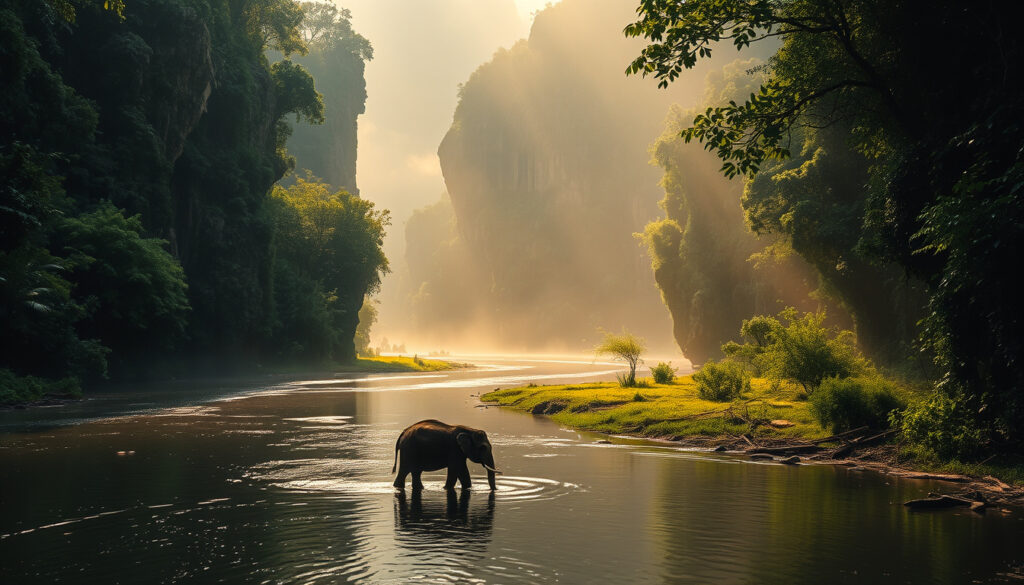
Khao Sok National Park: Worth Visiting? Costs & Wildlife
There’s a reason travelers who have been to Phuket, Krabi, and the islands still talk about Khao Sok with a certain reverence. This 739 km² national park in southern Thailand holds one of the oldest evergreen rainforests on the planet — older and more biodiverse than the Amazon — and it delivers a jungle experience that Thailand’s coastal hubs simply cannot replicate.
Area: 739 km² · Established: 1980 · Rainforest age: Over 160 million years · Average annual rainfall: 3,500 mm · Bird species: Over 300 · Mammal species: 48
Quick snapshot
- Park contains the oldest evergreen rainforest on Earth (Khao Sok Beginner’s Guide)
- Entrance fee: 300 THB for adults, valid 24 hours (Rough Guides)
- Asian elephants and estuarine crocodiles inhabit the park (Thailand National Parks)
- Current tiger population — no confirmed sightings since the early 2000s (Thailand National Parks)
- Exact number of remaining wild elephant herds (Thailand National Parks)
- Whether crocodile attacks on tourists have occurred (Thailand National Parks)
- 1980: Khao Sok National Park established
- 1982: Ratchaprapha Dam completed, creating Cheow Lan Lake
- 2000s: Tourism infrastructure expands; floating bungalows appear
- Growing demand for low-season travel to avoid crowds
- Sustainable tourism initiatives around floating bungalow regulations
- Continued camera trap monitoring for tiger presence
Khao Sok National Park key facts
Eight facts, one pattern: the park’s superlatives — oldest rainforest, largest man-made lake in Thailand — come with real trade-offs in access and certainty.
| Location | Southern Thailand, Surat Thani Province (Khao Sok Beginner’s Guide) |
| Nearest airport | Phuket (HKT) – 2 hours drive |
| Established | 1980 |
| Area | 739 km² |
| Rainforest age | Over 160 million years |
| Lake area (Cheow Lan) | 185 km² |
| Peak season | December–April |
| Park entrance fee (adult) | 300 THB (Rough Guides) |
The pattern: Khao Sok is one of the oldest and most biodiverse parks in Thailand, offering a genuine jungle experience far removed from the coastal resort hubs.
Is it worth going to Khao Sok National Park?
The short answer: yes, but only if you want a genuine rainforest experience — not a polished resort vacation. Khao Sok’s ancient ecosystem offers something the beach towns can’t: immersion in a 160-million-year-old jungle where limestone karsts rise from emerald water and the soundtrack is gibbon calls, not jet skis.
Pros and cons of visiting Khao Sok
Upsides
- World’s oldest evergreen rainforest — more biodiverse than the Amazon (Khao Sok Beginner’s Guide)
- Cheow Lan Lake’s limestone karsts rival Halong Bay without the crowds
- Smaller crowds than Phuket or Krabi, especially in low season
- Range of accommodation from budget bungalows (from 500 THB) to luxury floating lodges
- Authentic wildlife experiences — elephants, gibbons, hornbills
Downsides
- Wildlife sightings are not guaranteed — patience required
- Leeches are common in wet season jungle trails
- Limited nightlife and dining compared to coastal hubs
- Rainy season (May–November) can disrupt lake tours and treks
- Tour quality varies widely — reputable guides recommended
How does Khao Sok compare to other Thai parks?
Khao Sok’s edge is habitat diversity: rainforest, lake, and karst formations in one park. Thailand National Parks ranks it among the most biodiverse mainland parks, with over 300 bird species and 48 mammal species — figures that outpace Khao Yai in some categories. What Khao Yai has in accessibility (closer to Bangkok), Khao Sok trades for dramatic geography and a more remote feel.
The implication: Khao Sok is for travelers who want to trade convenience for immersion. If your priority is easy wildlife viewing with guaranteed sightings, a well-marked trail system like Khao Yai’s might serve you better. If you want to sleep on a lake in a floating bungalow surrounded by limestone cliffs, Khao Sok is unmatched.
Are there tigers in Khao Sok?
This is the question that draws many visitors — and it’s the one with the most sobering answer.
Historical tiger population in Khao Sok
The park sits within the Tenasserim Hills forest complex, a historically significant tiger corridor connecting Thailand’s western forests with Myanmar. Camera trap surveys conducted by Thailand’s Department of National Parks detected tiger presence in the region through the late 1990s.
Current tiger status and sightings
No confirmed wild tiger sightings have been recorded in Khao Sok since the early 2000s, according to Thailand National Parks (the official park authority). Poaching, habitat fragmentation, and prey depletion have decimated populations across the Tenasserim range. A ranger from Khao Sok noted that “tiger sightings are extremely rare and only historical,” reflecting the grim reality that Indochinese tigers are functionally extinct in much of their former range.
If you’re visiting Khao Sok specifically hoping to see a tiger, you will leave disappointed. The park’s real wildlife draw is elephants, gibbons, and birds — not the big cat that has all but vanished.
How expensive is Khao Sok?
Spoiler: it’s significantly cheaper than Phuket, but costs vary wildly depending on how you visit.
Entrance fees and park costs
- Adult entrance fee: 300 THB (valid for 24 hours) — confirmed by both Rough Guides and Nomadic Matt
- Children: 150 THB
- Vehicle entry fee (if driving): additional charge at checkpoint
Accommodation price ranges
Accommodation costs vary widely depending on comfort level and location.
| Type | Price per night | Notes |
| Basic jungle bungalow | from 500 THB | Fan, cold water, basic amenities |
| Mid-range guesthouse | 800–1,500 THB | AC, hot water, some with pool access |
| Floating bungalow (Cheow Lan) | 1,500–5,000 THB | Price includes meals; basic to deluxe options |
| Luxury eco-resort | 3,000–8,000 THB | Full-board packages, guided activities |
Tour and activity costs
- Half-day guided trek: 600 THB (from Nomadic Matt)
- Full-day guided trek: 1,200 THB
- Night hiking (6 PM–9 PM): 600 THB
- 2-day/1-night lake tour (floating bungalow included): 1,500–3,000 THB per person (from Wanderlust Chloe)
- Minivan from Phuket: 320 THB one way
- Private taxi from Phuket: 2,800 THB one way
The pattern: a solid budget of 1,500–2,500 THB per day (excluding transport to the park) covers a good bungalow, meals, and one guided activity. Pair that with the flat 300 THB entrance fee, and Khao Sok becomes a cheaper alternative to a day in Patong.
Budget travelers can get by on 1,000 THB/day staying in village bungalows and cooking some meals. But the lake experience — floating bungalows, boat transfers, kayaking — costs 2,000–3,000 THB per person no matter how you book.
How do I get into Khao Sok National Park?
The access question matters because Khao Sok isn’t a quick detour — it’s a deliberate journey that requires planning from whichever Thai city you’re based in.
From Phuket
- Minivan: 320 THB one way, ~2 hours, multiple daily departures from Phuket bus terminal
- Private taxi: ~2,800 THB, door-to-door, ~2 hours
- Self-drive: Follow Route 402 through Phuket, cross Sarasin Bridge, then Route 401 north to kilometer marker 109
From Krabi
- Minivan: ~250 THB, ~2–2.5 hours
- Private transfer: ~2,000 THB
From Surat Thani
- Minivan: 240 THB one way (from Nomadic Matt), ~1.5 hours
- Train to Phun Phin station then bus: slightly slower but cheaper route
From Bangkok
- Overnight train to Surat Thani: ~800–1,200 THB for sleeper, then minivan to Khao Sok (240 THB)
- Flight to Surat Thani (URT): from 1,500 THB one way (Air Asia, Nok Air), then minivan
- Bus from Bangkok Southern Terminal: ~600 THB, 11–12 hours
Rough Guides notes that the park entrance is at kilometer 109 on Highway 401, about 2 km from the tourist village — a map from the checkpoint office helps orient first-timers.
The transport cost to Khao Sok often exceeds the accommodation cost. For a family of four, a private transfer from Phuket (2,800 THB) plus park entry fees (1,200 THB) adds up to 4,000 THB before you’ve paid for lodging. Budget travelers should factor transport into their total trip cost, not just the nightly rate.
What wildlife can you see in Khao Sok National Park?
Expectation management is the key to a rewarding wildlife experience here. The park is wild — not a safari park with guaranteed sightings.
Mammals: elephants, gibbons, bears, wild boar
- Asian elephants: Regularly seen near Cheow Lan Lake, especially at dawn and dusk
- Gibbons: Heard more than seen — their morning calls echo across the valley
- Macaques and langurs: Common near the tourist village
- Sun bears and wild boar: Present but rarely seen without night hiking
- Tapirs and slow lorises: Nocturnal; best spotted on night safaris
Birds: hornbills, kingfishers, eagles
- Over 300 bird species recorded in the park — among the highest counts in Thailand (Thailand National Parks)
- Great hornbills and oriental pied hornbills are the park’s star species
- Blue-eared kingfishers and white-throated kingfishers along lake shores
- Crested serpent eagles and changeable hawk-eagles soar overhead
Reptiles: crocodiles, monitor lizards, snakes
- Estuarine crocodiles: Inhabit Cheow Lan Lake and rivers — swimming is not recommended (Rough Guides)
- Water monitors: Common near water bodies, can grow over 2 meters
- King cobras and pythons: Present but elusive; most visitors never see them
Rough Guides warns that monkeys can be aggressive — avoid feeding them and keep food sealed.
The pattern: visitors who go with a guide and start before dawn see three times more wildlife than those who wander mid-day. The catch is that dawn starts mean a 5 AM wake-up — worth it for a gibbon chorus, not for a lie-in.
Khao Sok rewards patient, dawn-active visitors with genuine rainforest immersion, but anyone expecting a curated safari experience with guaranteed tiger or elephant sightings will find the park’s wild, uncontrolled nature a challenge rather than a thrill.
How to plan your Khao Sok visit: a step-by-step guide
Here’s the sequence that works for most first-time visitors who want to cover the park’s two main zones — the rainforest trails and Cheow Lan Lake — without wasting time.
- Decide how many nights. A 2-night/3-day trip is the sweet spot: one night in the village for jungle treks, one night on the lake for the floating bungalow experience.
- Book transport from your departure city. Minivans from Phuket, Krabi, or Surat Thani drop you at the tourist village.
- Pay entrance fee at the checkpoint. 300 THB adult, 150 THB child, valid 24 hours. Keep the ticket — you’ll need it for re-entry.
- Book a guide for day 1. Half-day trek (600 THB) in the morning, then afternoon free. Night hiking (600 THB) if you want to see nocturnal species.
- Arrange your lake trip for day 2. Book through your accommodation or a tour shop in the village. The 2-day/1-night package includes boat transfer to floating bungalows, meals, and kayaking.
- Plan for exit on day 3. Morning wildlife viewing or a final short trek before your afternoon transport.
For more detailed budget travel planning, you might find our Flights to Palma de Mallorca: Cheap Airlines and Budget Guide useful for understanding overall trip structuring, while our Things to do in Blackpool guide offers a different perspective on destination guides.
justynjen.com, tripadvisor.com, youtube.com, memoirs-of-acacia.com
Frequently asked questions
What is the entrance fee for Khao Sok National Park?
300 THB for adults, 150 THB for children. The pass is valid for 24 hours from the time of purchase, making it good value for overnight visits.
Can I stay overnight in the park?
Yes, but only in designated accommodation. Options range from basic jungle bungalows (from 500 THB) in the tourist village to floating bungalows on Cheow Lan Lake (1,500–5,000 THB). Camping is not permitted inside the core zone.
Is it safe to swim in Cheow Lan Lake?
Not recommended. Estuarine crocodiles are confirmed inhabitants of the lake and rivers, and the water depth and current near the dam can be unpredictable. Floating bungalows provide life jackets for kayaking, but deliberate swimming is discouraged.
What should I pack for a trip to Khao Sok?
Rough Guides recommends loose long trousers, a long-sleeved shirt, insect repellent, and plenty of water. Add: waterproof shoes or sandals (mud on treks), a rain jacket (especially May–November), a flashlight (for night walks), and any medication you might need — the nearest proper pharmacy is in Surat Thani.
Are there leeches in the jungle?
Yes, especially after rain and in wet season (May–November). They’re harmless (no disease transmission in Thailand) but unpleasant. Wear leech socks or tuck trousers into socks. Guide teams carry salt to remove them. Travelers on Nomadic Matt’s trip described them as “numerous but manageable.”
How far is Khao Sok from Phuket?
About 140 km, which takes roughly 2 hours by minivan or car. It’s a straightforward drive on paved highways, making Khao Sok a viable add-on to a Phuket itinerary.
Do I need a guide to explore the park?
Not legally required, but strongly recommended. The trails are not well-marked, and a guide dramatically increases your chances of spotting wildlife (they know where to find gibbon troops, elephant tracks, and hornbill nests). Guides cost 600 THB for a half day — money well spent.
What is the best time of day for wildlife viewing?
Dawn (5:30–7:30 AM) and dusk (4:30–6:30 PM). Most mammals and birds are active in the cooler hours. Mid-day heat drives animals into shade and cover. Night hikes (6–9 PM) reveal nocturnal species like civets, slow lorises, and owls.
This guide provides a comprehensive, fact-checked foundation for deciding if Khao Sok National Park aligns with your travel expectations, ensuring visitors can make an informed choice based on verified costs and realistic wildlife insights.
More related posts
 Matt Bomer Biography: Age, Husband, Kids & Career
 Cast of Grace (TV Series): Full Character Guide for All Seasons
 Aamir Khan: Age, Wife, Top Movies, Instagram, Productions
 La Voix: Real Name, Injury, Strictly Withdrawal & Return
 Burt Reynolds: Cause of Death, Estate, and Sally Field
 Queen Band: Who’s Alive and What Happened After Freddie
 Lord Hermer: Biography, Beliefs, and Role as Attorney General