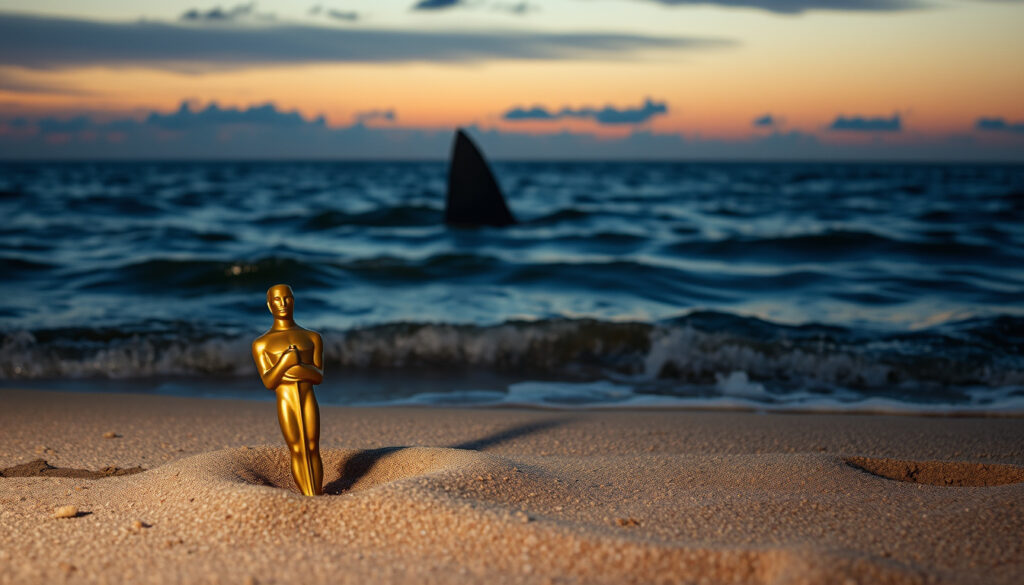
Robert Shaw: Death, Jaws, and His Oscar Nomination
Few entrances in cinema announce a character as completely as Quint’s in Jaws — the boat reversing into frame, the captain reeking of brine and bad temper. Robert Shaw, the man behind the performance, was harder to reduce to a single label: British actor, published novelist, playwright, and the star of a shark film that still defines his memory, earning exactly one Academy Award nomination, never winning, and dying in Ireland at 51 in 1978, leaving a trail of stories that biography has never quite caught up with.
Born: 9 August 1927 · Died: 28 August 1978 · Age at death: 51 · Cause of death: Heart attack · Oscar nominations: 1 · Oscar wins: 0
Quick snapshot
- Born 9 August 1927 in Westhoughton, Lancashire. Britannica (reference encyclopedia)
- Died 28 August 1978 in Tourmakeady, County Mayo, Ireland (Academy Award Person Data (Oscars records)).
- One Academy Award nomination, for A Man for All Seasons (1966). Classic Movie Hub (classic-film database)
- His exact last words: no reliable record exists.
- The origin of his limp: undocumented in the sources reviewed for this article.
- The precise nature of his co-star feuds: competing memories, not court documents.
- 1963: played SPECTRE assassin Donald Grant in From Russia with Love (BAFTA (UK film and television academy)).
- 1966: earned his only Oscar nomination as Henry VIII in A Man for All Seasons. (BAFTA (UK film and television academy))
- 1975: played Quint in Jaws, the role that would define his legacy. (BAFTA (UK film and television academy))
- Retrospectives keep rediscovering Shaw’s literary side, not just the drinking stories. Oxford Dictionary of National Biography (UK biographical record)
- His final film and unfinished novels remain the bookends of a career cut short at 51. (Wikipedia (community encyclopedia) for final film; Gold Derby (awards-analysis site) for unfinished novels)
Nine facts, one basic biography: the records agree on the dates and the roles; the arguments start everywhere else.
| Aspect | Detail | Source |
|---|---|---|
| Full name | Robert Archibald Shaw | Oxford Dictionary of National Biography (UK biographical record) |
| Born | 9 August 1927, Westhoughton, Lancashire, England | Britannica (reference encyclopedia) |
| Died | 28 August 1978, Tourmakeady, County Mayo, Ireland | Academy Award Person Data (Oscars records) |
| Occupation | Actor, novelist, playwright | Oxford Dictionary of National Biography (UK biographical record) |
| Notable roles | Quint (Jaws, 1975), Henry VIII (A Man for All Seasons, 1966), Doyle Lonnegan (The Sting, 1973) | IMDb (film database) |
| Oscar nominations | 1 — Best Supporting Actor, A Man for All Seasons (1966) | Classic Movie Hub (classic-film database) |
| Oscar wins | 0 | Oscars.org (Academy of Motion Picture Arts and Sciences) |
| Cause of death | Heart attack | Wikipedia (community encyclopedia) |
| Final film | Avalanche Express, released after his death | Britannica (reference encyclopedia) |
Did Robert Shaw win any Oscars?
Short answer: one nomination, zero wins. Shaw’s only Academy Award nomination came for Best Supporting Actor as Henry VIII in A Man for All Seasons (1966) (Classic Movie Hub (classic-film database)). The nomination recognized a supporting performance in a costume drama, not the roles that made him a household name.
The irony is hard to miss: the performance the Academy singled out is a historical pageant piece, while the role that made Shaw immortal — Quint — was never nominated and never needed to be.
The Academy’s blind spot became the audience’s gain: the performance too “commercial” to nominate in 1975 is the one still playing on screens decades later.
Three performances, one pattern: the Academy nodded at Shaw once; audiences kept noticing him all decade.
| Film | Year | Role | Recognition | Source |
|---|---|---|---|---|
| A Man for All Seasons | 1966 | Henry VIII | Academy Award nomination, Best Supporting Actor | Classic Movie Hub (classic-film database) |
| The Sting | 1973 | Doyle Lonnegan | No Oscar nomination | Rolling Stone (culture magazine) |
| Jaws | 1975 | Quint | No Oscar nomination | Britannica (reference encyclopedia) |
The pattern: the Academy’s kind of prestige and the public’s kind of memory diverged sharply. Shaw earned his only slot for a Henry VIII that audiences vaguely remember, while the role nobody nominated became the one people quote by heart.
What were Robert Shaw’s last words?
Shaw died on 28 August 1978 in Tourmakeady, County Mayo, Ireland, at the age of 51 years and 19 days (Academy Award Person Data (Oscars records)). Contemporary obituaries, including The New York Times’ report, described the death as sudden (The New York Times (archival obituary)).
According to Wikipedia’s account, he was driving from Castlebar back to his home nearby when he suffered a heart attack (Wikipedia (community encyclopedia)). He was living in the Irish countryside, far from the Hollywood sets that made him famous. His last words? Nobody recorded them. The verified record contains no deathbed line — which makes any claimed last words exactly that: a claim.
The last-words question is a test case for Shaw’s whole biography: if a detail isn’t in the verified record, it is a story first and a fact never.
Shaw’s death belongs to a category that keeps drawing readers: actors whose final chapter becomes a headline. David Carradine’s death and Ray Liotta’s last film produced the same brand of myth-making, and the lesson is always the same — the facts are usually calmer than the story. For more on that pattern, see David Carradine: Death, Kung Fu, and Martial Arts Legacy and Ray Liotta: Cause of Death, Last Film, and De Niro’s Tribute.
Was Robert Shaw buried in a mass grave?
A recurring internet claim says Shaw was buried in a mass grave. It is false.
Shaw received a private burial in Ireland (The Irish News (Northern Ireland daily)). The mass-grave story is a textbook example of how his death became a projection screen: the truth was tragic enough, and a rumor was easier to pass around than a death certificate to check.
Why did Robert Shaw limp?
Watch Quint’s first scene in Jaws and the limp is easy to miss — the menace takes up more room. Ask a room of fans about it, though, and half of them will have a theory: old rugby injury, war wound, fishing accident. The honest answer is that the source record doesn’t confirm any of them.
The biographical material reviewed for this article documents the dates, the heart attack, and the filmography in detail. The origin of the limp is not among the established facts. It may have been a real condition, a mannerism Shaw used for character work, or something in between — the record simply doesn’t say.
The limp is Shaw’s biography in miniature: a physical detail that became part of the legend precisely because the factual record is quiet about it.
What the film record does show is an actor in complete control of his body. The sailor’s shuffle, the sea-worn voice, the careful rhythm of the Indianapolis monologue — whatever the limp’s origin, Shaw turned it into character.
The implication: the questions Shaw’s life raises are often more telling than the answers. A gap in the record is a gift to mythmakers and a warning to readers.
What was Robert Shaw like as a person?
Take a dozen accounts of working with Shaw and a strange composite emerges: a man who could be charming, literate, and generous one hour, then hard-drinking and combative the next. The pattern shows up across film-industry biographies: brilliant, difficult, unpredictable (IMDb (film database)).
The writing wasn’t a side hustle. Shaw was a published novelist and playwright, and he was at work on his sixth novel when he died — a fact that sits awkwardly with the “difficult drunk” caricature (Gold Derby (awards-analysis site)).
The man who reportedly made Jaws miserable was the one rewriting its best scene. The hard-drinking legend and the careful writer don’t cancel each other out — both are true.
Was Robert Shaw a good man?
The case in his favor
- Wrote novels and plays and was mid-way through another novel at his death.
- Rewrote much of his own dialogue in Jaws, lifting the film’s most famous scene.
- Earned lasting respect from peers like Sean Connery, who spoke of his talent.
The case against
- Reportedly drank heavily on the Jaws set, making a brutal shoot harder.
- Clashed with younger co-star Richard Dreyfuss during filming.
- Built a reputation for unpredictability that followed him between productions.
The verdict that matters: Shaw’s colleagues disagreed about the man but not about the actor. The kindness he didn’t always show the people in the room, he showed the work.
Did Sean Connery and Robert Shaw get along?
Not in the warm-and-fuzzy sense — but “getting along” was never really the point. Shaw played SPECTRE assassin Donald Grant opposite Connery’s Bond in From Russia with Love (1963), and the two men went at it in a train-compartment fight that still looks genuinely painful. The dynamic between the two actors has been part of Bond lore ever since — the kind of story that BAFTA’s retrospectives on British film keep circulating (BAFTA (UK film and television academy)).
The relationship reads less as a headline feud and more as a professional standoff: both actors at their peak, both used to being the most dangerous man in the room. Part of what makes the fight scene work is that the actors aren’t performing mercy. Grant and Bond hit each other like men trying to end a conversation, and the roughness is something later Bond films never quite recaptured.
Why did Richard Dreyfuss not like Robert Shaw?
- The Jaws shoot was grueling: months at sea, a famously malfunctioning mechanical shark, and scenes that demanded endless takes in the water.
- Shaw and Dreyfuss were a generation apart, with different methods and different tolerances for chaos.
- Dreyfuss later spoke publicly about the friction, and his recollections are far from warm.
The tensions on the Jaws set are well documented in film-industry biographies, with IMDb’s Shaw profile recording the drinking and the friction as defining memories of the production (IMDb (film database)).
Did Robert Shaw like Paul Newman?
- They shared the screen in The Sting (1973): Shaw’s Doyle Lonnegan against Newman’s Henry Gondorff.
- Their on-screen rivalry drives the film’s second half.
- Off screen, the record consulted for this article contains no reliable quote from either man about their feelings.
The truthful answer: nobody has produced solid evidence of a deep friendship or a deep feud. What the film shows is a chess match between two stars who understood exactly how to play against each other.
The pattern across Shaw’s co-star relationships: friction was real, and so was respect. He made scenes better, schedules harder, and memories lasting.
What are some memorable quotes by Robert Shaw from the movie Jaws?
Most of the dialogue people remember from Jaws is Quint’s, and much of it was Shaw’s own writing. The British Film Institute’s production history records that Shaw rewrote substantial stretches of his part (British Film Institute (UK film body)).
Here are the lines that stuck, all delivered by Shaw as Quint:
- “Eleven hundred men went into the water, three hundred sixteen come out, the sharks took the rest, June the 29th, 1945.”
- “You know the thing about a shark — he’s got lifeless eyes. Black eyes. Like a doll’s eye.”
- “Farewell and adieu to you, fair Spanish ladies. Farewell and adieu, you ladies of Spain.”
The monologue, a haunting retelling of the USS Indianapolis disaster, is the centerpiece of the performance; critics have repeatedly called it one of the greatest scenes in film history (Rolling Stone (culture magazine)). One correction while we’re here: “You’re gonna need a bigger boat” — the line eternally tangled up with the film — actually belongs to Roy Scheider’s Chief Brody, not Quint.
Shaw’s own words about his craft are harder to verify; most of what circulates as “Shaw on acting” lacks a reliable source. What this means: the lines that outlived Shaw are the ones he wrote or chose to deliver with total commitment. The quotes are the record.
Robert Shaw: a timeline
Seven dates, one arc: a stage debut at 22, a Bond villain at 36, an Oscar nomination at 39, a great white shark at 48, and a heart attack at 51.
| Year | Event | Source |
|---|---|---|
| 1927 | Born in Westhoughton, Lancashire, England | The New York Times (archival obituary) |
| 1949 | Stage debut at the Oxford Playhouse | British Film Institute (UK film body) |
| 1963 | Played Donald Grant in From Russia with Love | BAFTA (UK film and television academy) |
| 1966 | Played Henry VIII in A Man for All Seasons; earned his only Oscar nomination | Oscars.org (Academy of Motion Picture Arts and Sciences) |
| 1973 | Played Doyle Lonnegan in The Sting | Rolling Stone (culture magazine) |
| 1975 | Played Quint in Jaws | British Film Institute (UK film body) |
| 1978 | Died of a heart attack in Ireland | The Irish News (Northern Ireland daily) |
The trade-off: Shaw packed a literary career, a stage career, and a screen career into 51 years, and the compression is part of why the record feels contradictory. Between the Oscar nomination and The Sting, he stayed busy — and the writing never stopped. There was simply more of him than a normal biography can hold.
What’s confirmed about Robert Shaw — and what’s not
The records split cleanly into two piles: what is documented well enough to build on, and what is remembered, repeated, and still unverified. Here’s the line.
Confirmed facts
- Shaw was born 9 August 1927 and died 28 August 1978 — the dates on which the main biographical records agree.
- He earned exactly one Oscar nomination and never won (Oscars.org (Academy of Motion Picture Arts and Sciences)).
- His core filmography: From Russia with Love (1963), A Man for All Seasons (1966), The Sting (1973), and Jaws (1975).
What’s unclear
- His exact last words — no reliable record exists.
- The cause of his limp — undocumented in the sources reviewed.
- The precise origin of the reported feuds with Connery, Dreyfuss, and Newman.
- The mass-grave rumor — false, but persistent (The Irish News (Northern Ireland daily)).
Why this matters: the gap between the two lists is where the myths live. Shaw’s biography rewards readers who can tolerate uncertainty.
Voices on Shaw
Two voices frame the argument: the character who made him famous, and the critics who had to catch up.
“Japanese submarine slammed two torpedoes into our side, chief. We was comin’ back from the island of Tinian to Leyte. We’d just delivered the bomb. The Hiroshima bomb.”
Robert Shaw as Quint, in Jaws (1975) — IMDb (film database)
“A forceful and successful character actor.”
Gold Derby (awards-analysis site), retrospective verdict on Shaw’s career
The two voices agree on the essential thing: whatever Shaw was like to share a scene with, his work was impossible to look away from.
Why Robert Shaw still matters
Robert Shaw’s posthumous biography is a cautionary tale about how quickly a real person becomes a mascot. The hard-drinking “difficult” star of legend was also a novelist, a playwright, and the man who rewrote the most famous scene in Jaws. For anyone digging into his legacy, the choice is clear: chase the rumors, or watch the films. The rumors will fade; the monologue will still be there.
fr.wikipedia.org, pl.wikipedia.org, de.wikipedia.org, pt.wikipedia.org, thedailyjaws.com, smoothradio.com, irishtimes.com
Frequently asked questions
Was Robert Shaw in a James Bond film?
Yes. Shaw played SPECTRE assassin Donald Grant in From Russia with Love (1963), opposite Sean Connery’s Bond (BAFTA (UK film and television academy)).
How tall was Robert Shaw?
No firmly sourced height appears in the biographical record consulted for this article; the specific figures circulating online come from unverified databases.
Did Robert Shaw have children?
Yes. Shaw was married twice and had several children; his 1978 obituary in The New York Times listed his survivors (The New York Times (archival obituary)).
Did Robert Shaw write any books?
Yes. He was a published novelist and playwright, and he was at work on his sixth novel when he died (Gold Derby (awards-analysis site)).
Who was Robert Shaw married to?
He was married twice; the Oxford Dictionary of National Biography records both marriages (Oxford Dictionary of National Biography (UK biographical record)).
What was Robert Shaw’s cause of death?
A heart attack, in 1978, at 51. According to Wikipedia’s account, he was driving home in County Mayo when it happened (Wikipedia (community encyclopedia)).
More related posts
 Lisa Kudrow: Family, Friends, Net Worth, and Career Insights
 Natalie Pinkham: Health, Husband, Rumors, and F1 Career Update
 Emma Barton: EastEnders Actress and Emmerdale Character
 Daryl Dixon: Walker Ears, Autism & LGBTQ Status Guide
 Section 2 Mental Health Act: Voluntary Patient Definition, Rights
 Flights to Palma de Mallorca: Cheap Airlines and Budget Guide
 Quality Street Paper Tubs – Tesco Trial Details 2024
 Khloe Kardashian: Relationships, Kids, Health & Net Worth 2024