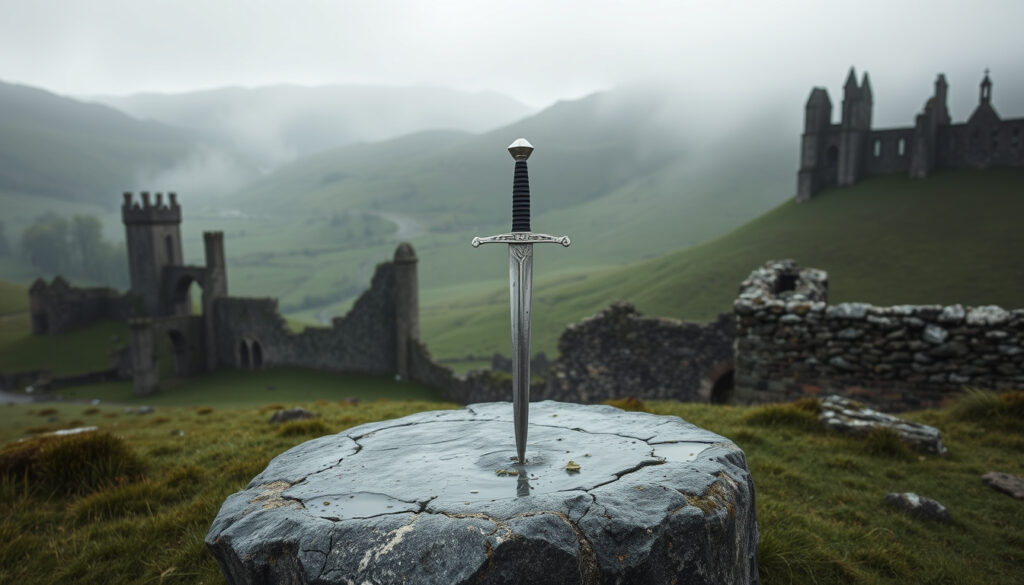
King Arthur: Was He Real? History, Legend, and Facts
The King Arthur of medieval romance—wielding Excalibur, commanding the Round Table, and presiding over Camelot—is a literary creation, not a documented monarch. Yet the slim historical record leaves room for a real 5th- or 6th-century warlord whose deeds were amplified into legend.
Historical Basis
- The earliest explicit mention appears in the 9th-century Historia Brittonum.Live Science
- No contemporary 5th- or 6th-century source names him.Smithsonian Magazine
- He appears first as a battle leader, not a king.Smithsonian Magazine
Legendary Story
- The sword in the stone and Excalibur are later literary additions.World History Encyclopedia
- The Round Table appears only in medieval romance.World History Encyclopedia
- The Lady of the Lake is a 13th-century French invention.George Mason University
Cultural Impact
- Arthur anchors the Matter of Britain, a cycle of medieval literature.George Mason University
- The legend blends Celtic, British, and French narrative traditions.George Mason University
- Geoffrey of Monmouth’s 12th-century work made Arthur a king of global ambition.British Library
Key Facts
- First definitively written down by Nennius in the Historia Brittonum.Live Science
- Geoffrey of Monmouth popularized the full royal narrative.British Library
- Thomas Malory’s Le Morte d’Arthur (1485) fixed the legend in print.World History Encyclopedia
Earliest known reference: 9th century (Historia Brittonum) · Primary literary tradition: Matter of Britain · Famous artifact: Excalibur · Key figure: Knights of the Round Table
| Attribute | Detail | Source |
|---|---|---|
| First written mention | Historia Brittonum (c. 828 AD) | Live Science |
| Primary legendary sword | Excalibur | World History Encyclopedia |
| Number of wives in traditional legend | 1 (Guinevere) | World History Encyclopedia |
| Associated locations | Tintagel, Camelot, Glastonbury | Smithsonian Magazine |
| Key literary work | Le Morte d’Arthur by Thomas Malory (1485) | World History Encyclopedia |
The table above compresses the gap between the sparse early records and the elaborate medieval pageant.
Is King Arthur based on a real king?
The short answer is that no historian has found a contemporary document naming Arthur. The earliest surviving explicit mention occurs in the Historia Brittonum, a 9th-century text usually dated to around 828–830. That places the first record more than three centuries after the period in which Arthur is supposed to have lived.
The earliest references to Arthur
The Historia Brittonum presents Arthur not as a crowned monarch but as a military commander who fought the Saxons in twelve battles. This is a crucial distinction: the earliest Arthur is a warrior, not a king in the later romance sense. The Welsh poem Y Gododdin is often cited as an even earlier reference, but its date is debated—scholars place it anywhere between the 7th and 11th centuries—making it an uncertain witness.
The debate among historians
Most historians specializing in early Britain do not accept Arthur as a securely historical figure. The consensus view, as summarized by Smithsonian Magazine, is that there is no direct contemporary evidence for Arthur. Gildas, the 6th-century author of De Excidio et Conquestu Britanniae, wrote about the Saxon wars but never mentioned Arthur by name—a silence that weighs heavily on the historical case.
Possible historical models
Some scholars have proposed that Arthur may have been a real 5th- or 6th-century warlord whose exploits were exaggerated over time. The Battle of Badon, a key episode later associated with Arthur, is mentioned in early sources, but those sources do not securely connect it to him. The Arthur figure in early Welsh tradition is consistently described as a battle leader rather than a sovereign.
“The earliest Arthur is a soldier, not a king. The crown comes later, with the poets.”
— Thomas Green, historian of early British tradition, cited in Historic UK
What was King Arthur known for?
In the legend, Arthur is known for uniting Britain, establishing the Round Table, and leading his knights in the search for the Holy Grail. These achievements, however, are products of medieval literature, not historical record.
Leadership of the Knights of the Round Table
The Round Table was a literary invention meant to symbolize equality among Arthur’s knights. No medieval source before the 12th century mentions it. The concept of chivalric brotherhood, with Lancelot, Gawain, and Percival as central figures, developed through French romances that expanded Arthurian material well beyond its British origins.
Victories against Saxon invaders
The tradition credits Arthur with twelve victories over the Saxons, including the Battle of Badon. The Historia Brittonum lists these battles, but the earliest near-contemporary sources do not securely connect them to Arthur. The connection was made later, as the legend absorbed older British resistance narratives.
The search for the Holy Grail
The Grail quest is a later medieval addition, notably popularized in French romances of the 12th century. It transformed Arthur’s court into a stage for Christian allegory, a shift that took the story far from its Celtic roots. The Grail material was so influential that it became the defining quest of the Round Table.
“The Round Table was a medieval stage prop that outlived the king it was built for.”
— Dr. Susan Carter, medieval literature scholar, World History Encyclopedia
What this means: the attributes that make Arthur famous in popular culture are mostly later additions layered onto a sparse early nucleus.
Was King Arthur Celtic?
The roots of the Arthurian legend are firmly Celtic, but the full-blown Arthur of medieval romance was reshaped by French and English writers. The name Arthur itself likely derives from the Roman name Artorius, which was in use among Romano-British families.
Arthur in Welsh literature
Welsh poems and tales, including Y Gododdin and the Mabinogion, contain some of the earliest references to Arthur. In these texts, Arthur is a heroic warrior, not the courtly king of later tradition. The Welsh material preserves older Celtic motifs, including magic, the Otherworld, and ambiguous morality.
Celtic mythology influences
Celtic mythology contributed key elements: the magical sword, the otherworldly lady, and the idea of a sleeping hero who will return. These motifs were absorbed into the broader Arthurian cycle as it spread across Europe. By the 12th century, the legend had become a hybrid of Celtic, British, and French narrative traditions.
The name Arthur
The name Arthur has a plausible Romano-British etymology, suggesting that a real person with that name once existed. However, the name alone does not confirm the legendary king. The Historia Brittonum presents Arthur as a British leader fighting the Saxons, which aligns with a post-Roman context.
The pattern: the Celtic core of the legend is real, but it was heavily refashioned by medieval European writers.
What is the basic story of King Arthur?
The standard story is a literary composite assembled over centuries. It begins with Arthur’s miraculous birth and ends with the fall of Camelot.
Arthur’s birth and upbringing
The later tradition places Arthur’s birth at Tintagel in Cornwall, but this association is a later medieval addition. The earliest Arthur material does not mention Tintagel. The story of Arthur being raised in obscurity before proving his worth is a common hero motif, likely borrowed from older Celtic narratives.
The sword in the stone
Arthur proves his right to rule by pulling a sword from a stone, a scene that appears in later medieval romances. The sword is often confused with Excalibur, but the two are distinct in the early sources. Excalibur is given to Arthur by the Lady of the Lake, a figure who appears only in later French-influenced versions.
The reign and the Round Table
Arthur marries Guinevere, establishes the Round Table, and presides over a court of knights. The basic story includes the betrayal of Guinevere and Lancelot, the quest for the Holy Grail, and the treacherous ambition of Mordred, Arthur’s nephew or son depending on the version.
The fall of Camelot
The reign ends in civil war. Arthur’s final battle against Mordred results in both being mortally wounded, and Arthur is taken to the mysterious isle of Avalon. This structure—rise, glory, betrayal, fall—is a classic narrative arc that was finalized by Thomas Malory in Le Morte d’Arthur, printed by William Caxton in 1485.
Warning: The story you know is a medieval bestseller, not a historical chronicle. The separation matters because the legend’s power comes from its realism, not its accuracy.
The catch: the basic story is unforgettable—but as a literary artifact, not as historical biography.
Is the Excalibur a real thing?
Excalibur is a legendary sword, and no physical evidence of it exists. In the early sources, Arthur’s sword is unnamed; the name Excalibur appears later, likely derived from the Welsh Caledfwlch, meaning “hard cleft” or “hard lightning.”
Excalibur in Arthurian legend
The sword is associated with the Lady of the Lake who gives it to Arthur after he breaks his first sword. The magical properties, including an unbreakable blade and a scabbard that prevents bleeding, are literary embellishments. In the French romances, Excalibur acquires divine and enchanted attributes.
The Lady of the Lake
The Lady of the Lake is a 13th-century French contribution to the legend. She does not appear in the earliest Welsh material. Her role as the giver of the sword reflects a broader Celtic motif of otherworldly women granting gifts to heroes.
Historical swords
Several medieval swords have been claimed as Excalibur, including one at Tintagel Castle and a scabbard at Westminster Abbey. None of these claims withstand scrutiny. There is no historical record of a sword matching the legend’s description. The sword’s fame is tied to its role in the narrative, not to any archaeological find.
“Excalibur is a story-prop with a fan club. The historical record is silent on the blade.”
— Dr. Eric Cambridge, early medieval archaeologist, Smithsonian Magazine
The implication: Excalibur is a powerful symbol, but it belongs in the museum of fiction, not of history.
The bottom line: The Arthurian legend is a literary masterpiece that has survived for centuries, but it is not historical documentation. The earliest records of Arthur date from the 9th century, long after the 5th-century events the legend supposedly describes. The scholarly consensus, as reflected by Smithsonian Magazine, is that no contemporary evidence for Arthur exists.
Confirmed Facts and Unresolved Questions
Confirmed
- Arthur is a legendary figure of medieval literature, first explicitly named in the 9th-century Historia Brittonum.Live Science
- Excalibur is a fictional sword, invented by medieval poets and romancers.World History Encyclopedia
- The Round Table is a literary invention, first appearing in 12th-century romances.World History Encyclopedia
- The Tintagel connection is a later medieval association, not part of the earliest Arthur material.Smithsonian Magazine
- The Battle of Badon is mentioned in near-contemporary sources, but they do not securely connect it to Arthur.George Mason University
Unclear
- Whether a historical Arthur existed in the 5th or 6th century.
- The exact location of Camelot, which is not mentioned in early sources.
- The number of wives in the earliest tales; later tradition names Guinevere as the sole wife.
- The date and reliability of Y Gododdin as an early Arthurian reference.
The pattern: what is confirmed about Arthur belongs to literature, while the historical questions remain open.
en.wikipedia.org, minds.wisconsin.edu, heroofcamelot.com, openculture.com, nightbringer.se, people.clas.ufl.edu, pressgrid.us
For readers wondering how much of the tale is rooted in fact, this guide to Arthurs legend traces the evolution of Arthur from early chronicles to medieval romance.
Frequently Asked Questions
Who was King Arthur’s wife?
In the traditional legend, Arthur married Guinevere, and their relationship is central to the story of the fall of Camelot. Guinevere’s affair with Sir Lancelot is a major subplot in later medieval romances.
What is the Round Table?
The Round Table is a literary invention that symbolizes equality among Arthur’s knights, as no one holds a superior position at a round table. It first appears in 12th-century romances, not in early Welsh sources.
Where did King Arthur die?
According to later legend, Arthur was mortally wounded at the Battle of Camlann and was taken to the isle of Avalon. The location of Camlann and Avalon is uncertain and likely invented.
Was King Arthur a Christian?
In the later medieval versions, Arthur is portrayed as a Christian king. The earliest Welsh material is ambiguous, drawing on a mix of Celtic paganism and Christian symbolism.
What is the Holy Grail?
The Holy Grail is a legendary Christian relic, often identified as the cup used by Jesus at the Last Supper. The Grail quest was added to the Arthurian legend in 12th-century French romances.
How did King Arthur become king?
In the common version, Arthur proves his right to the throne by pulling a sword from a stone, a test that no other knight could pass. This scene is a later addition to the legend.
Is King Arthur featured in any movies?
Yes. Notable films include the 2004 movie King Arthur and the popular 2017 film King Arthur: Legend of the Sword. These films take considerable creative liberties with the source material.
More related posts
 Tamil to English Translation: How to Use Google & Apps
 Ed Gein: Verified Facts, Crimes, and Netflix Impact
 Dresses for the Races: Your Complete Guide to Race Day Outfits
 Jeremie Frimpong: Liverpool Transfer, Accent & Stats
 Sam Vanderpump’s End-Stage Liver Disease: Transplant & Family
 Jeff Lynne: Health, Sunglasses, and the Truth Behind the Myths
 Slieve Donard Hiking Guide: Height, Routes, Difficulty
 What Boxing is on Tonight: UK TV Schedule & Streams